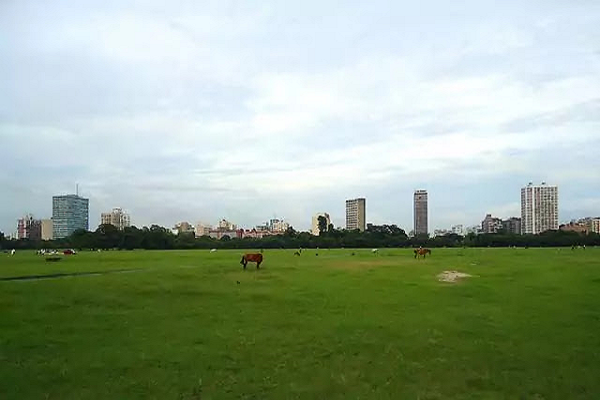
Quick answer: The Maidan is the huge open green space in the centre of Kolkata. It runs from Lok Bhavan (formerly Raj Bhavan) at Esplanade in the north to the National Library at Alipore in the south, and from the Hooghly River in the west to the Victoria Memorial in the east. The Brigade Parade Ground is the part of the Maidan best known for military parades and the city’s biggest political rallies. The land is owned by the Ministry of Defence. As of October 2026 there is no ticket or official opening time for the open grounds, but the stadiums, clubs and monuments in and around the Maidan have their own rules.
What is the Maidan?
“Maidan” means “open field”. In Bengali the area is also called Garh-er Maath, roughly “the field of the fort”, because it grew up around Fort William. It is often described as the “lungs of Kolkata”, because it is the largest green space in a crowded city.
The figures for its size vary. Wikipedia gives a total of about 519 hectares (1,280 acres), of which about 160 hectares (400 acres) is open public green space. An earlier version of this article said the Maidan covered 988 acres. That is the same as 400 hectares, so it was probably a mix-up between acres and hectares. Either way, the Maidan is Kolkata’s largest urban park.
The Maidan is not one single park. It is a patchwork of open grass, sports grounds, club tents, wide roads and monuments, including:
- Eden Gardens, the cricket stadium;
- football grounds used by the city’s historic clubs, including the Mohun Bagan Ground;
- the Kolkata Race Course;
- Fort William, headquarters of the Indian Army’s Eastern Command;
- statues and memorials, such as the Shaheed Minar at Esplanade.
Brigade Parade Ground
The Brigade Parade Ground is the wide open stretch of the Maidan near Fort William. It was first used as a parade ground for the troops stationed at the fort. Today it is Kolkata’s main venue for mass political meetings, and parties of every colour have held rallies there.
The best-remembered event came on 6 February 1972. Sheikh Mujibur Rahman, Prime Minister of newly independent Bangladesh, and Indian Prime Minister Indira Gandhi addressed a joint rally on the ground. Press reports put the crowd at around a million people. Bangladesh still marks the anniversary of that speech.
Because rallies and events can draw very large crowds, roads around the Maidan are sometimes closed or diverted on those days. Check local news and Kolkata Traffic Police advisories if you are travelling through the area during a big event.
History of the Maidan
The Maidan’s story starts with the Battle of Plassey in 1757. After the East India Company defeated Siraj-ud-Daulah, Nawab of Bengal, it decided to build a much stronger new Fort William. Work began in 1758 on the site of the village of Gobindapur. The villagers were moved and given land elsewhere in the city, including at Taltala, Kumartuli and Shovabazar.
The forest and scrub around the new fort were cleared, leaving a large open area around it. This open ground, first developed as a parade ground for the troops, became the Maidan. The army has owned the land ever since. That is one reason why so little of it has been built over, even as the city grew around it.
Over the next two centuries, landmarks rose along its edges:
- Government House, now Lok Bhavan, completed in 1803;
- the Ochterlony Monument, now the Shaheed Minar, completed in 1828;
- St Paul’s Cathedral, built between 1839 and 1847;
- the Victoria Memorial, opened in 1921.
The Maidan also hosted the Calcutta International Exhibition of 1883 to 1884.
The Maidan and sport
The Maidan has been central to sport in Kolkata for more than two centuries:
- Cricket: the Calcutta Cricket Club was founded on the Maidan in 1792; today it is the Calcutta Cricket and Football Club.
- Football: the Indian Football Association has long been based here. The city’s big football clubs keep grounds and club tents on the Maidan.
- Hockey: the Beighton Cup, described as the world’s oldest hockey tournament, was started in 1895 and is usually played at the Mohun Bagan Ground.
An earlier version of this article said cricket was introduced to India through a two-day match on the Maidan in 1804. That is not correct. The Board of Control for Cricket in India (BCCI) dates the earliest known reference to cricket in India to 1721, when British sailors played on the coast of Kutch. The 1804 game is real, though. An account of a cricket match in Calcutta between Etonian and non-Etonian servants of the East India Company, dated 26 January 1804, is held in the Eton College archives. The BCCI notes Robert Vansittart’s hundred in the Calcutta Cricket Club’s match against the Old Etonians as the first recorded century on Indian soil.
Things to see in and around the Maidan
- Eden Gardens: the historic cricket ground at the northern end of the Maidan. See our Eden Gardens Kolkata guide.
- Victoria Memorial: the white marble memorial and museum on the eastern edge of the Maidan.
- St Paul’s Cathedral: the Gothic Revival cathedral near the Victoria Memorial.
- Birla Planetarium: next to St Paul’s Cathedral, at the south-eastern corner.
- Rabindra Sadan, Nandan and the Academy of Fine Arts: Kolkata’s cultural hub, on the south-eastern side. See our Rabindra Sadan Kolkata guide.
- Shaheed Minar: the 48-metre column at Esplanade.
- Lok Bhavan (Raj Bhavan): the Governor’s residence, at the northern edge. Read our Raj Bhavan Kolkata guide.
- Kolkata Race Course: on the southern side of the Maidan.
- Prinsep Ghat and the riverfront: on the Hooghly, on the western side. Millennium Park is further north along the river.
- Park Street: the restaurant and heritage street just east of the Maidan, with the old South Park Street Cemetery further along.
- Fort William: an active army headquarters, so public entry is restricted.
Tips before you go
- Timing: early mornings are the best time. The air is cooler, and you will see joggers, cricket games in progress and everyday life. Late evenings bring families out for walks. Avoid the large, unlit stretches late at night, as you would in any big city park.
- Weather: during the monsoon, roughly June to September, the grounds can become waterlogged and muddy. The winter months are the most comfortable for a long walk.
- Mosquitoes and sun: carry insect repellent, especially around dusk, and sun protection during the day. There is little shade on the open grounds.
- Families: there is plenty of open space for children to run around, but busy roads cross the Maidan, so keep an eye on young children.
- Stadiums and clubs: Eden Gardens, club grounds and the race course have their own access rules and event tickets. Being on the Maidan does not mean you can walk into them.
How to reach the Maidan
- Metro: on the Blue Line, Esplanade, Maidan, Park Street and Rabindra Sadan stations all border the Maidan. Esplanade is also on the Green Line, which links it with Howrah station and Sealdah station.
- Circular Railway: Eden Gardens and Prinsep Ghat stations on Kolkata’s Circular Railway are on the western side. An earlier version of this article listed Prinsep Ghat as a metro station; it is on the Circular Railway, not the metro.
- Bus: many city buses pass along the roads around the Maidan, including Jawaharlal Nehru Road, Red Road and Kidderpore Road, with stops near Esplanade, Park Street and Rabindra Sadan.
- Ferry: ferries from Howrah call at Babughat, on the north-western side of the Maidan.
- Tram: Kolkata’s tram network has been sharply cut back since 2024. The state government announced in September 2024 that only a short Maidan to Esplanade heritage stretch would be kept, but it is not clear whether trams run on the Maidan when you visit. Check with the West Bengal Transport Corporation before planning a tram ride.
- From the airport and main stations: from Netaji Subhas Chandra Bose International Airport, Howrah or Sealdah, take a prepaid taxi, an app cab or the metro to Esplanade.
Frequently asked questions
Is the Maidan the same as the Brigade Parade Ground?
Not exactly. The Maidan is the whole green belt in central Kolkata. The Brigade Parade Ground is the open stretch within it, near Fort William, that is used for parades and mass rallies. People often use the two names loosely for the same area.
Who owns the Maidan in Kolkata?
The Maidan belongs to the Ministry of Defence, and the army has controlled it since the land was cleared around Fort William in the 18th century.
Is there an entry fee for the Maidan?
There is no ticket for the open grounds. Eden Gardens, the Victoria Memorial, the race course and the sports clubs have their own access rules, events and fees.
Which metro station is nearest to the Brigade Parade Ground?
Maidan and Esplanade stations on the Blue Line are among the closest. Park Street and Rabindra Sadan also border the Maidan.
Why is the Maidan called the lungs of Kolkata?
The Maidan is the city’s largest open green space. In a dense city, its trees and grass give a rare stretch of fresh air and open sky.
Details checked in October 2026 against records of the Maidan and Fort William, the BCCI’s history of Indian cricket, the Eton College archives catalogue, Kolkata Metro records and news reports on the 1972 Brigade rally and Kolkata’s tram services. Transport services and event rules change, so check before you go.