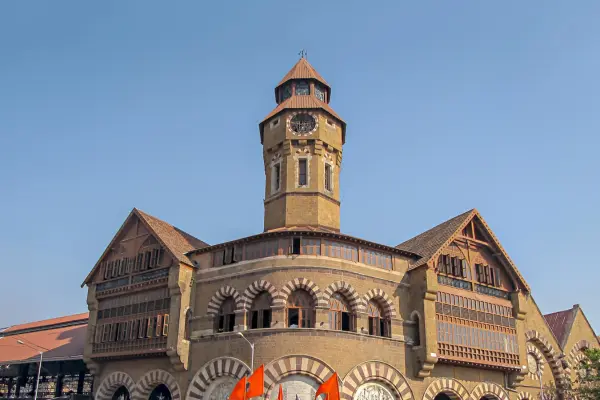
Quick answer: Crawford Market, officially Mahatma Jyotiba Phule Mandai, is a historic covered market in south Mumbai, just north of Chhatrapati Shivaji Maharaj Terminus (CSMT). Completed in 1869 to a design by William Emerson, with carved panels by John Lockwood Kipling, it sells fruit, vegetables, dry fruits, household goods, toys and imported foods, and in 1882 it became the first building in India lit by electricity. Shops set their own hours and many close on Sundays; there is no entry fee.
Crawford Market at a glance
| Detail | What to know |
|---|---|
| Official name | Mahatma Jyotiba Phule Mandai |
| Location | Opposite the Mumbai Police headquarters, north of CSMT, south Mumbai |
| Completed | 1869 |
| Architect | William Emerson |
| Heritage status | Main building is a Grade I heritage structure |
| Entry fee | None |
| Best time to visit | Weekday mornings for fresh produce; November to February for cooler weather |
| Time needed | One to two hours to browse; longer for serious shopping |
| Nearest stations | CSMT and Masjid (Central line) |
History of Crawford Market
The market was named after Arthur Crawford, the first Municipal Commissioner of Bombay and an energetic planner of the growing city. It was completed in 1869, and the philanthropist Cowasji Jehangir donated the building to the city. In 1882 Crawford Market became the first building in India to be lit by electricity.
For more than a century it was the city’s main wholesale fruit market. That changed in March 1996, when the wholesale fruit traders moved to Navi Mumbai. The market was later renamed Mahatma Jyotiba Phule Mandai, after Jotirao (Jyotiba) Phule, the 19th-century social reformer from Maharashtra, though most people and taxi drivers still call it Crawford Market. An earlier version of this article said the renaming happened soon after Independence; we could not confirm the year, so that detail has been removed.
Architecture
Crawford Market was designed by the British architect William Emerson, who had trained under William Burges. The design is often compared to English country market halls, with a clock tower, gabled fronts and wide wooden galleries suited to Bombay’s climate. Inside is a central hall with two wings, tiers of wooden stalls and, in the original design, flagstone floors and iron lamp brackets shaped like winged dragons. A tall skylight lets daylight into the main hall.
The building is made of coarse buff Kurla stone with red stone from Bassein (Vasai). Above the entrance arches are bas-relief panels designed by John Lockwood Kipling, father of the writer Rudyard Kipling and then head of the Sir J.J. School of Art, showing Indian farmers and workers. Kipling and his students also decorated the central fountain, which Emerson designed.
An earlier version of this article described the style as “Norman and Flemish”. Published architectural histories describe the market as Victorian Gothic in spirit with Indian elements, so we have changed that description.
Restoration and redevelopment
The Brihanmumbai Municipal Corporation (BMC) has been redeveloping the market in phases. Restoration of the main heritage building was reported to be completed in 2018, and new blocks around it have since been under construction. Parts of the market may be affected by ongoing work, so expect some stalls to have moved.
What is Crawford Market known for?
The market and the busy streets around it work like an open-air bazaar. You can find:
- Fresh fruit and vegetables, including seasonal and imported fruit. Trade starts early in the morning.
- Dry fruits, spices, chocolates and bakery goods, often sold in bulk.
- Imported foods and household goods, from cosmetics to kitchenware.
- Toys, gifts, travel accessories and costume jewellery.
- Clothes and dress materials, including wholesale shops for women’s and children’s wear in the surrounding lanes.
- Meat and poultry, in a separate section that is busiest in the early hours.
A note on the pet market
Crawford Market has long had a pet section selling dogs, cats and birds. There have been repeated reports of illegal sales of protected and endangered species here. Buying wild-caught birds or animals of protected species is an offence under India’s Wildlife (Protection) Act, so do not buy any wild animal, and report suspected wildlife trade to the authorities.
Timings
Crawford Market has no single official opening time; each shop sets its own hours. In general, wholesale produce trade begins early in the morning, most retail shops open from late morning into the evening, and many shops close on Sundays. An earlier version of this article gave specific hours and said some shops close on Tuesdays; we could not confirm those, so check with the shops you plan to visit.
Shopping tips
- Go in the morning for the freshest produce and smaller crowds. The market gets more crowded as the day goes on.
- Bargaining is common at many stalls, but not all. Ask politely and compare prices before you buy.
- Browse first. Part of the fun is wandering the lanes and seeing what turns up.
- Keep your phone and wallet secure in the crowds.
- Carry some cash; not every small stall takes cards.
How to reach Crawford Market
- By suburban rail: CSMT, on the Central and Harbour lines, is a short walk south of the market. Masjid station on the Central line is also close.
- By metro: Metro Line 3 (the Aqua Line) has stations at CSMT and Kalbadevi.
- By road: taxis and BEST buses reach the market from across the city. Traffic around the market is heavy for much of the day.
- From outside Mumbai: long-distance trains arrive at CSMT, a few minutes’ walk away, and Mumbai Central.
Places to visit near Crawford Market
- Chhatrapati Shivaji Maharaj Terminus, the UNESCO-listed railway station just to the south.
- Chor Bazaar, Mumbai’s famous antiques and second-hand market, a short ride north.
- Flora Fountain and the Fort area to the south-west.
- The Byculla Zoo (Veermata Jijabai Bhosale Udyan) and the Dr Bhau Daji Lad Museum, further north.
Frequently asked questions
What is the new name of Crawford Market?
Its official name is Mahatma Jyotiba Phule Mandai, after the social reformer Jotirao Phule. Most people still call it Crawford Market.
Is Crawford Market open on Sunday?
Many shops close on Sundays, so a weekday is a better choice. Shop hours vary.
Who designed Crawford Market?
The British architect William Emerson designed it, and John Lockwood Kipling designed its carved entrance panels and helped decorate the fountain.
Which station is nearest to Crawford Market?
CSMT is a short walk away, and Masjid station on the Central line is also close.
Why is Crawford Market famous?
For its 1869 heritage building, its fruit, dry fruit and imported goods, and its history as the first building in India to be lit by electricity, in 1882.
History and details were checked in October 2026 against published histories of Crawford Market and its architecture, and reports on its redevelopment. Shop hours vary, so check before a special trip.