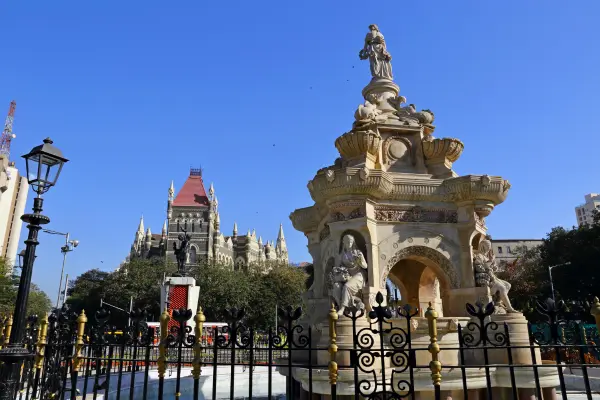
Quick answer: Flora Fountain is an ornate 1864 fountain at Hutatma Chowk, in Mumbai’s Fort business district, topped by a statue of Flora, the Roman goddess of flowers and spring. It was designed by Richard Norman Shaw, carved by James Forsythe in imported Portland stone, and restored by the Brihanmumbai Municipal Corporation (BMC) between 2017 and 2019. It stands in an open public square, so there is no ticket and you can see it at any time.
Flora Fountain at a glance
| Detail | What to know |
|---|---|
| Location | Hutatma Chowk, at the southern end of Dadabhai Naoroji Road, Fort, Mumbai |
| Built | 1864 |
| Designed and carved by | Richard Norman Shaw (design); James Forsythe (sculptor) |
| Heritage status | Grade I heritage structure |
| Timings | Open public square; viewable at any time |
| Entry fee | None |
| Best time to visit | November to February; early morning for photographs, evening for the lit-up fountain |
| Time needed | 15 to 30 minutes; longer if you walk the Fort heritage area |
History of Flora Fountain
Built where Church Gate once stood
Until 1860, the old town of Bombay was enclosed by the walls of the Fort, which had several gates. When the walls were pulled down to let the city expand, the fountain was placed where one of those gates, Church Gate, had stood. (The modern Churchgate station area takes its name from the same gate.)
The fountain was built in 1864 by the Agri-Horticultural Society of Western India. It cost Rs 47,000, about £9,000 at the time, of which Rs 20,000 was donated by Cursetjee Fardoonjee Parekh. It was planned in honour of the Governor of Bombay, Sir Bartle Frere, but before it was unveiled it was named instead after the goddess Flora. According to published histories, it was first intended for Victoria Gardens, today’s Jijamata Udyan in Byculla, before being installed at its present site.
An earlier version of this article said the fountain was unveiled to visitors in 1869. We could not confirm that date, so we now give only the 1864 construction date found in published records.
Hutatma Chowk: Martyrs’ Square
In the 1950s, the square around the fountain was the scene of police firing on protesters of the Samyukta Maharashtra movement, which campaigned for a separate Marathi-speaking state with Bombay as its capital. More than a hundred people were killed. Maharashtra was formed on 1 May 1960, and the square was renamed Hutatma Chowk (Martyrs’ Square) in their memory. A memorial with a flame now stands beside the fountain. Published sources differ slightly on the number of people killed and on the exact year of renaming, so we have not given precise figures.
Architecture and design
Flora Fountain was designed by the architect Richard Norman Shaw and carved by the sculptor James Forsythe in Portland stone imported from England. The original article described its style as a blend of Neo-Gothic and Indo-Saracenic; we could not confirm that label from a reliable source, so we have not repeated it.
- The statue of Flora: about 7 feet tall, standing at the top of the fountain, which is about 32 feet tall overall.
- Corner figures: four female figures at the corners of the base. Restorers found details such as one figure with braided hair, one with a smile, and others with disc earrings, a necklace or anklets.
- The basin: four fish at Flora’s feet and twenty lion heads around the fountain.
The 2017 to 2019 restoration
Over the decades the fountain had been coated in white oil paint, cement and enamel, and many people assumed it was white. The BMC began a two-phase restoration in 2017 with conservation architect Vikas Dilawari, the BMC’s heritage cell and the Indian National Trust for Art and Cultural Heritage (INTACH). The team carefully removed the layers of paint and grime, revealing the beige Portland stone beneath; repaired missing arms, legs and noses on the figures; uncovered a sealed underground water chamber; and restored the fountain’s hydraulic system. The restored fountain was unveiled in January 2019.
Keeping the fountain running has proved harder. In March 2026 news reports said the water had been switched off after algae filled the lower basins, pending cleaning by the BMC. Whether the water is flowing on the day you visit may vary.
What to do at Flora Fountain
- Look at the details. Walk around the fountain to see the corner figures, the fish and the lion heads, and the statue of Flora at the top.
- See it in the evening. The fountain is lit up after dark, which makes a good photograph against the surrounding heritage buildings.
- Walk the Fort heritage district. Flora Fountain is a natural starting point for exploring South Mumbai’s Victorian and Art Deco buildings on foot.
How to reach Flora Fountain
- Metro: Hutatma Chowk station on Mumbai Metro Line 3 (the Aqua Line), which has run its full length to Cuffe Parade since October 2025, is the closest.
- Suburban rail: Churchgate (Western line) and Chhatrapati Shivaji Maharaj Terminus (Central and Harbour lines) are both within walking distance.
- Bus and taxi: Many BEST bus routes pass through Hutatma Chowk, and taxis are easy to find in the Fort area.
- By air: Chhatrapati Shivaji Maharaj International Airport is in the suburbs; allow at least an hour by road in traffic.
Places to visit near Flora Fountain
- Chhatrapati Shivaji Maharaj Terminus: The UNESCO-listed Victorian Gothic railway station is a short walk north-east.
- Asiatic Society and Town Hall: The neoclassical Asiatic Society of Mumbai faces Horniman Circle nearby.
- Kala Ghoda: The Jehangir Art Gallery and the Chhatrapati Shivaji Maharaj Vastu Sangrahalaya museum are a short walk south.
- Gateway of India: Further south at Apollo Bunder; see our Gateway of India guide.
Frequently asked questions
Who built Flora Fountain?
The Agri-Horticultural Society of Western India built it in 1864. Richard Norman Shaw designed it and James Forsythe carved it, with Rs 20,000 of the Rs 47,000 cost donated by Cursetjee Fardoonjee Parekh.
Why is the area called Hutatma Chowk?
Hutatma Chowk means Martyrs’ Square. It honours the people killed in police firing during the Samyukta Maharashtra movement of the 1950s, which led to the creation of Maharashtra in 1960.
Is there an entry fee for Flora Fountain?
No. The fountain stands in an open public square and can be seen at any time.
Why does Flora Fountain look beige now instead of white?
It was carved from beige Portland stone but had been painted white over the years. The 2017 to 2019 restoration removed the paint and grime, revealing the original stone.
Which is the nearest metro station to Flora Fountain?
Hutatma Chowk station on Metro Line 3 (Aqua Line).
Details checked in October 2026 against published histories of Flora Fountain and Hutatma Chowk, reporting on the BMC and INTACH restoration, and Mumbai Metro Line 3 records. The fountain’s water supply depends on BMC maintenance, so it may not always be running.