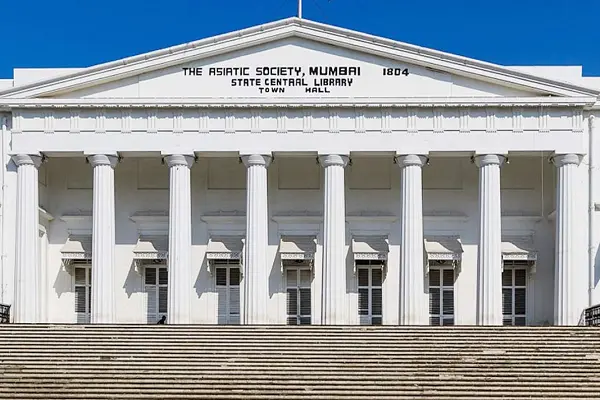
Quick answer: The Town Hall at Horniman Circle in Fort, South Mumbai, is a neoclassical building completed in 1833 that houses the Asiatic Society of Mumbai, one of India’s oldest learned societies, along with the State Central Library and a small museum. Its grand staircase and Doric portico are a Mumbai landmark. The library is run for members, and there is no general tourist ticket; opening hours and membership fees are set by the Society, so check with it before visiting.
Asiatic Society Town Hall at a glance
| Detail | What to know |
|---|---|
| Location | Town Hall, Shahid Bhagat Singh Road, facing Horniman Circle, Fort, Mumbai |
| Built | Completed 1833 |
| Architect | Colonel Thomas Cowper, Bombay Engineers |
| Style | Neoclassical, with a Grecian portico of eight Doric columns |
| Inside | Asiatic Society of Mumbai, State Central Library, museum and government offices |
| Entry | Library access through membership; check visiting arrangements with the Society |
| Time needed | 30 minutes for the exterior; longer for the library or museum |
The Asiatic Society of Mumbai
The Asiatic Society of Mumbai began as the Literary Society of Bombay, which held its first meeting on 26 November 1804. It was founded by Sir James Mackintosh, a British lawyer and scholar, to promote “useful knowledge” about India. The model was the Asiatic Society in Calcutta, set up by Sir William Jones two decades earlier.
The Society’s name changed with the times:
- 1804: founded as the Literary Society of Bombay.
- Late 1820s: after the Royal Asiatic Society was founded in London in 1823, the Bombay society became affiliated with it and was known as the Bombay Branch of the Royal Asiatic Society (BBRAS).
- 1841: the Bombay Branch began publishing its journal.
- 1873 and 1896: the Bombay Geographical Society and the Anthropological Society of Bombay merged into it.
- 1954: it separated from the Royal Asiatic Society and became the Asiatic Society of Bombay.
- 2002: it was renamed the Asiatic Society of Mumbai, following the renaming of the city.
An earlier version of this article said the Society became the BBRAS in 1826. Sources differ on the exact year of the affiliation, which took place in the late 1820s.
History of the Town Hall
The Literary Society wanted a building that would hold its library and museum and serve as a town hall for Bombay. Planning began around 1811, and the Society raised about ₹10,000 through a lottery, but this was enough only for the library and museum wings. The Government of Bombay covered the shortfall in return for office space, and the full building was completed in 1833. It became the setting for official meetings and public events in British Bombay.
Architecture
The Town Hall was designed by Colonel Thomas Cowper of the Bombay Engineers in the neoclassical style, drawing on Greek and Roman models. Key features:
- A flight of 30 broad steps leading up to a Grecian portico with eight Doric columns.
- A frontage spanning about 61 metres (200 feet), with the building rising about 30 metres (98 feet).
- Stone shipped from England, with wooden floors, spiral staircases and terraces with wrought-iron railings inside.
- The Durbar Hall and corridors lined with marble statues of 19th-century patrons and public figures.
The Indian national flag is hoisted on the building on 15 August and 26 January. The wide steps are among the most photographed spots in Fort and have appeared in many films.
The library and its treasures
The Asiatic Society’s library holds over 1 lakh (100,000) books, including about 15,000 rare volumes, and more than 3,000 manuscripts in Sanskrit, Prakrit, Persian, Urdu and other languages. An earlier version of this article said the library had 8 lakh books; that figure was not supported and has been corrected.
Highlights of the collections include:
- A manuscript of Dante’s Divine Comedy, donated by Mountstuart Elphinstone, one of the library’s best-known treasures.
- A coin collection of nearly 12,000 coins, including a gold coin of the Gupta emperor Kumaragupta I, a rare gold mohur of the Mughal emperor Akbar, and coins issued by Chhatrapati Shivaji Maharaj.
- About 1,300 maps.
The Society has digitised much of its collection, which is available through its Granth Sanjeevani platform.
Two libraries in one building
The Town Hall houses two separate libraries. The Asiatic Society’s own library is for its members. The State Central Library, run by the Government of Maharashtra’s Directorate of Libraries, is also in the building. Other occupants include the Directorate’s head office, the Maharashtra State Women’s Council, the Additional Controller of Stamps office and a post office.
Visiting the Town Hall
- Viewing the building: You can see the exterior and the famous steps from Horniman Circle at any time.
- Using the library: Library access is through membership. The Society offers different membership categories, and it revises its fees from time to time. An earlier version of this article quoted fees of ₹60 to ₹15,000; these are out of date, so ask the Society for the current rates and rules.
- Opening hours: Library and office hours are set by the Society and the State Central Library. Published guides say the library is closed on Sundays and public holidays; confirm current hours by phone before you go.
How to reach
- Suburban rail: Chhatrapati Shivaji Maharaj Terminus (CSMT) and Churchgate are both within walking distance of Horniman Circle.
- Metro: Mumbai Metro Line 3 (the Aqua Line) has stations at CSMT and Hutatma Chowk nearby.
Nearby places
- St Thomas Cathedral, close to Horniman Circle
- Flora Fountain at Hutatma Chowk
- Chhatrapati Shivaji Maharaj Terminus
- The Chhatrapati Shivaji Maharaj Vastu Sangrahalaya museum
Frequently asked questions
When was the Asiatic Society Town Hall built?
The building was completed in 1833, after the Literary Society of Bombay had started raising funds for it around 1811.
Who designed the Town Hall in Mumbai?
Colonel Thomas Cowper of the Bombay Engineers, in the neoclassical style.
Can tourists visit the Asiatic Society library?
The library is for members. Visitors can view the building from outside; for access to the library or museum, contact the Society in advance.
How many books does the Asiatic Society of Mumbai have?
Over 100,000 books, including about 15,000 rare volumes, and more than 3,000 manuscripts.
What is the Asiatic Society of Mumbai’s oldest name?
It was founded in 1804 as the Literary Society of Bombay.
Details checked in October 2026 against published records of the Asiatic Society of Mumbai and the Town Hall. Membership fees and opening hours are set by the Society and change, so confirm them directly before visiting.