Rajasthan has three national parks, according to the state Forest Department: Ranthambhore (Sawai Madhopur), Keoladeo (Bharatpur) and Mukundra Hills (Kota and Chittorgarh), together 510.31 km². A 2025 report by the Comptroller and Auditor General (CAG), covering the year ended 31 March 2023, also counts three national parks in the state.
Many lists of national parks in Rajasthan say five because they add Sariska and Desert National Park. Both are wildlife sanctuaries in the Forest Department’s records, and the CAG says Sariska “is not notified as National Park”. This guide shows each park’s district, area and notification from the scanned gazettes, explains the sanctuary confusion, and gives the official booking routes and the entry fees in force from 1 April 2026 to 31 March 2028, as we read them on 19 November 2026.
Key takeaways
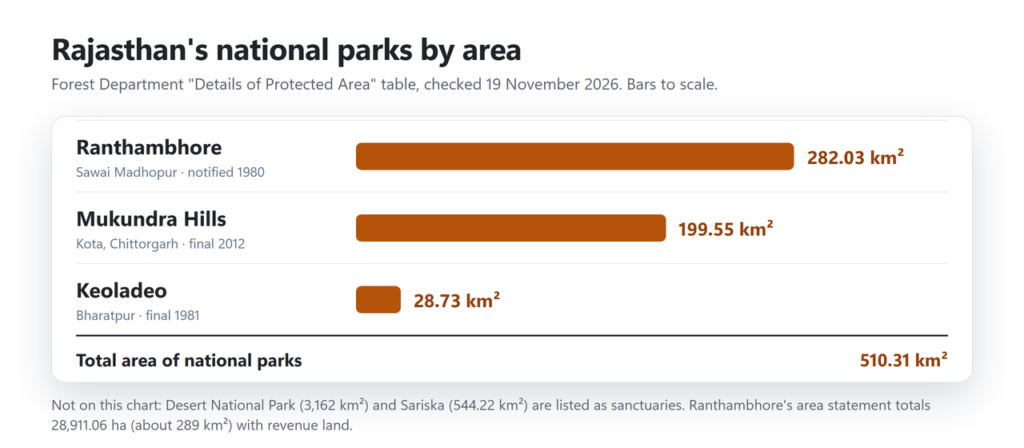
- Three national parks: Ranthambhore (282.03 km²), Mukundra Hills (199.55 km²) and Keoladeo (28.73 km²), per the Forest Department’s protected-area table.
- Sariska is a wildlife sanctuary and tiger reserve. Its national park was proposed but, according to the CAG, never finally notified.
- Desert National Park keeps “National Park” in its name but was declared a sanctuary in 1980. At 3,162 km² it is listed under sanctuaries.
- Keoladeo became one of India’s first two Ramsar sites in 1981 and a UNESCO World Heritage Site in 1985 (per PIB).
- Book Ranthambhore through forestrajasthan.com, and Keoladeo, Sariska and Mukundara through the state’s OBMS portal (obms-tourist.rajasthan.gov.in). Both are linked from the Forest Department’s home page.
- Entry for Indian visitors is ₹215 per person per visit in Ranthambhore’s core and ₹165 in Keoladeo, under the 2026–28 fee order. The order does not cover safari vehicle hire.
List of national parks in Rajasthan
The Forest Department’s “Details of Protected Area” page lists national parks, tiger reserves, sanctuaries and conservation reserves in separate sections. Its national park section has three rows.
| National park | District(s) | Area (department table) | Notification we read | Tiger reserve |
|---|---|---|---|---|
| Ranthambhore | Sawai Madhopur | 282.03 km² | 1 November 1980, under section 35 of the 1972 Act as it then stood | Ranthambhore |
| Mukundra Hills | Kota, Chittorgarh | 199.55 km² | Intention 3 March 2006; final notification 9 January 2012 | Mukundara Hills |
| Keoladeo | Bharatpur | 28.73 km² | Intention 10 March 1981; final notification 26 August 1981 | No |
Three details help when you compare this with other lists:
- Ranthambhore’s area has two official figures. The table says 282.03 km², while the department’s area statement for the park adds up to 28,911.06 hectares (about 289.11 km²), including revenue land and relocated village areas. The CAG’s 2006 report also gives 282 km².
- The park is not the tiger reserve. Ranthambhore Tiger Reserve is far larger (1,530.23 km² on the department’s list, 1,411.29 km² on NTCA’s), and also takes in sanctuaries and other forest.
- Mukundra Hills is not Darrah. The department lists Darrah Sanctuary (227.63 km², Kota and Jhalawar) as a separate protected area, although the park’s boundary description includes the Darrah forest block.
First notice and final notice: what makes a national park
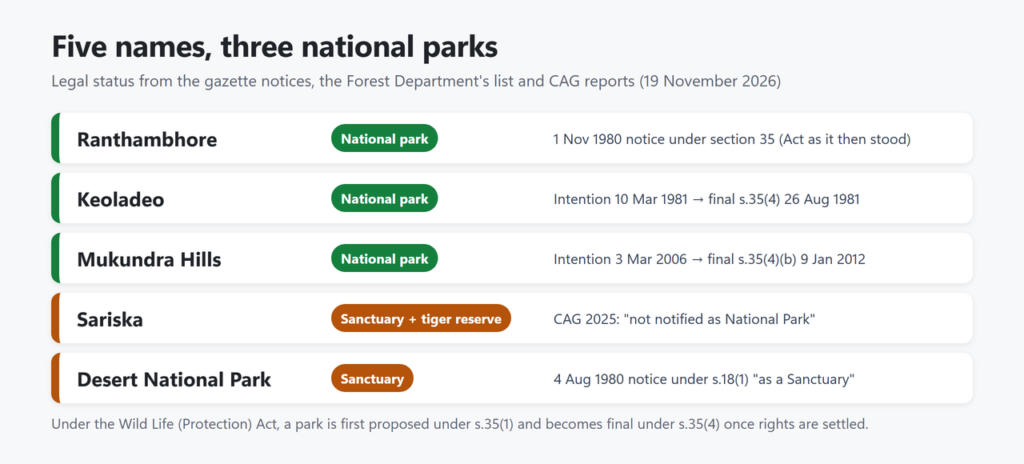
Under the Wild Life (Protection) Act, 1972, a state first announces its intention to create a national park under section 35(1). Only after people’s rights in the area are settled does it issue the final declaration under section 35(4). The gazettes on the Forest Department’s site show both steps for two parks:
- Keoladeo: intention notified on 10 March 1981; the final notice of 26 August 1981 (gazette of 27 August) names it “Keoladeo National Park, Bharatpur” in Hindi. The gazette does not use the word “Ghana”, though the booking portal does.
- Mukundra Hills: intention on 3 March 2006 (published 10 March 2006); rights settled in 2009 (Chittorgarh) and 2011 (Kota); final declaration under section 35(4)(b) on 9 January 2012.
- Ranthambhore: the Hindi notice of 1 November 1980 declares the land a national park “under section 35” without naming a sub-section. The department’s area statement notes it was “Notified under unamended Wildlife (Protection) Act 1972”. We have not read the original 1972 text of section 35, so we do not say whether this notice counts as a final declaration.
Why some lists say five national parks
Sariska is a sanctuary and tiger reserve
The department lists “Sariska Sanctuary” in Alwar at 544.22 km². Sariska was protected as a “Reserved Area” in a 1955 notification, and the Environment Ministry’s 2023 draft eco-sensitive-zone notice dates the sanctuary notification to 5 August 1958. The CAG’s 2006 report described a “proposed National Park (400 sq. km)” inside the tiger reserve; a CAG summary of its 2013 audit says the final notification “has not been issued as of December 2012”, and its 2025 report states that Sariska “is not notified as National Park”. Even the state’s booking portal calls it “Sariska National Park” in its overview, so the label appears on an official site too.
Desert National Park is legally a sanctuary
The 4 August 1980 gazette notice for Jaisalmer and Barmer districts was issued under section 18(1), the sanctuary section, and declares the area “as a Sanctuary”, even though its boundary heading says “Desert National Park”. The department lists it as “Desert National Park Sanctuary” at 3,162 km², its largest sanctuary. The CAG summary of the 2013 audit noted that only 50.76 km² of that area was forest land and that 73 villages lay inside it. We found no national park notification for it on the department’s site.
Other places often mislabelled
Van Vihar in Dholpur and Mount Abu are sanctuaries on the department’s list, and Machiya in Jodhpur is a biological park. (The Van Vihar National Park you may have read about is in Bhopal; see our guide to the national parks in Madhya Pradesh.) Lists that claim 20 national parks are counting sanctuaries and other protected areas.
Tiger reserves in Rajasthan and the parks in them
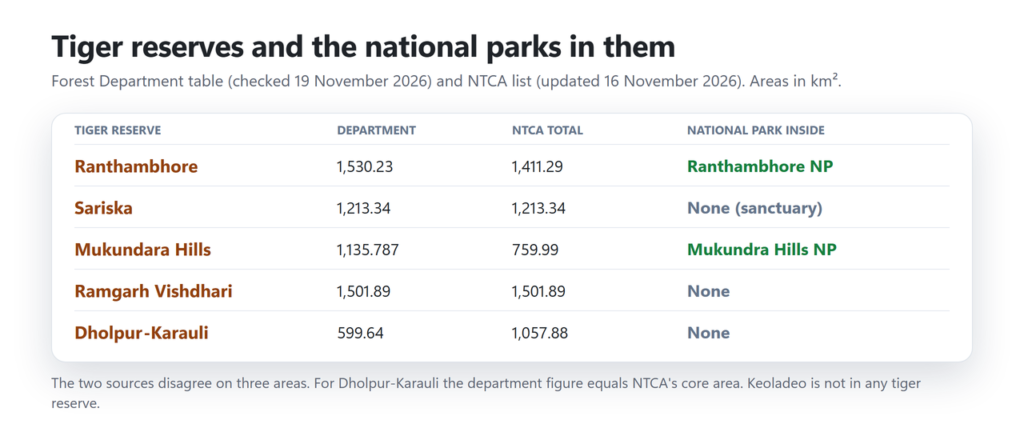
Rajasthan has five tiger reserves. Only two contain a national park.
| Tiger reserve | Districts (department) | Area: department | Area: NTCA total | National park inside |
|---|---|---|---|---|
| Ranthambhore | Sawai Madhopur, Karauli, Bundi, Tonk | 1,530.23 km² | 1,411.29 km² | Ranthambhore |
| Sariska | Alwar, Jaipur Rural, Kotputli-Behror | 1,213.34 km² | 1,213.34 km² | None (Sariska sanctuary) |
| Mukundara Hills | Kota, Bundi, Jhalawar, Chittorgarh | 1,135.787 km² | 759.99 km² | Mukundra Hills |
| Ramgarh Vishdhari | Kota, Bundi | 1,501.89 km² | 1,501.8921 km² | None |
| Dholpur-Karauli | Dholpur, Karauli | 599.6406 km² | 1,057.8806 km² | None |
NTCA’s table also has two year columns. For Ranthambhore it shows “PA Notificn Year” 1973-74 and “TR Notifcn Year” 2007; for Sariska 1978-79 and 2007; Mukundara 2013, Ramgarh Vishdhari 2022 and Dholpur-Karauli 2023 have only a tiger reserve year. For Dholpur-Karauli, the department’s 599.6406 km² equals NTCA’s core area alone.
The three national parks at a glance
Ranthambhore National Park
In Sawai Madhopur district, the park’s forest area lies inside the tiger reserve’s critical tiger habitat, apart from 458.3 hectares of relocated-village land, according to the department’s area statement. The official booking site describes the reserve as known for its tigers and the historic Ranthambore Fort. The reserve’s tourism is split into ten zones, numbered 1 to 10, with routes of 12 to 27 km.
Keoladeo National Park, Bharatpur
The smallest of the three at 28.73 km², it is bounded by the Bharatpur–Jaipur road on the north and by walls on the other sides, according to its 1981 notification. A PIB backgrounder says Keoladeo and Chilika became India’s first Ramsar sites on 1 October 1981, and a Ministry of Culture list on PIB records its UNESCO World Heritage inscription in 1985 as a former duck-hunting reserve that hosts wintering waterbirds. It is not in a tiger reserve.
Mukundra Hills National Park
The newest national park, finally notified in 2012, covers land in Kota and Chittorgarh districts along the Chambal. The OBMS portal says Mukundara Hills Tiger Reserve, notified on 9 April 2013, includes the park, Darrah and Jawahar Sagar sanctuaries and part of the National Gharial Sanctuary.
How to visit and book a safari
The Forest Department’s home page has two booking links. Use them, or type the addresses yourself, rather than following ads.
| Where you want to go | Official link text on the department’s home page | Booking site |
|---|---|---|
| Ranthambhore | “Click here to book tickets for Ranthambore Safari” | forestrajasthan.com, which sends you to booking.forestrajasthan.com |
| Keoladeo, Sariska, Mukundara and other parks and zoos | “Click here to book tickets for other Wildlife Parks & Zoos of the Rajasthan Forest Department” | obms-tourist.rajasthan.gov.in (OBMS) |
Ranthambhore: when bookings open
forestrajasthan.com is managed by the Rajasthan Tiger Conservation Foundation and calls itself the official booking website. Its booking calendar shows:
| Booking type | Visit dates | Opens |
|---|---|---|
| Advance | 1 October to 31 December | From 1 August, 12 noon |
| Advance | 1 January to 31 March | From 1 November, 12 noon |
| Advance | 1 April to 30 June | From 1 February, 12 noon |
| Tatkal | Today + 7 days | Daily, 11 AM |
| Premium Tatkal | Today + 3 days | Daily, 10 AM and 6 PM |
| Current | Today’s afternoon or tomorrow’s morning safari | Daily, 10 AM |
The site describes October to June as the “Open season for safaris”, offers a six-seat open jeep (Gypsy) or a 20-seat open canter, asks for each visitor’s ID details while booking, and says timings are shown during booking and vary by season. We could not open the booking pages themselves, which sit behind a bot check, so seat prices and the exact gate times are not given here.
Keoladeo, Sariska and Mukundara on OBMS
- Keoladeo: open 6 AM to 5 PM. Fee per member ₹165 for Indian visitors, ₹1,010 for non-Indian visitors, ₹65 for students, free under 5 years; video camera ₹890 (Indian) or ₹1,320 (non-Indian).
- Sariska: OBMS says Wednesday is the weekly holiday for safaris and mobile phones are not allowed in the core tourism zone. Gypsy ₹1,359 and canter ₹916.75 for Indians on its advance booking price list.
- Mukundara Hills: morning and evening trips in summer and winter; Gypsy ₹1,242, canter ₹1,092 for Indians. The page does not say whether these are per seat or per vehicle, so check before paying.
We read these pages but did not book anything. Desert National Park has no page on OBMS, and we found no official visitor page for it.
Entry fees from 1 April 2026
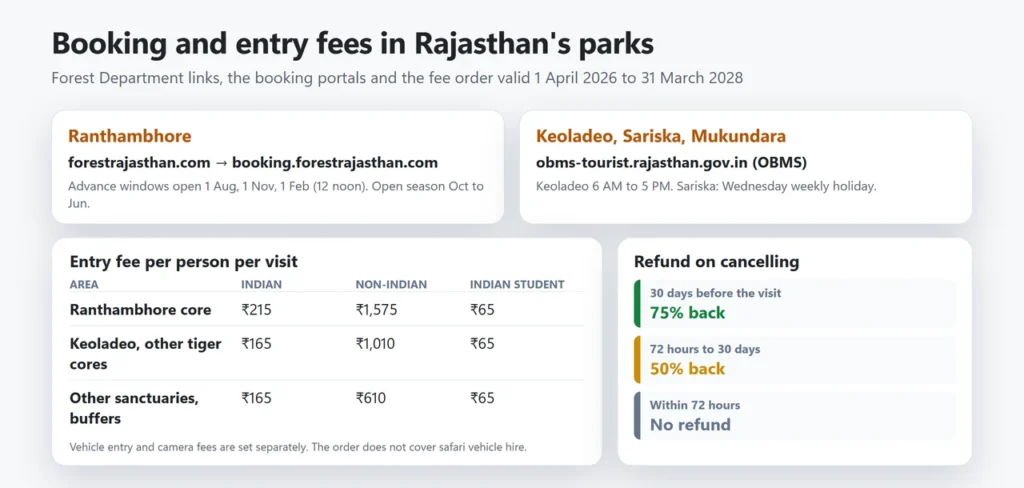
A Forest Department order signed on 30 March 2026 (F 3(5)Part/Tech-I/CWLW/2026/E-File-00397) sets entrance fees plus an eco-development surcharge from 1 April 2026 to 31 March 2028. The order’s column is headed “Total fee per person per visit”.
| Area | Indian citizen | Non-Indian citizen | Indian student |
|---|---|---|---|
| Ranthambhore Tiger Reserve, critical tiger habitat | ₹215 | ₹1,575 | ₹65 |
| Keoladeo and other critical tiger habitats | ₹165 | ₹1,010 | ₹65 |
| Other sanctuaries and protected areas, including tiger reserve buffers | ₹165 | ₹610 | ₹65 |
The order adds a vehicle fee per vehicle per visit (in Ranthambhore’s core, ₹695 for a jeep, car, mini-bus or canter and ₹1,455 for a motorised vehicle registered for tourism) and boat fees. If a route passes through both core and buffer, the core fee applies. Its refund table returns 75% if you cancel 30 days before the visit, 50% between 72 hours and 30 days, and nothing within 72 hours.
Common mistakes
- Calling Sariska a national park. It is a sanctuary and tiger reserve; its national park was never finally notified, according to the CAG.
- Calling Desert National Park the largest national park. It is a 3,162 km² sanctuary in law.
- Using the tiger reserve’s area for the park. Ranthambhore National Park is 282.03 km²; the tiger reserve is over 1,400 km².
- Treating Mukundra Hills and Darrah as one. They are separate protected areas inside the same tiger reserve.
- Paying fees found on old blogs. The current order’s rates apply from 1 April 2026 to 31 March 2028.
How many national parks are there in Rajasthan?
Three: Ranthambhore, Keoladeo and Mukundra Hills, covering 510.31 km², according to the Forest Department’s protected-area table. The CAG’s 2025 audit also counts three.
Is Sariska a national park?
No. The Forest Department lists Sariska as a sanctuary, and it is also a tiger reserve. The CAG says a national park was proposed but Sariska “is not notified as National Park”.
Which is the largest national park in Rajasthan?
Ranthambhore, at 282.03 km² on the department’s table. Desert National Park is bigger (3,162 km²) but is legally a sanctuary.
Which is the newest national park in Rajasthan?
Mukundra Hills. Its intention was notified in 2006 and the final notification was issued on 9 January 2012.
Is Keoladeo a national park or a bird sanctuary?
A national park. Its final notification of 26 August 1981 declared it Keoladeo National Park, Bharatpur. The OBMS portal describes it as “a vast bird sanctuary and former royal game reserve”, but that is a description, not its legal status.
Where can I book a Ranthambhore safari officially?
On forestrajasthan.com (booking.forestrajasthan.com), which the Forest Department’s home page links as the Ranthambore safari booking site. Other parks use obms-tourist.rajasthan.gov.in.
When is Ranthambhore open for safaris?
The official booking site calls October to June the open season, and its advance calendar offers visit dates from 1 October to 30 June.
More national park guides
Compare Rajasthan with our guides to the best national parks in India, the national parks in Madhya Pradesh, the national parks and sanctuaries in Gujarat, the national parks in Maharashtra and the national parks in Punjab. Checking land near a park? See our guide to Apna Khata Rajasthan land records.
Checked on 19 November 2026 against the Rajasthan Forest Department’s “Details of Protected Area” table, its April 2026 protected-area map, the scanned gazette notifications for Ranthambhore, Keoladeo, Mukundra Hills, Desert National Park and Sariska, its area statements and its entry fee order of 30 March 2026; CAG reports of 2006 and 2025 and a summary of its 2013 audit; MoEFCC draft notification S.O. 4766(E) of 2023; the NTCA tiger reserve list; PIB documents on Ramsar sites and World Heritage Sites; forestrajasthan.com and the OBMS portal. Nothing was booked.