Madhya Pradesh has 11 national parks, according to the state Forest Department: Kanha, Bandhavgarh, Panna, Pench, Satpura, Sanjay, Madhav, Van Vihar, Kuno, Ghughwa Fossil and Dinosaur Fossil (Bagh). The department’s wildlife page says the state has 11 national parks and 24 wildlife sanctuaries, and a 2022 report by the Comptroller and Auditor General (CAG) names the same 11.
Seven of the 11 national parks in Madhya Pradesh lie within the state’s nine tiger reserves, and those are where the tiger safaris are. This guide gives each park’s district, area and notification from the scanned gazettes on the Forest Department’s site, explains why some lists say 10 or 12, and shows how to book a safari on the official portal, with the season, timings, fee rules and cancellation rules as we read them on 18 November 2026.
Key takeaways
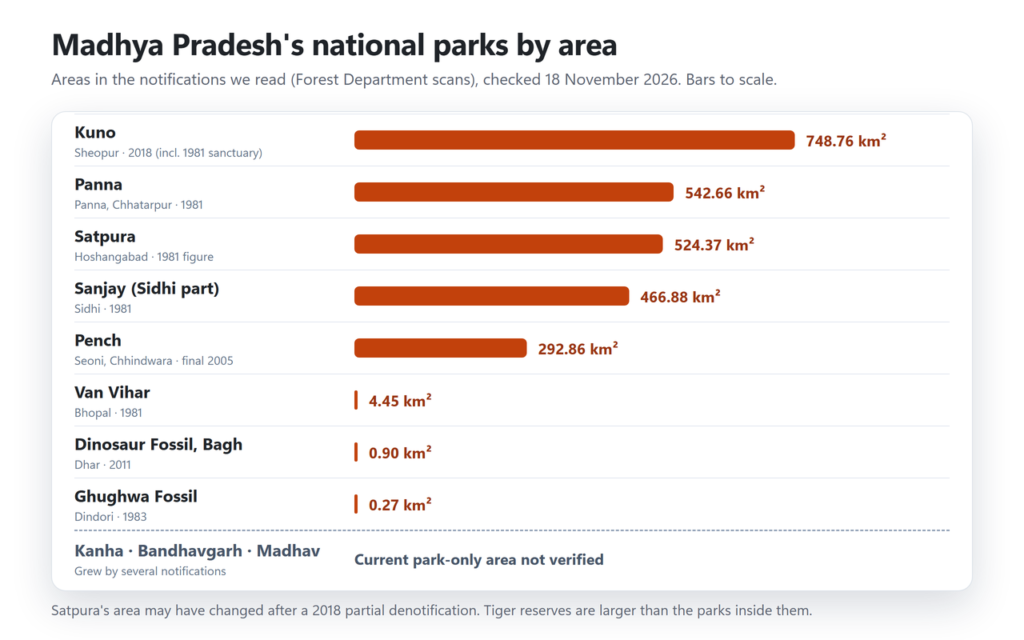
- Madhya Pradesh has 11 national parks on the Forest Department’s own list. Kuno is the newest (2018) and Ghughwa Fossil, at 0.27 km², is the smallest.
- Lists that say 12 add Omkareshwar, which is only a proposal (sent to the government in 2007; the CAG found no progress by 2019).
- Kanha, Bandhavgarh, Panna, Pench, Satpura and Sanjay sit inside tiger reserves, and Madhav became a tiger reserve in 2025. Kuno, Van Vihar and the two fossil parks are not tiger reserves.
- Book safaris only on forest.mponline.gov.in, the portal the Forest Department’s pages link to. A notice on its home page says bookings open 120 days ahead.
- Core zones close for tourism from 1 July to 30 September under the 2021 rules. Buffer zones of tiger reserves stay open all year.
- Carry the ID named on your permit. Cancellation refunds shrink from the full permit fee minus the portal fee (30 days or more before) to 25% (from 14 days until 5 PM the day before).
List of national parks in Madhya Pradesh
The table follows the Forest Department’s notification list (11 parks) and the scanned notifications it links to. “Notified” here means the first legal step, explained in the next section. Where we could not read a current park-only area, the table says so rather than repeat an unsourced figure.
| National park | District(s) | Area in the notification we read | Notification we read | Tiger reserve |
|---|---|---|---|---|
| Kanha | Mandla, Balaghat | Not verified (318.44 km² after a 1964 extension, plus 128.257 km² added in 1970) | Extensions of 1964 and 1970 | Kanha (1973-74; TR notification 2007) |
| Bandhavgarh | Umaria (brochure: Umaria and Katni) | Not verified (1982 extension of 118.72 + 208.74 km²) | Extension, 11 May 1982 | Bandhavgarh (1993-94; TR notification 2007) |
| Panna | Panna, Chhatarpur | 542.6626 km² | 17 October 1981 | Panna (1993-94; TR notification 2007) |
| Pench (Indira Priyadarshini) | Seoni, Chhindwara | 292.857 km² | 1 March 1983; final notification 16 December 2005 | Pench (1992-93; TR notification 2007) |
| Satpura | Hoshangabad (now Narmadapuram) | 524.37 km² (1981) | 13 October 1981 | Satpura (1999-20 as printed; TR notification 2007) |
| Sanjay | Sidhi | 466.882 km² in Sidhi (of a 1,938.012 km² park that also covered Surguja) | 23 September 1981 | Sanjay-Dubri (2011) |
| Madhav | Shivpuri | Not verified (2,863.40 ha added in 1999) | Extension, 25 October 1999 | Madhav (2025) |
| Kuno | Sheopur | 748.7618 km² | 12 October 2018 | No |
| Van Vihar | Bhopal | 445.21 ha (4.45 km²) | 16 September 1981 | No |
| Dinosaur Fossil, Bagh | Dhar | 89.740 ha (0.90 km²) | 12 January 2011 | No |
| Ghughwa Fossil | Dindori (notified in Mandla district) | 0.27 km² (department page) | 5 May 1983 | No |
Three points help when you compare this with other lists:
- Kanha, Bandhavgarh and Madhav grew through several notifications, and we did not read every page of their compilations. Figures such as 940 km² for Kanha appear on other sites but not in the documents we read, so we leave the current park-only areas as not verified. Their tiger reserves are much larger (Kanha’s core alone is 917.43 km² on the National Tiger Conservation Authority list).
- Kuno is 748.7618 km²: the 344.686 km² sanctuary of 1981 plus 404.0758 km² added in the 2018 notification. Pages that give Kuno as 404 km² are quoting only the addition.
- Satpura was 524.37 km² in the 1981 notification. The 2018 Kuno notification adds 22.13 km² to Kuno to offset a partial denotification of Satpura for fishing (the area removed from Satpura is not stated), so Satpura’s current area may differ.
Why some lists say 10 or 12
The count of 11 comes from three official places that agree: the Forest Department’s wildlife-wing page, its list of national park notifications, and CAG Report No. 1 of 2022, which says the state “has notified 11 National Parks and 24 Wildlife Sanctuaries till date”. Other counts have traceable causes:
- 12 usually adds Omkareshwar. The CAG report records that a proposal for an Omkareshwar National Park of 246.44 km² was sent to the state government in December 2007 and that there was “no progress in the matter since” (as of 2019). It is not on the department’s list.
- 10 can come from the booking portal, whose home page lists Kuno, Dinosaur, Ghughwa and Van Vihar and then says “The other 6 National Parks are notified as Tiger Reserve as well”. That line predates Madhav becoming a tiger reserve in 2025; with Madhav the total is 4 + 7 = 11. Some exam lists also drop one of the fossil parks or Van Vihar.
- Lists that include Gandhi Sagar, Ratapani or Nauradehi are mixing in sanctuaries or tiger reserves. None of these is a national park.
Most parks are still at the first legal step
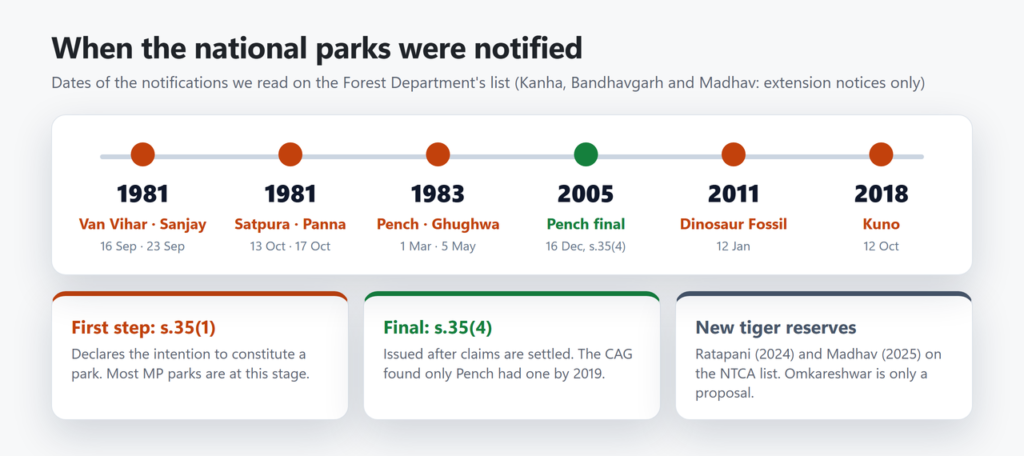
Under section 35 of the Wild Life (Protection) Act, 1972, a state first declares its intention to constitute a national park (section 35(1)) and issues the final notification (section 35(4)) only after people’s claims in the area are settled. Most of the notifications on the Forest Department’s list are the first kind. The CAG audited nine of the parks and found that by 2019 only Pench had its final notification; we read it, dated 16 December 2005, which “finally notifies” 292.857 km² as the Indira Priyadharshini Pench National Park. The department’s own page says the final notification of some protected areas is still pending and that the status is given in its annexures, which we did not read. We found no later final notices on its notification list.
For an exam, “11 national parks” is the answer the state’s own records support. If a question asks for the oldest, say which basis you use: Kanha was a national park under the Madhya Pradesh National Parks Act, 1955 (its 1964 extension cites that Act), but we did not read its founding notice, and Madhav’s original notice is not on the department’s list either.
National parks, tiger reserves and sanctuaries
Safari bookings are sold by tiger reserve, so it helps to know how the three overlap. The National Tiger Conservation Authority (NTCA) lists nine tiger reserves in Madhya Pradesh (page last updated 16 November 2026). Seven of them include a national park (per the NTCA list and the Forest Department); two are built on sanctuaries. NTCA prints two years for the older reserves: a “PA Notificn Year” (for example 1973-74 for Kanha) and a “TR Notifcn Year” (2007 for the five older reserves). The table shows both, as printed.
| Tiger reserve (NTCA years) | National park in it | Core / total area (km²) |
|---|---|---|
| Kanha (1973-74 / 2007) | Kanha | 917.43 / 2,051.79 |
| Bandhavgarh (1993-94 / 2007) | Bandhavgarh | 716.90 / 1,536.93 |
| Panna (1993-94 / 2007) | Panna | 576.13 / 1,598.10 |
| Pench (1992-93 / 2007) | Pench | 411.33 / 1,179.63 |
| Satpura (1999-20 / 2007) | Satpura | 1,339.26 / 2,133.31 |
| Sanjay-Dubri (2011) | Sanjay | 812.57 / 1,674.50 |
| Madhav (2025) | Madhav | 375.233 / 1,651.387 |
| Veerangana Durgavati (2023) | None (Nauradehi and Durgavati sanctuaries) | 1,414.006 / 2,339.12 |
| Ratapani (2024) | None (Ratapani sanctuary) | 763.812 / 1,271.465 |
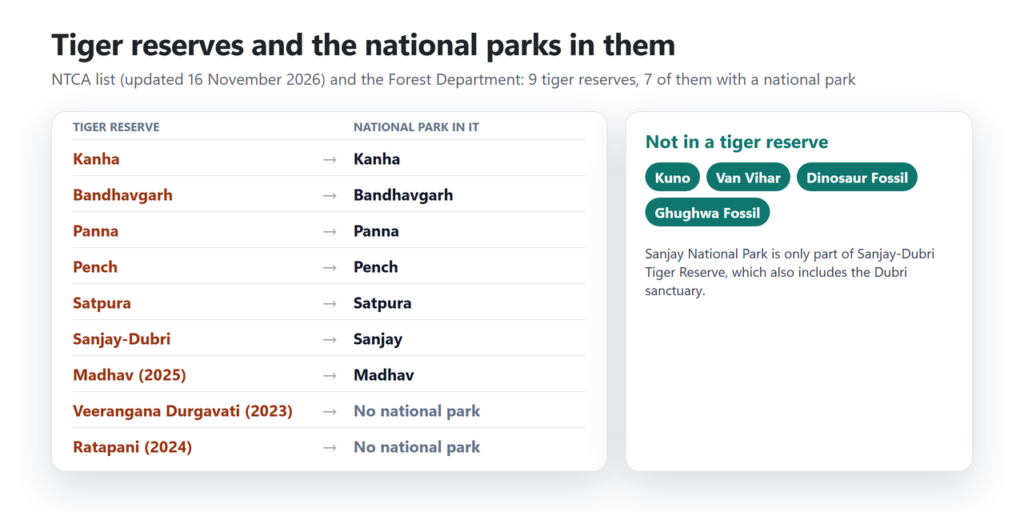
Two naming traps: Sanjay National Park is not the same as Sanjay-Dubri Tiger Reserve, which also includes the Dubri sanctuary. And Pench’s park is officially the Indira Priyadarshini Pench National Park; the department’s Pench page says its core area of 411.330 km² is the national park (292.857 km²) plus a sanctuary (118.473 km²).
The parks at a glance
Zone names, best months and nearest airports below are quoted from each tiger reserve’s e-brochure on the booking portal; the brochures call these the best time to visit, which is not the same as the legal season.
- Kanha (Mandla, Balaghat): eight zones, four in the core (Kanha, Kisli, Mukki, Sarhi), one in the adjoining Phen sanctuary and three in the buffer (Khatia, Khapa, Sijhora). Home of the hard-ground barasingha, the state animal (the Satpura page says it was also reintroduced there in 2015). Best time 15 October to 30 June. Airports: Nagpur, Jabalpur, Raipur.
- Bandhavgarh (Umaria): core zones Tala, Magadhi and Khitauli; buffer zones Dhamokhar, Johila and Panpatha. Best time 15 October to 15 June. Airports: Jabalpur, Khajuraho, Nagpur; Umaria station is 32 km from Tala.
- Panna (Panna, Chhatarpur): zones Madla, Hinauta and Akola. Best time 15 October to 15 June. Airport: Khajuraho. Stations: Khajuraho (25 km, per the department), Satna, Katni and Jhansi.
- Pench (Seoni, Chhindwara): zones Turia, Karmajhiri and Jamtara; the brochure calls it the real story area of Kipling’s The Jungle Book. Best time 15 October to 30 June. Airports: Jabalpur, Nagpur.
- Satpura (Hoshangabad, now Narmadapuram): allows cycling, canoeing and trekking; only 30 vehicles a day are permitted to enter the Madhai core zone. Best time 15 October to 30 June; Pachmarhi is open all year. Stations: Pipariya, Itarsi.
- Sanjay (Sidhi), in Sanjay-Dubri Tiger Reserve: zones Koilari, Dubari, Gadduha, Bastua and Badkadol. The portal says the Bastua zone is closed for booking from 19 October 2026 until further notice, with advance permits cancelled and refunded by the park authority. Best time 1 October to 30 June. Stations: Rewa, Satna, Jabalpur.
- Madhav (Shivpuri): tigers were reintroduced in March 2023 (one male, two females, per the department), and it became a tiger reserve in 2025.
- Kuno (Sheopur): where eight cheetahs from Namibia were released into quarantine enclosures on 17 September 2022, followed by 12 from South Africa on 18 February 2023. We do not give a current number; the department’s sentence on it is undated.
- Van Vihar (Bhopal): recognised as a modern zoo; about 8 km from Bhopal station and 6.5 km from Habibganj (as the department’s page names it). It has a post-sunset safari.
- Dinosaur Fossil, Bagh (Dhar): dinosaur bones and eggs about 6.5 crore years old; 150 km from Indore via Dhar and Rajgarh; capacity 200 visitors, with no separate tourism zones.
- Ghughwa Fossil (Dindori): fossils up to 6 crore years old, protected in a 0.27 km² park.
How to book a safari on the official portal
The Forest Department’s “Visit national parks” page links each tiger reserve to forest.mponline.gov.in, run by MPOnline. Its home page has tabs for all nine tiger reserves, the Kuno, Madhav, Dinosaur and Ghughwa national parks, Van Vihar (zoo and late-night safari) and several sanctuaries. We read the public pages only; we did not log in or open a booking form, so the steps below come from the portal’s notices and the 2021 rules it links (“RuleBook (English)”).
- Pick the reserve and zone. Core zones (Class 1) cost more than buffer zones (Class 2). Check the portal’s notices for zone closures such as Bastua.
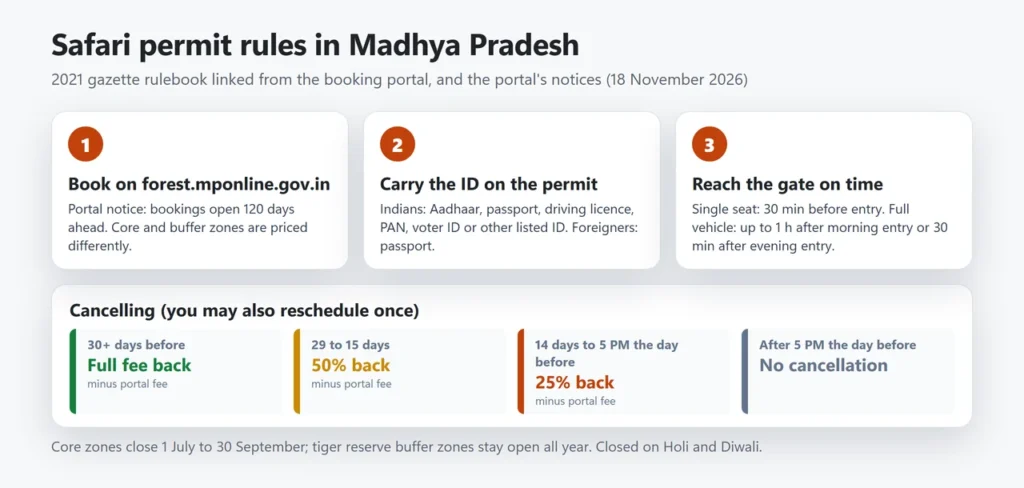
- Book early. A home-page notice says “Bookings of next 120 days will be open today at 11:00 AM” (the notice is undated). The rules split the permits: 10% single seats online, 10% single seats at the gate (from 5 PM the day before), 10% Field Director’s quota, and the rest full-vehicle permits online.
- Choose single seat or full vehicle. A full-vehicle permit covers a registered light vehicle with up to six tourists. Vehicle hire and the guide fee are paid separately.
- Enter every visitor’s ID. Indians may carry an Aadhaar card, passport, driving licence, PAN card, voter ID, another government ID or a school or college ID card. Foreigners must carry their passport. The permit can be cancelled if identities cannot be confirmed.
- Arrive on time. Single-seat holders must reach the gate half an hour before entry. Full-vehicle holders may arrive up to one hour after the morning entry time or half an hour after the evening entry time; after that the permit is cancelled automatically.
- Wait list and add-ons. Wait-list permits (about 10% of online permits) are cancelled and refunded, minus the portal fee, if not confirmed 5 days before the safari. On a full-vehicle permit booked with at least two names, up to four more names can be added once, for an extra fee equal to one permit. At least two of the original names must be present on the day or the permit is cancelled, and you cannot add names after rescheduling.
Season, timings and closures
Rule 12 of the 2021 rules sets the season. From 1 July to 30 September, all places inside national parks and sanctuaries are closed to tourism, except a listed set that ordinarily has no closed period: Van Vihar, Madhav, the two fossil parks, Pandav Falls in Panna, the tourist spots of Pachmarhi, several sanctuary sites and the buffer areas of tiger reserves, which stay open all year. Park officers may open limited areas between 1 and 15 October depending on the weather. (Madhav’s “no closed period” was written when it was not yet a tiger reserve; check the portal for its core zone.) Under rule 12(3), vehicle safaris follow the times of sunrise and sunset, the actual entry and exit times are printed on your permit, and buffer-zone visitors may arrive half an hour after the core-zone time; under rule 12(5) the officer in charge can change the timings for a day or longer.
The portal’s timings table applies to safari dates from 1 October 2026 (it does not name the parks it covers):
| Months | Morning entry | Morning exit | Evening entry | Evening exit |
|---|---|---|---|---|
| October, November | 6:00 AM | 11:30 AM | 3:00 PM | 6:00 PM |
| December, January | 6:20 AM | 11:30 AM | 3:00 PM | 6:00 PM |
| February, March | 6:10 AM | 11:30 AM | 3:00 PM | 6:30 PM |
| April, May, June | 5:30 AM | 11:00 AM | 3:30 PM | 7:00 PM |
All protected areas close for tourism on the government holidays of Diwali and Holi, and the state can add other closed days. You may read online that parks shut on Wednesday afternoons: an undated amendment PDF on the portal says so, but the gazetted rules we read (August 2021) do not include it. Check the notices on the portal for your date rather than rely on either.
Safari fees: how Madhya Pradesh calculates them
The rules do not print one price per park. Rule 3 sets a base rate and multiplies it by a coefficient for the class of area, rounding up to the next ₹5 or ₹10. The base rates are ₹250 for a single-seat permit and ₹1,500 for a full-vehicle permit (light vehicle, up to six tourists), “for one round”, valid for a day.
| Class | Areas (as listed in 2021) | Coefficient |
|---|---|---|
| Class 1 | Core zones of tiger reserves (and zones partly in core) | 1.6 |
| Class 2 | Buffer zones of tiger reserves and Phen sanctuary | 0.8 |
| Class 3 | Madhav NP, Gandhisagar, Nauradehi, Ratapani, Kuno Palpur, Kheoni | 0.5 |
| Class 4 | Ghughwa and Dinosaur fossil parks (and listed sanctuaries) | 0.2 |
| Class 6 | Van Vihar, Ralamandal, Mukundpur Zoo | Own table |
The same rulebook elsewhere calls ₹1,500 the cost of one permit for core areas, so we do not print a calculated core fee; the portal shows the fee when you book. Other rules are clear: children aged 5 to 12 pay half for a single seat and those under five go free, sharing a parent’s seat; foreign tourists pay double in Class 1 areas; and on premium days declared each year, the Class 1 coefficient rises to 2 for Indians and 4 for foreigners. Guide fees in the gazetted table are ₹600 (G-1 guide) or ₹480 (G-2) per vehicle round. Cameras are free on normal safari rounds, and phones must be on silent.
Van Vihar has its own table (2021): ₹20 per person on foot, ₹30 per bicycle, ₹250 per light vehicle up to five people, and ₹200 per person for the post-sunset safari (₹100 for ages 5 to 12, free under five). These are the 2021 gazette figures; current fees are not shown on the portal’s public pages.
Cancellation and rescheduling
| When you cancel | Refund |
|---|---|
| 30 days or more before the safari | Full permit fee minus the portal fee |
| 29 to 15 days before | 50% of the permit fee (portal fee deducted) |
| 14 days before until 5 PM the day before | 25% of the permit fee (portal fee deducted) |
| After 5 PM the day before | Not possible |
These rules apply in tourism areas where carrying capacity is fixed (permits booked online). You may reschedule the date and zone once, within the same protected area: 30 days or more ahead it costs only the portal fee, 29 to 15 days ahead it costs 50% of the permit fee plus the portal fee, and after that the table charges 75% plus the portal fee. Neither cancelling nor rescheduling is possible after 5 PM the day before.
Common mistakes in online lists
- Listing Omkareshwar as a national park (it is a 2007 proposal).
- Giving Kuno as 404 km² (that is only the 2018 addition).
- Giving the Dinosaur Fossil park as 108 km² notified in 2010; the gazette says 89.740 hectares on 12 January 2011.
- Dating Pench to 1975; the department says the sanctuary came in 1977 and the park in 1983.
- Calling the Ghughwa park “Mandla Plant Fossils National Park”; the department’s name is Ghughwa Fossil National Park, now in Dindori.
- Counting six, seven or eight tiger reserves; the NTCA lists nine, with Ratapani (2024) and Madhav (2025).
- Quoting safari fees “per person” when the safari rules price a seat or a vehicle.
How many national parks are there in Madhya Pradesh?
Eleven: Kanha, Bandhavgarh, Panna, Pench, Satpura, Sanjay, Madhav, Van Vihar, Kuno, Ghughwa Fossil and Dinosaur Fossil (Bagh). That is the Forest Department’s list and the CAG’s 2022 count.
Is Omkareshwar a national park?
No. A proposal for a 246.44 km² Omkareshwar National Park was sent to the state government in December 2007, and the CAG found no progress by 2019. It is not on the Forest Department’s list of national parks.
Which is the smallest national park in Madhya Pradesh?
Ghughwa Fossil National Park in Dindori, at 0.27 km² on the Forest Department’s page. The Dinosaur Fossil park at Bagh is next, at 89.740 hectares.
Which is the newest national park in Madhya Pradesh?
Kuno, notified on 12 October 2018 at 748.7618 km², including the earlier Kuno sanctuary.
Are Kanha and Bandhavgarh closed in the monsoon?
Their core zones close from 1 July to 30 September under the 2021 rules. Buffer zones of tiger reserves stay open all year.
What is the official website to book a Kanha or Bandhavgarh safari?
forest.mponline.gov.in, the MPOnline portal that the Forest Department’s pages link to. A notice on it says bookings open 120 days ahead.
More national park guides
Compare Madhya Pradesh with our guides to the best national parks in India, the national parks in Maharashtra, the national parks and sanctuaries in Gujarat and the national parks in Punjab. Buying land near a park? Our guide to MP Bhulekh land records shows how to check a plot’s record. For the North East, see our guide to the national parks in Assam.
Checked on 18 November 2026 against the Madhya Pradesh Forest Department’s wildlife-wing page, its list of national park notifications and the scanned notifications for each park (including Pench’s final notification of 2005 and Kuno’s of 2018); CAG Report No. 1 of 2022 on wildlife conservation in Madhya Pradesh; the NTCA tiger reserve list; and the forest.mponline.gov.in home page, park e-brochures and the 2021 gazette rulebook it links. Nothing was booked.