Domain privacy (also called WHOIS privacy) is a service that keeps your name, address, phone number and email out of public domain lookups. Every domain owner has to give their registrar accurate contact details, and those details used to be published for anyone to see. Today, for generic domains such as .com, many registrars already hide personal contact data by default. ICANN’s Registration Data Policy, in force since August 2025, allows this redaction, but it doesn’t require it. Registrars that redact must offer an email address or web form so people can still reach you. Many registrars now include privacy free, but it isn’t available everywhere: the .IN Registry, for example, doesn’t allow privacy or proxy services for .in domains. Privacy doesn’t make you anonymous. Your registrar still holds your real details and can disclose them for legitimate legal requests.
This guide explains what domain privacy hides, how it changed after GDPR and ICANN’s 2025 policy, the difference between privacy and proxy services, what it costs at some major registrars, where it isn’t allowed, and when you need it. It is based on ICANN’s policies and agreements, the .IN Registry’s registrar agreement and terms, and registrars’ own help pages, checked on 13 November 2026.
Key takeaways
- Domain privacy hides your personal contact details from public lookups.
- You must still give accurate details to your registrar. Inaccurate details can lead to suspension.
- Since 2018 (GDPR), and under ICANN’s 2025 policy, many registrars redact personal data for generic domains anyway.
- Privacy vs proxy: with privacy you stay the registrant. With a proxy, the provider is the registrant of record.
- Not available for .in: the .IN Registry doesn’t allow privacy or proxy services.
- Not anonymity: registrars can disclose your details for valid legal or abuse requests.
What domain privacy hides
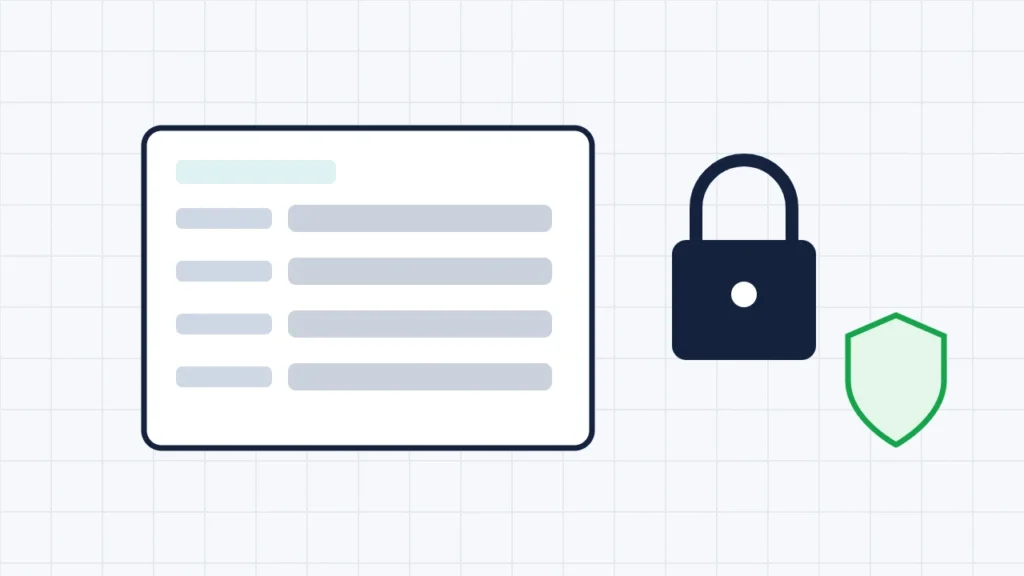
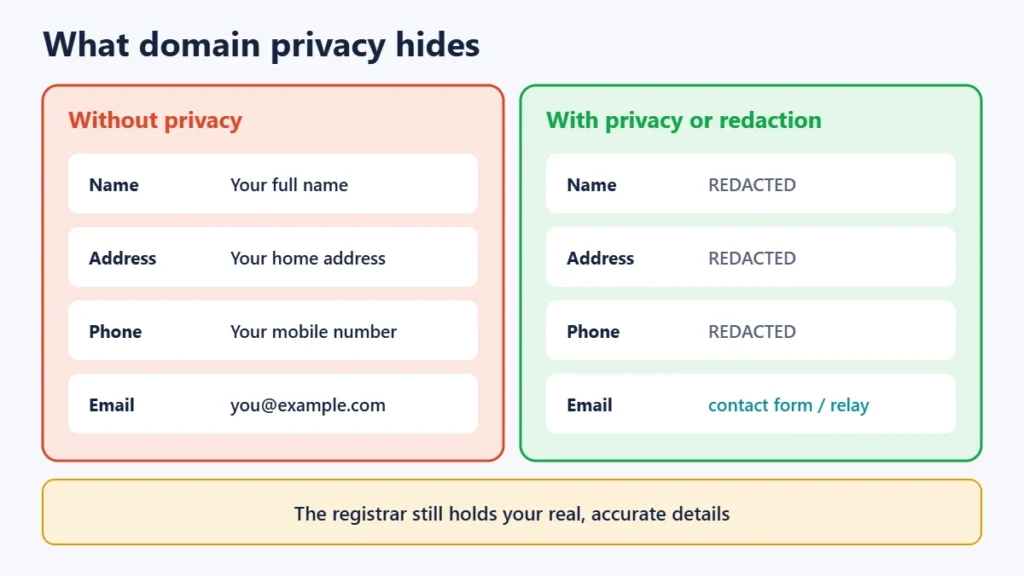
When you register a domain, the registrar collects your name, address, phone number and email. ICANN’s policy requires registrars to collect these. Without privacy or redaction, a public lookup could show them all, which invites spam, scam calls and unwanted contact. Domain privacy replaces them in public results with the privacy service’s details, or with a redaction notice and a way to contact you.
How things changed: GDPR and ICANN’s 2025 policy
- Before 2018: registrant contact details for generic domains were commonly public in WHOIS, so privacy services were the main way to hide them.
- May 2018: after Europe’s GDPR took effect, ICANN adopted a temporary specification that let registrars redact personal data. Lookups started showing “REDACTED FOR PRIVACY”.
- January 2025: RDAP replaced the old WHOIS protocol as the definitive source of registration data for generic domains.
- August 2025: ICANN’s Registration Data Policy took effect. It allows registrars to redact personal data, but doesn’t require it. Registrars that redact must publish an email address or a web form to reach the registrant.
The result: for many .com and other generic domains, your personal details may already be hidden without a separate privacy service. It depends on your registrar’s practice, so check what a lookup of your own domain shows.
Privacy vs proxy services
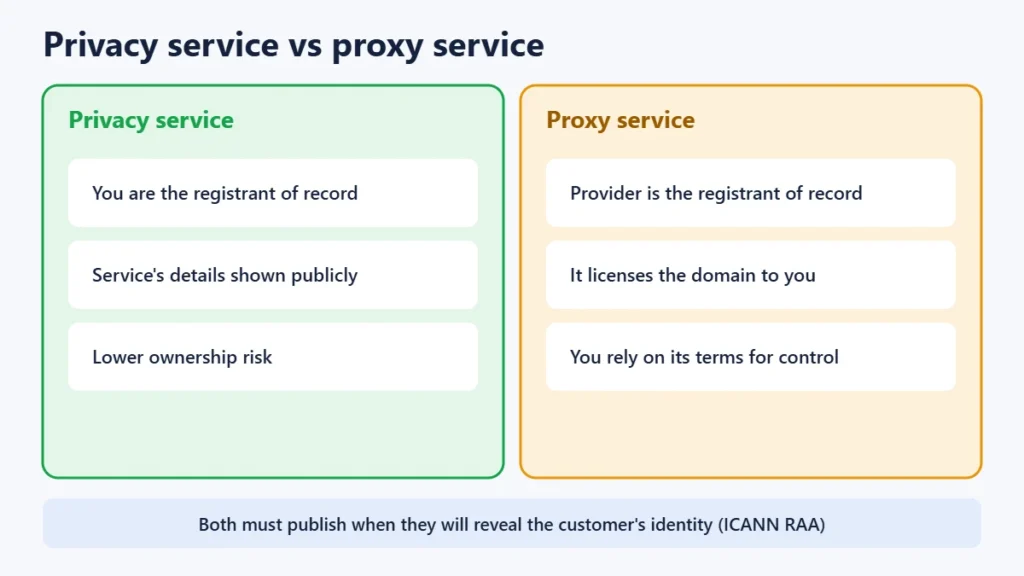
| Privacy service | Proxy service | |
|---|---|---|
| Who is the registrant? | You | The proxy provider, which licenses the name to you |
| What’s public | The service’s contact details instead of yours | The provider’s details |
| Risk | Low: you remain the owner of record | You depend on the provider’s terms to control the domain |
ICANN’s registrar agreement defines both. It also says someone who licenses a domain to another person is still the registered name holder of record. That’s why a proxy arrangement carries some ownership risk: on paper the domain is registered to the provider. Privacy and proxy providers must publish the circumstances in which they’ll reveal your identity.
What domain privacy costs
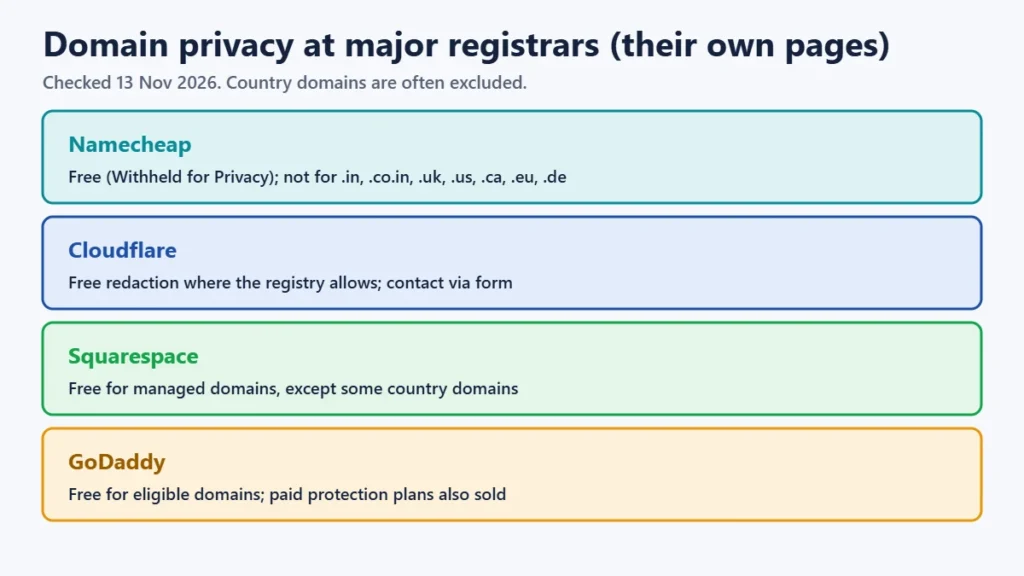
Many registrars now include privacy at no extra cost. As of 13 November 2026, according to their own help pages:
- Namecheap says privacy is free, through its Withheld for Privacy service, but that it can’t be used for some country domains, including .in, .co.in, .uk, .us, .ca, .eu and .de.
- Cloudflare says it redacts registrant data free where the registry allows. State and country remain visible, and contact goes through a web form.
- Squarespace says it provides free privacy for domains it manages, except some country domains.
- GoDaddy says it includes free domain privacy for eligible domains and also sells paid protection plans.
Terms and prices change, and some extensions are excluded, so check at checkout whether privacy is included for the exact domain you’re buying.
Where domain privacy isn’t allowed: .in and other country domains
Country domains follow their own registry’s rules. The .IN Registry’s registrar agreement states that no privacy or proxy service will be provided by any registrar to .in or .bharat registrants. Its registrant terms add that if your details are masked through a proxy, you may not be recognised as the domain’s owner. So for a .in domain, register in your own or your organisation’s real name. Our guide to registering a .in domain covers the KYC and WHOIS rules in more detail. Other country registries, such as the UK’s, have their own approaches to showing or hiding registrant details.
What privacy doesn’t do
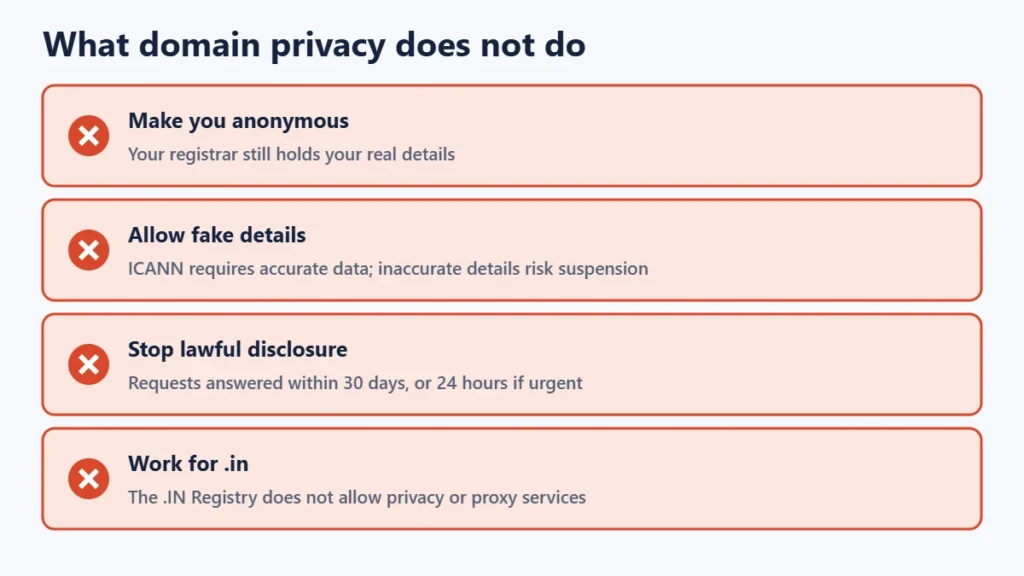
- It doesn’t make you anonymous. Your registrar still has your real details.
- It doesn’t let you use fake details. ICANN’s agreement requires accurate information. Giving inaccurate details, or not responding to your registrar within 15 days about them, can be treated as a breach and lead to suspension. Registrars must also verify your email or phone.
- It can be lifted. Under ICANN’s policy, registrars must respond to disclosure requests within set times (30 days, or 24 hours for urgent cases). ICANN also runs a request service for people with a legitimate need, such as police, trademark owners or security researchers.
Do you need domain privacy?
- Personal sites and blogs: usually yes, if your registrar doesn’t already redact your details. It cuts spam and protects your home address.
- Businesses: often less important, since your business address is public anyway. Some businesses prefer visible details for trust.
- .in and other restricted country domains: privacy isn’t available, so use contact details you’re comfortable showing.
- If privacy is free: there’s little reason not to turn it on, as long as you keep your real details accurate with the registrar.
Frequently asked questions
Is domain privacy worth it?
For individuals, usually yes. It’s often free, cuts spam and keeps your address private. Many registrars already redact personal data for generic domains, so check before paying for it.
Can I get domain privacy for a .in domain?
No. The .IN Registry doesn’t allow privacy or proxy services for .in or .bharat domains.
Is WHOIS still public?
For generic domains, RDAP has replaced WHOIS as the official source, and many registrars redact personal data. Country domains vary. Look up your own domain to see what’s shown.
Can someone still contact me if my details are hidden?
Usually yes. Registrars that redact must provide an email address or web form. ICANN has clarified that a form may simply pass on a contact request.
Does domain privacy affect SEO?
We found no official search-engine guidance saying it does. Treat claims either way with caution.
Will domain privacy stop my domain being transferred?
Privacy itself doesn’t block transfers, but keep your registrant email working, because transfer notices may go to it. See our guide to transferring a domain.
The short version
Domain privacy hides your personal contact details from public lookups while your registrar keeps the real ones. It’s often free and many registrars redact anyway for .com and similar domains, but it isn’t allowed for .in. Keep your details accurate, and remember privacy isn’t anonymity. If your domain shows a placeholder page instead of your site, see our guide to expired hosting or point the domain at your host.