A VPN and Tor both hide your internet traffic from your internet provider and the local network, but they work differently and protect against different things. A VPN sends all your device’s traffic through one server run by a company. It’s fast and covers every app, but that company can see your traffic, so you have to trust it. Tor sends your browsing through at least three relays run by volunteers, and no single relay knows both who you are and where you’re going. That gives far stronger anonymity, but it’s slower and usually protects only the Tor Browser. In short: use a VPN for everyday privacy, such as on public Wi-Fi, and use Tor when hiding who you are from the sites you visit matters more than speed. Neither makes you completely anonymous.
This guide explains how each works, what each hides and from whom, their limits, whether to combine them, and the legal position in India. It is based on the Tor Project’s documentation, the Electronic Frontier Foundation’s Surveillance Self-Defense guides, VPN providers’ published policies and CERT-In’s 2022 directions and FAQs, checked on 13 November 2026.
Key takeaways
- VPN: one trusted company’s server. Fast, covers all apps, but the provider can see your traffic. The EFF says “a VPN is not a tool for anonymity.”
- Tor: three or more volunteer relays, encrypted in layers. Strong anonymity, but slower and usually only for the Tor Browser.
- Both hide your traffic from your ISP, though your ISP can tell that you’re using a VPN or Tor.
- Neither stops you identifying yourself by logging into accounts, and neither protects against malware.
- The Tor Project doesn’t recommend combining a VPN with Tor unless you’re an advanced user.
- In India, CERT-In’s 2022 rules apply to VPN providers, not individual users. We found no official Indian statement on Tor.
How a VPN works
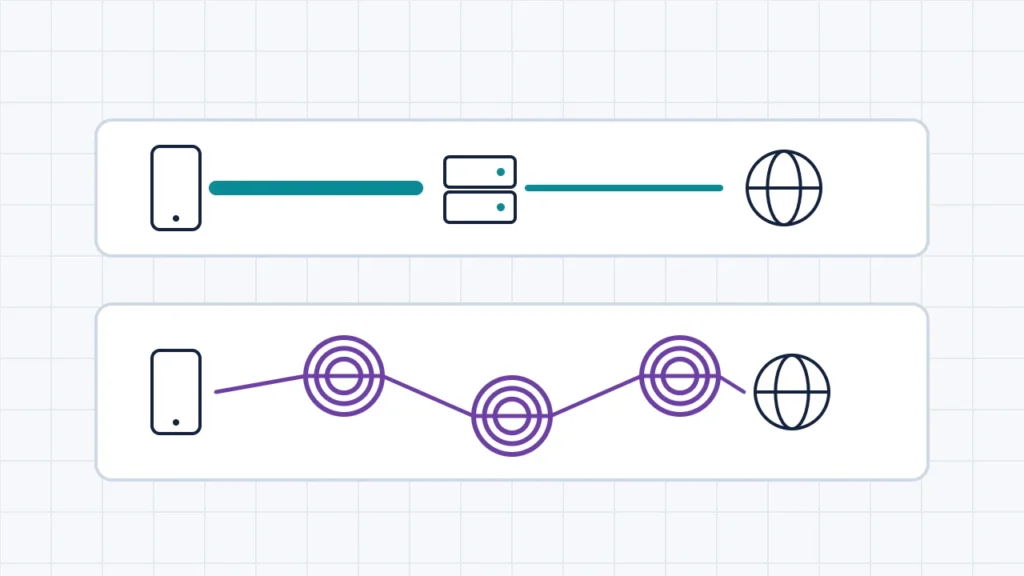
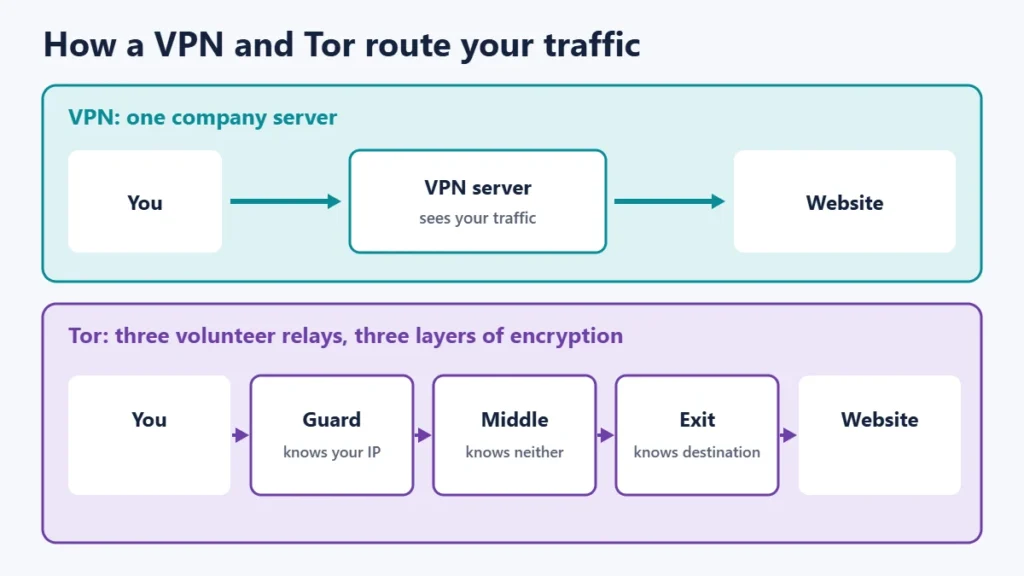
A VPN app creates an encrypted tunnel from your device to a server run by the VPN company. Everything goes through it: browser, apps and background traffic. Your internet provider and the local Wi-Fi see only an encrypted connection to the VPN. Websites see the VPN server’s IP address and location instead of yours.
The catch is trust. The EFF explains that a VPN shifts what your ISP could see to the VPN provider, which can see everything you do through it. Many providers say they keep no logs of activity. Some have had those claims audited, but they remain the companies’ own claims. The EFF also warns that free VPNs may make money from your data.
How Tor works
Tor (short for “The Onion Router”) sends your traffic through at least three relays run by volunteers around the world: a guard (entry) relay, a middle relay and an exit relay. Your traffic is encrypted three times, once for each relay, like layers of an onion. Each relay removes one layer.
- The guard knows your IP address and that you’re using Tor, but not where you’re going.
- The middle relay knows neither who you are nor where you’re going.
- The exit relay knows the destination, but not who you are. If the site uses HTTPS, the exit relay can’t read the content.
Because no single relay has the full picture, Tor gives much stronger anonymity than a single VPN server. You use it through the free Tor Browser, made by the non-profit Tor Project. It also keeps each website separate from others, so trackers can’t follow you between sites, and tries to make all its users look alike to resist fingerprinting.
VPN vs Tor: side by side
| VPN | Tor | |
|---|---|---|
| Route | One server run by a company | At least three volunteer relays |
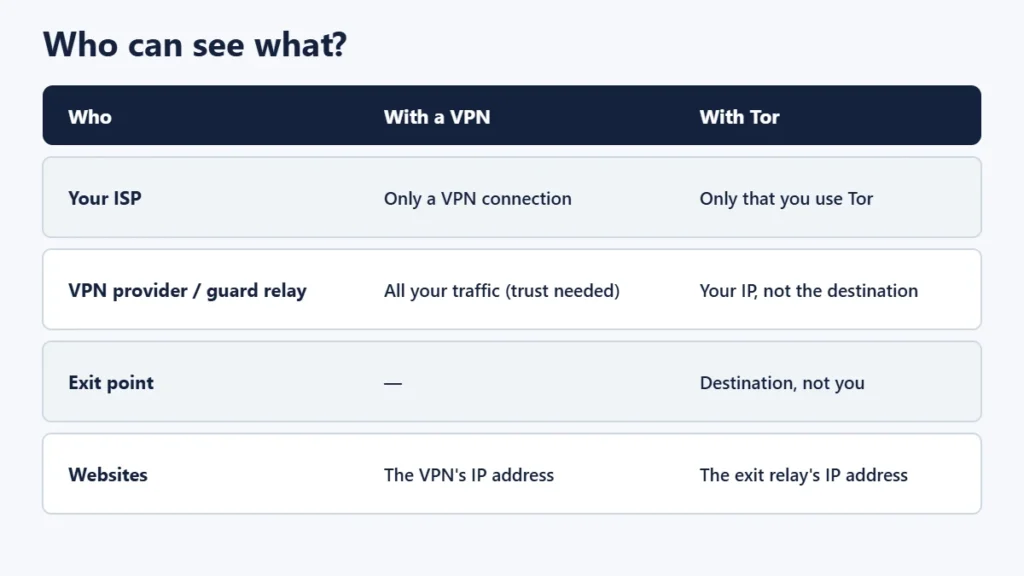
| Who could see your activity | The VPN provider | No single relay sees both you and your destination |
| Hides activity from your ISP | Yes (ISP sees you use a VPN) | Yes (ISP sees you use Tor) |
| Hides your IP from websites | Yes, shows the VPN’s IP | Yes, shows the exit relay’s IP |
| Covers | All apps on the device | Usually just the Tor Browser |
| Speed | Usually close to your normal speed on a nearby server | Noticeably slower, because traffic hops between relays worldwide |
| Cost | Usually paid; free ones carry risks | Free and open source |
| Best for | Everyday privacy, public Wi-Fi, all-device protection | Strong anonymity for browsing |
| Anonymity | Not designed for it | Designed for it, but not perfect |
What neither protects you from
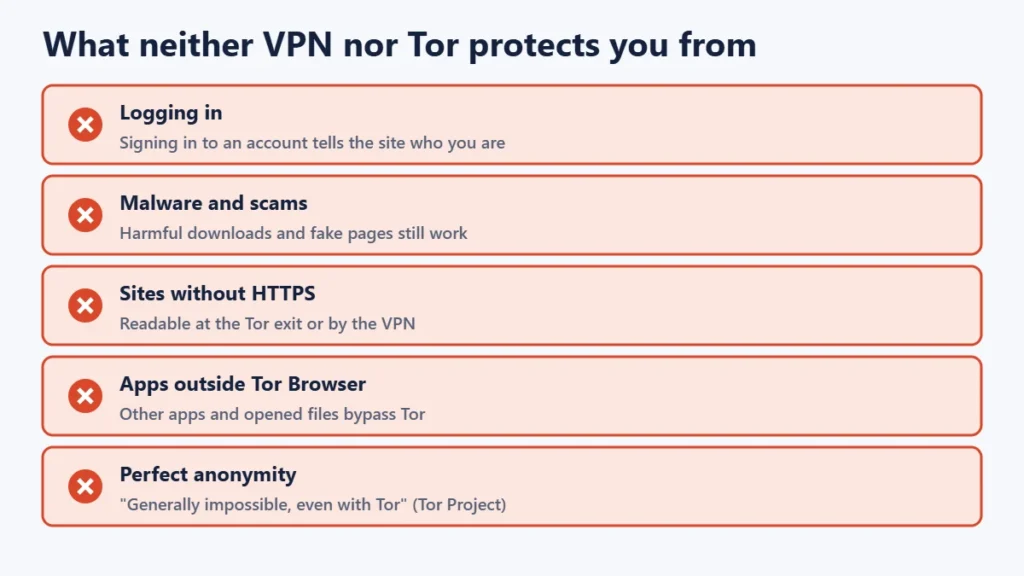
- Identifying yourself. If you sign in to an account, the site knows who you are, whatever route you used.
- Malware and scams. Neither stops you downloading something harmful or entering details on a fake page.
- Unencrypted sites. On Tor, the exit relay can see traffic to sites that don’t use HTTPS. With a VPN, the provider can.
- Leaks outside the tool. The Tor Project warns that documents opened in other apps can connect outside Tor, that browser add-ons can weaken protection, and that only Tor Browser traffic is protected.
- Powerful observers. Tor doesn’t protect against someone who can watch both ends of your connection. The Tor Project says perfect anonymity is “generally impossible”, even with Tor.
Should you use a VPN and Tor together?
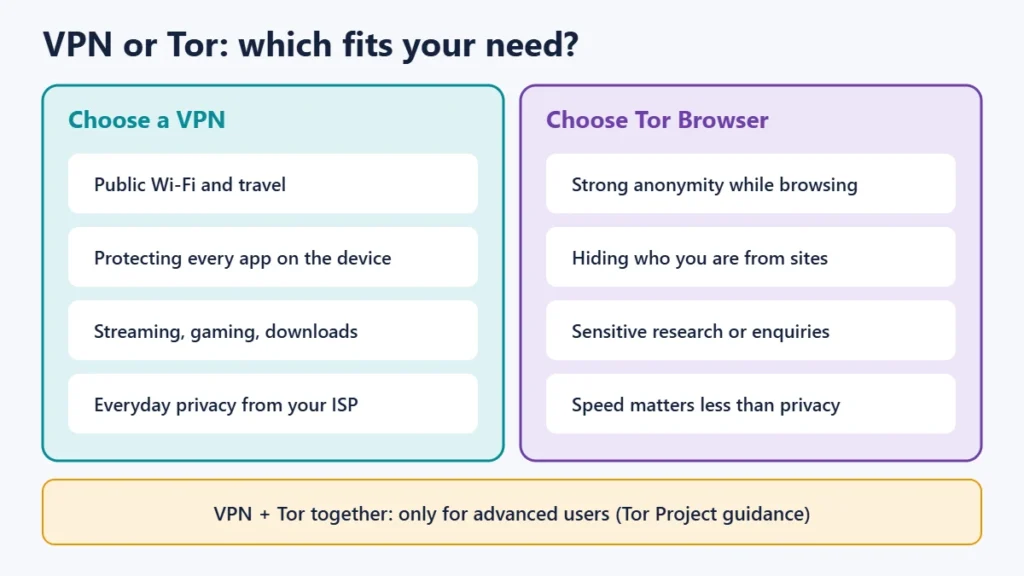
Some people connect to a VPN first and then open Tor. The Tor Project’s guidance is that it doesn’t recommend using a VPN with Tor unless you’re an advanced user who knows how to set both up in a way that doesn’t harm privacy, because a careless set-up can weaken anonymity. For most people, choose the right tool for the task rather than stacking them.
Which should you use?
- Public Wi-Fi, travel, everyday privacy from your ISP: a reputable VPN. Our guide to public Wi-Fi safety explains when it helps.
- Protecting all apps on your phone or laptop: a VPN, since Tor Browser covers only the browser.
- Strong anonymity while browsing, for example for researchers, journalists or anyone protecting sensitive enquiries: Tor Browser, with the habits above.
- Streaming, gaming or large downloads: a VPN, because Tor is too slow for these.
Legal position in India
Using a VPN is legal for individuals in India. CERT-In’s April 2022 directions require VPN service providers to keep verified customer details, including names, dates of use, IP addresses, contact details and purpose, for at least five years. CERT-In’s FAQ states that “individual citizens are not covered” by the directions. Several VPN companies removed their servers physically located in India in 2022. Proton, for example, now offers Indian IP addresses from servers in Singapore. We found no official Indian government statement specifically about Tor. As with any tool, using a VPN or Tor for an illegal activity doesn’t make that activity legal. Our guide to whether VPNs are legal in India covers the rules in detail. This is general information, not legal advice.
Frequently asked questions
Is Tor safer than a VPN?
For anonymity, yes. Tor is designed so no single relay knows both who you are and what you’re visiting. For everyday protection of all your apps, a VPN is more practical. Neither is complete protection on its own.
Can my internet provider see that I use Tor or a VPN?
Usually yes. They can see that you’re connected to a VPN server or to Tor, but not the content of what you do through it.
Why is Tor so slow?
Your traffic passes through three or more volunteer relays around the world, each adding delay. The Tor Project says some delay is unavoidable.
Does a VPN make me anonymous?
No. A VPN hides your activity from your ISP and your IP from websites, but the VPN provider can see your traffic. The EFF says a VPN “is not a tool for anonymity.”
Is Tor only for the dark web?
No. Most people use Tor Browser to visit ordinary websites more privately. It can also reach special “.onion” sites, but that’s only one use.
Is it legal to use Tor in India?
We found no Indian law or official statement banning Tor for individuals. Illegal activities remain illegal whatever tool you use. For a specific legal question, consult a lawyer.
The short version
A VPN trusts one company to hide your traffic from your ISP and local network. It’s fast and covers your whole device. Tor spreads trust across three volunteer relays for strong anonymity, but it’s slow and covers only the Tor Browser. Use a VPN for everyday privacy and Tor when anonymity matters most, don’t log into personal accounts if you want to stay anonymous, and remember neither is perfect. If your VPN feels slow, see our guide to why a VPN is slow.