Quick answer: St Thomas Cathedral is Mumbai’s oldest Anglican church, standing at Horniman Circle in the Fort area of south Mumbai. Its foundation stone was laid in 1676, it opened for worship on Christmas Day 1718, and it became a cathedral in 1837; Churchgate takes its name from the old fort gate that led to it. There is no entry fee. The cathedral does not publish visiting hours online as of October 2026, so plan your visit around service times and check locally.
St Thomas Cathedral at a glance
| Detail | What to know |
|---|---|
| Location | Horniman Circle, Fort, south Mumbai (Veer Nariman Road) |
| Denomination | Church of North India, Diocese of Mumbai |
| Foundation stone | 1676 |
| Opened for worship | 25 December 1718 |
| Became a cathedral | July 1837 |
| Recognition | UNESCO Asia-Pacific Heritage Award for Culture Heritage Conservation, 2004 |
| Entry fee | None |
| Nearest station | Churchgate (Western line); CSMT is also within reach |
History of St Thomas Cathedral
Begun under Gerald Aungier
The church was conceived in the early years of British Bombay, when the East India Company’s settlement was growing inside a fortified town. The foundation stone was laid in 1676 on Bombay Green, during the governorship of Gerald Aungier (governor from 1672 to 1677). Work stalled after his time, and for decades the building stood unfinished.
Completed by Richard Cobbe in 1718
In 1715 a new chaplain, Richard Cobbe, arrived in Bombay and took up the task of finishing the church. He completed it in about three years, and the church opened for divine service on Christmas Day, 25 December 1718. In all, it took more than 40 years from foundation to opening.
From church to cathedral
In 1816 the church was dedicated to St Thomas the Apostle by Thomas Middleton, the first Bishop of Calcutta. When the Diocese of Bombay was created, the church was consecrated as a cathedral in July 1837, with Thomas Carr as the first Bishop of Bombay. A tower and clock were added at the western end in 1838, and the chancel was enlarged in a renovation completed by 1865.
An earlier version of this article said the church was “blessed as a basilica” in 1837. That was wrong: a basilica is a Roman Catholic title, and St Thomas is an Anglican cathedral, now part of the Church of North India.
How Churchgate got its name
When Bombay was a walled town, the church was reached through one of the fort’s gates, which became known as Church Gate. The fort walls were pulled down in the 1860s, and Flora Fountain was built in 1864 roughly where the gate had stood. The name survived in the area west of the church and in Churchgate railway station. The street leading to the cathedral, once Churchgate Street, is now Veer Nariman Road.
Restoration and the 2004 UNESCO award
After a major restoration, St Thomas Cathedral received a UNESCO Asia-Pacific Heritage Award for Culture Heritage Conservation in 2004. The cathedral is also regarded as the “point zero” of colonial Bombay: milestones measuring distances northwards from the city were laid out from here, and several of them still survive.
Architecture and what to see
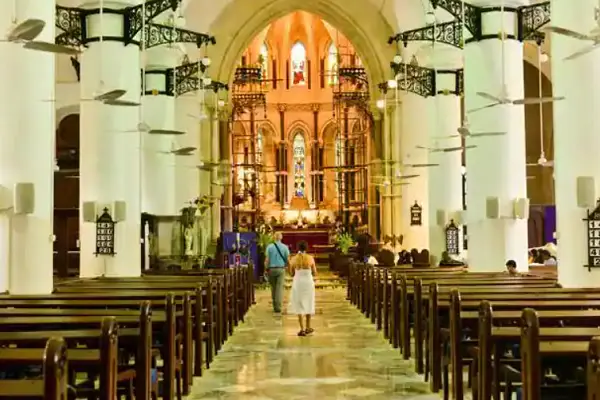
The cathedral has a white exterior and a tall tower at the western end. Because it was built, extended and remodelled over nearly two centuries, it combines more than one style; it is usually described as mixing classical and Gothic features.
Inside, look for:
- The memorials. The walls are lined with carved stone memorials from the East India Company and British Raj periods, a record of colonial Bombay’s officials, soldiers and sailors. They include a recumbent effigy of Bishop Thomas Carr by the sculptor Matthew Noble, a marble memorial to Captain George Nicholas Hardinge, who died in a naval action off Ceylon in 1808, and a plaque to the officers and crew of the steamship Cleopatra, lost off the Malabar coast in 1847.
- The royal chairs. The front-row chairs used by King George V and Queen Mary at a service here in 1911, before the Delhi Durbar, carry brass plates with their names.
- The stained glass and arched windows of the nave.
- The fountain at the entrance, designed by the architect George Gilbert Scott and paid for by the philanthropist Cowasji Jehangir Readymoney, installed in the 1870s.
The cathedral seats more than 1,200 people. Its choir has a long history: the Cathedral and John Connon School was founded in 1860 to supply choristers, and the school still holds its Founder’s Day service here on 14 November.
An earlier version of this article said the cathedral’s interior mirrors a “St Thomas Cathedral in Ireland” and that its roof was built to be cannonball-proof. We could not confirm either claim from a reliable source, so both have been removed.
Visiting St Thomas Cathedral
- Entry: there is no entry fee.
- Timings: no official visiting hours are published online. The cathedral is a working church, so avoid walking around during services, and check at the church office for current hours.
- Conduct: dress modestly, keep your voice down and ask before taking photographs inside, particularly during a service.
How to reach St Thomas Cathedral
- By suburban rail: Churchgate station, the southern terminus of the Western line, is the nearest. Chhatrapati Shivaji Maharaj Terminus (CSMT), on the Central and Harbour lines, is also within walking distance of the Fort area.
- By metro: Metro Line 3 (the Aqua Line) has stations at Hutatma Chowk and Churchgate, both close to Horniman Circle.
- By road: taxis and BEST buses serve the Fort area from across the city.
An earlier version of this article told readers to come via “M.G. Street station” and the Worli Sea Link from the south. Neither direction made sense for a church in the Fort; Churchgate and CSMT are the stations to use.
Places to visit near St Thomas Cathedral
- The Asiatic Society and Town Hall, across Horniman Circle gardens.
- Flora Fountain at Hutatma Chowk, built near the site of the old Church Gate.
- The Churchgate area, with its art deco buildings and the station.
- Jehangir Art Gallery and the Chhatrapati Shivaji Maharaj Vastu Sangrahalaya in Kala Ghoda, a short walk south.
Frequently asked questions
How old is St Thomas Cathedral?
The foundation stone was laid in 1676 and the church opened on Christmas Day 1718, making it Mumbai’s oldest Anglican church, more than 300 years old.
Is Churchgate named after St Thomas Cathedral?
Yes. Churchgate was the gate in the old fort wall through which people reached the church. The gate was demolished in the 1860s, but the name lives on in the area and the railway station.
Is there an entry fee for St Thomas Cathedral?
No. There is no entry fee, but it is a working church, so be respectful during services.
Which denomination does St Thomas Cathedral belong to?
It is the cathedral of the Diocese of Mumbai of the Church of North India, a united Protestant church that includes the former Anglican congregations in north India.
History and details in this guide were checked in October 2026 against published histories of the cathedral and records of its 2004 UNESCO conservation award. Visiting hours are not published online, so check locally before you go.