Quick answer: Jehangir Art Gallery is one of India’s best-known spaces for contemporary art, in the Kala Ghoda art district of South Mumbai, next to the Chhatrapati Shivaji Maharaj Vastu Sangrahalaya (formerly the Prince of Wales Museum). It opened on 21 January 1952 and today hosts more than 300 exhibitions a year across seven halls. Entry is free. The gallery does not publish its opening hours online, so check current exhibitions on its website or call before you visit.
Jehangir Art Gallery at a glance
| Detail | What to know |
|---|---|
| Address | 161B, Mahatma Gandhi Road, Kala Ghoda, Fort, Mumbai |
| Opened | 21 January 1952 |
| Founded by | Sir Cowasji Jehangir, 2nd Baronet, in memory of his son Jehangir |
| Entry fee | Free for visitors (jehangirartgallery.com, October 2026) |
| Exhibitions | More than 300 shows a year in seven halls; no permanent collection |
| Photography | Only with the permission of the exhibiting artist |
| Time needed | 1 to 2 hours |
Entry, photography and facility details are from the gallery’s official FAQ as read in October 2026. The gallery’s phone number and current exhibitions are listed on jehangirartgallery.com.
History of Jehangir Art Gallery
The gallery was founded with donations from Sir Cowasji Jehangir, 2nd Baronet (1879 to 1962), an industrialist, banker and patron of the arts in Bombay, in memory of his late son, Jehangir. He is generally said to have been encouraged to fund it by the painter K. K. Hebbar and the physicist Homi J. Bhabha.
B. G. Kher, then Chief Minister of Bombay, inaugurated the gallery on 21 January 1952. Over the decades it has shown the work of many leading Indian artists, including M. F. Husain, S. H. Raza, Akbar Padamsee, Ram Kumar, Anjolie Ela Menon and K. K. Hebbar. It has also given a platform to emerging artists from across India; its annual Monsoon Art Show is held especially for them.
The gallery is managed by a committee. Like most public spaces, it closed during the Covid-19 lockdown and partly reopened on 16 February 2021, after about 11 months.
Architecture
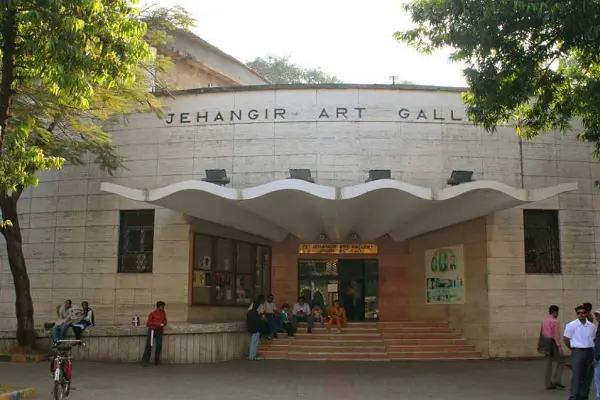
The building was designed by Durga Bajpai and is one of the early modern concrete buildings in Mumbai. Because it combines an auditorium with exhibition halls, it is turned inward rather than open to the street, an early example of the “inward-looking” modernist gallery. Its most striking feature is the large, wavy cantilevered concrete canopy over the entrance, which seems to reach out to the street. The otherwise plain facade is relieved by stone cladding.
Galleries and what to see
According to the gallery, it now has seven exhibition spaces:
- the Auditorium Hall;
- Exhibition Galleries 1, 2, 3 and 4;
- the Hirji Jehangir Gallery;
- the Terrace Art Gallery for photography and visual art.
Shows change every week or so and cover painting, sculpture, printmaking, ceramics, photography, textiles and crafts. The gallery has no permanent collection, so what you see depends on the week you visit. It puts up a programme about four months ahead on the noticeboard in its foyer and lists current and upcoming shows on its website. Works on show are often for sale by the artists, and there is a sales room in the foyer for publications and prints.
The gallery once housed Café Samovar, a well-known haunt of artists and writers that opened in 1964. The café closed on 31 March 2015, and its space was later turned into an additional exhibition gallery. An earlier version of this article listed Samovar as still operating; that was out of date. The building has also long been associated with Natesan’s, described as India’s oldest licensed antique dealer.
Rules and tips for visitors
- Photography and sketching: Allowed only with the permission of the artist who is exhibiting.
- Mobile phones: The gallery says phones may be used inside.
- Accessibility: There is a wheelchair ramp up to the foyer, but the gallery says no wheelchair is available inside.
- Parking: The gallery says there are two parking lots outside.
- Plan your visit: Check the event calendar on the website to see which shows are on.
- Look outside too: Artists often display work on the pavement outside the gallery.
Best time to visit
The gallery is indoors, so you can visit in any season; October to March is the most comfortable time to walk around Kala Ghoda. The best time of all is during the Kala Ghoda Arts Festival, a nine-day free festival of visual art, music, dance, theatre, cinema, literature and food held each year around late January and February. It has run since 1999 and is organised by the Kala Ghoda Association.
How to reach Jehangir Art Gallery
- Suburban rail: Churchgate (Western line) and Chhatrapati Shivaji Maharaj Terminus (Central and Harbour lines) are both within walking distance or a short taxi ride.
- Metro: Hutatma Chowk and Churchgate stations on Mumbai Metro Line 3 (the Aqua Line) are nearby.
- By road: Taxis and BEST buses reach Kala Ghoda from across South Mumbai.
Places to visit near Jehangir Art Gallery
- The Chhatrapati Shivaji Maharaj Vastu Sangrahalaya, Mumbai’s main museum, is next door.
- Flora Fountain at Hutatma Chowk is a short walk north.
- The Asiatic Society’s Town Hall at Horniman Circle is also within walking distance.
- Shop and eat on Colaba Causeway, just to the south.
- See the Gateway of India on the waterfront in Colaba.
Frequently asked questions
Is there an entry fee for Jehangir Art Gallery?
No. According to the gallery, entry is free for visitors to all exhibitions unless a show says otherwise.
Can I take photos inside Jehangir Art Gallery?
Only with the permission of the artist whose work is on display.
Who built Jehangir Art Gallery?
It was funded by Sir Cowasji Jehangir, 2nd Baronet, in memory of his son Jehangir, and designed by Durga Bajpai. It was inaugurated by B. G. Kher on 21 January 1952.
Does Jehangir Art Gallery have a permanent collection?
No. It is an exhibition space with changing shows, so check the event calendar before you go.
How can an artist exhibit at Jehangir Art Gallery?
Artists apply to the gallery and pay a fee to exhibit. Details and the application form are on the gallery’s website.
Details in this guide were checked in October 2026 against Jehangir Art Gallery’s official website and FAQ, and published histories of the gallery and the Kala Ghoda Arts Festival. Exhibitions change weekly, so check the calendar before visiting.