Quick answer: The Hanging Gardens, officially the Pherozeshah Mehta Gardens, are terraced public gardens on top of Malabar Hill in South Mumbai, laid out in 1881 over one of the city’s main water reservoirs. They are known for animal-shaped hedges, flower beds and views over Back Bay and Marine Drive, and Kamala Nehru Park lies just opposite. The garden is run by the Brihanmumbai Municipal Corporation (BMC), which does not publish its hours online; a long-debated plan to rebuild the reservoir underneath could affect access, so check locally before you go.
Hanging Gardens at a glance
| Detail | What to know |
|---|---|
| Official name | Pherozeshah Mehta Gardens |
| Location | Top of Malabar Hill (western side), opposite Kamala Nehru Park, South Mumbai |
| Laid out | 1881, over the Malabar Hill reservoir |
| Managed by | Brihanmumbai Municipal Corporation (BMC) |
| Timings and entry | Not published online by the BMC; check at the gate |
| Best time to visit | November to February, early morning or around sunset |
| Time needed | About 1 hour; longer with Kamala Nehru Park |
The reservoir plan: check before you go
The garden sits on top of the Malabar Hill reservoir, which supplies water to large parts of South Mumbai. By 2023 the BMC had proposed rebuilding the old reservoir and adding a new one, a project reported to cost around ₹400 crore and take about seven years. Press reports at the time said the work could mean closing all or part of the Hanging Gardens and cutting or moving a few hundred trees. Residents and heritage groups objected, and expert committees, including one from IIT Bombay and another representing citizens, were asked to assess whether the reservoir needed rebuilding or only repair. In January 2024 the BMC said it had not yet taken a final decision.
We could not confirm the project’s status as of October 2026. If you are planning a visit, ask locally or check recent Mumbai news to see whether any part of the garden is closed.
History of the Hanging Gardens
The gardens were laid out in 1881 on top of the reservoir that was then Bombay’s main water supply. One common explanation for covering the reservoir with a garden is that it shielded the water from possible contamination from the nearby Towers of Silence, the Parsi funeral grounds on Malabar Hill.
The garden is named after Sir Pherozeshah Mehta, the Bombay lawyer and civic leader. When seen from the air, the paths inside the garden are said to spell out “PMG”, for Pherozeshah Mehta Gardens. The popular name “Hanging Gardens” comes from the way the terraces sit on the hilltop.
The old version of this article named the garden’s designer as “Ulhas Ghapokar”. We could not find a reliable source for that name, so it has been removed.
What to see at the Hanging Gardens
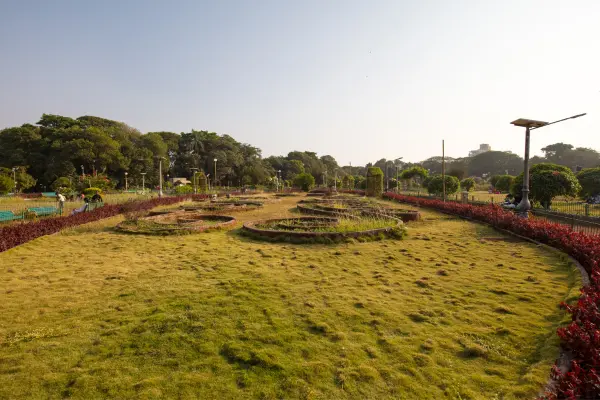
- Topiary. Hedges clipped into the shapes of animals are the garden’s best-known feature and a favourite with children.
- Flower beds and lawns. Neatly kept beds and paths make it a pleasant place for a morning walk.
- Sunset and city views. From the edge of the hill, there are views over the Arabian Sea and across Back Bay towards Marine Drive and Girgaon Chowpatty.
- Kamala Nehru Park. Across the road, this smaller park is known for its giant “boot house” that children can climb into, and for its view over Marine Drive.
- Photography. The garden is popular for photographs, including pre-wedding shoots. If you plan a professional shoot, ask the garden staff about permissions first.
Tips for visiting
- Go early or late. Mornings are cooler and quieter; evenings bring the sunset but more visitors.
- Combine with Malabar Hill. The temples, the Banganga Tank and Kamala Nehru Park are all nearby.
- Respect the rules. Do not pick flowers or walk on beds, and follow any instructions from garden staff.
- Weather: Mumbai summers are hot and the monsoon (roughly June to September) brings heavy rain, so November to February is the most comfortable time.
The old version of this article recommended several named restaurants near the garden, with distances. We could not confirm that they still operate, so they have been removed. There are snack stalls and restaurants around Malabar Hill, Walkeshwar and Girgaon Chowpatty.
How to reach the Hanging Gardens
- Suburban rail: Grant Road and Charni Road on the Western line are the closest suburban stations; from either, take a taxi up Malabar Hill.
- Metro: Girgaon station on Mumbai Metro Line 3 (the Aqua Line) is near the foot of the hill, by Girgaon Chowpatty.
- By road: Taxis, app cabs and BEST buses go up Malabar Hill. Parking near the garden is limited.
Places to visit near the Hanging Gardens
- The Babulnath Temple, an old Shiva temple on a hillock above Girgaon Chowpatty.
- Girgaon Chowpatty, the beach at the foot of Malabar Hill, best in the evening.
- Mani Bhavan, the house where Mahatma Gandhi stayed in Mumbai, now a museum.
- For the wider area, see our guide to Malabar Hill.
- Marine Drive, the seafront promenade you can see from the garden.
Frequently asked questions
What is the official name of the Hanging Gardens?
The Hanging Gardens are officially the Pherozeshah Mehta Gardens, named after Sir Pherozeshah Mehta.
Why are they called the Hanging Gardens?
The name comes from the terraced gardens perched on the top of Malabar Hill, built over a reservoir.
Are the Hanging Gardens closed for the reservoir work?
The BMC has proposed rebuilding the reservoir beneath the garden, which could close all or part of it, but we could not confirm the current status in October 2026. Check locally before you go.
What is opposite the Hanging Gardens?
Kamala Nehru Park, a smaller park known for its “boot house” and view over Marine Drive.
When were the Hanging Gardens built?
They were laid out in 1881 over the Malabar Hill reservoir.
History and the reservoir update in this guide were checked in October 2026 against published records of the Hanging Gardens and press reports on the Malabar Hill reservoir project from 2023 and 2024. The BMC does not publish garden timings online, so check locally before visiting.