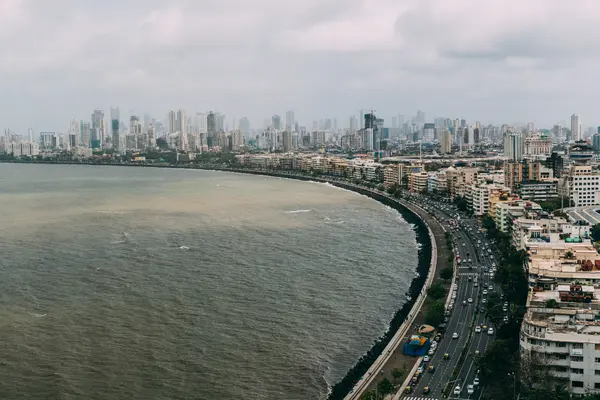
Quick answer: Marine Drive is Mumbai’s famous seafront promenade, a curving six-lane road of about 3 km along Back Bay in South Mumbai, running from Nariman Point to Girgaon Chowpatty. Its streetlights look like a string of pearls at night, which earned it the name “Queen’s Necklace”, and the Art Deco buildings along it are part of a UNESCO World Heritage Site inscribed in 2018. It is an open public road and promenade, free and accessible at all hours.
Marine Drive at a glance
| Detail | What to know |
|---|---|
| Official name | Netaji Subhash Chandra Bose Road |
| Location | South Mumbai, along Back Bay, from Nariman Point (south) to Girgaon Chowpatty (north) |
| Length | About 3 km |
| Heritage status | Its Art Deco buildings are part of the UNESCO World Heritage Site “Victorian Gothic and Art Deco Ensembles of Mumbai” (2018) |
| Timings | Open at all hours |
| Entry fee | None |
| Best time to visit | Sunset and after dark; November to February for cooler weather |
| Time needed | One to two hours for a walk from end to end |
Why it is called the Queen’s Necklace
Marine Drive curves around Back Bay in a long arc. At night its streetlights form a glowing curve that, seen from a height such as Malabar Hill, looks like a string of pearls; hence the nickname “Queen’s Necklace”. The road is officially Netaji Subhash Chandra Bose Road, though hardly anyone calls it that.
History of Marine Drive
Marine Drive is built on land reclaimed from the sea. The first attempt to reclaim Back Bay began in the 1860s, but the reclamation company collapsed after the Bombay stock-market crash of 1865, which followed the end of the cotton boom caused by the American Civil War. The strip that had been reclaimed went to the railway for its line to Colaba.
A new Back Bay Reclamation scheme started around 1920. It ran into delays, cost overruns and allegations of financial irregularity, and became known as “Lloyd’s Folly” after the Governor of Bombay, Sir George Lloyd. By 1929, four blocks covering about 440 acres had been reclaimed, far less than planned. The road and promenade along the new shoreline became Marine Drive; the Girgaon end was earlier known as Kennedy Sea Face. Published sources give different dates for when the road and promenade were built, ranging from work beginning around 1915 to completion as late as about 1940, so we have not given a single year.
An earlier version of this article said only 17 acres of a planned 1,500 acres became Marine Drive, and that locals still call it “Sonapur”. We could not confirm either claim, so we have removed them.
The Art Deco buildings
In the late 1930s and 1940s, rows of apartment buildings in the Art Deco style went up along the new seafront, many designed by Indian architects. Among the earliest are Kapur Mahal, Zaver Mahal and Keval Mahal, built between 1937 and 1939. On 30 June 2018, UNESCO inscribed the “Victorian Gothic and Art Deco Ensembles of Mumbai” as a World Heritage Site. The site sets the 19th-century Victorian Gothic public buildings on the east side of the Oval Maidan against the 20th-century Art Deco buildings on the west side, along the Back Bay Reclamation and Marine Drive. In all, the nomination covers 94 buildings.
Recent changes: the Coastal Road
Marine Drive is now the southern end of the Mumbai Coastal Road, officially the Dharmaveer Swarajya Rakshak Chhatrapati Sambhaji Maharaj Coastal Road. Its southbound arm from Worli to Marine Drive opened on 11 March 2024, and twin tunnels of about 2 km run from Marine Drive to Priyadarshini Park. A stretch of the Marine Drive footpath taken over during construction has since been restored by the Brihanmumbai Municipal Corporation (BMC).
The tetrapods
The concrete tetrapods piled along the sea wall break the force of the waves and protect the promenade. An earlier version of this article said they were imported from Australia in 1958 and gave figures for their number, weight and cost. We could not confirm any of these details, so we have removed them.
Things to do on Marine Drive
- Walk the promenade at sunset. The sea wall faces west across Back Bay, and the walk from Nariman Point to Chowpatty is one of Mumbai’s classic evening experiences.
- See the Queen’s Necklace at night. For the full curve of lights, view it from the Malabar Hill end.
- Look at the Art Deco buildings. The seafront apartment blocks, with their curved balconies and decorative details, are part of the UNESCO site.
- Snack at Girgaon Chowpatty. At the northern end, Chowpatty’s beach is known for evening crowds and food stalls. The water is not safe for swimming. See our Girgaon Chowpatty guide.
- Catch a show at the NCPA. At the Nariman Point end, the National Centre for the Performing Arts (NCPA), inaugurated in 1969 and conceived by J.R.D. Tata and Dr Jamshed Bhabha, describes itself as South Asia’s first multi-venue, multi-genre cultural centre. It hosts music, dance, theatre and film across five theatres.
- Climb Malabar Hill. The terraced Hanging Gardens (Pherozeshah Mehta Gardens) on Malabar Hill offer a view over Marine Drive; see our Hanging Garden guide.
An earlier version of this article recommended visiting the Taraporewala Aquarium on Marine Drive. The aquarium has been closed since the COVID-19 period and is awaiting redevelopment, so check its status before planning a visit. The earlier version also mentioned a Maharashtra Tourism open-deck bus tour; we could not confirm that it still runs.
Tips for visiting
- Sit on the sea wall but do not climb down on to the tetrapods; they are slippery and waves can be dangerous, especially in the monsoon.
- During monsoon high tides, waves break over the wall. The BMC publishes high-tide dates each year and asks people to keep away from the seafront at those times; on some alert days in past seasons, access to Marine Drive has been restricted.
- Marine Drive also hosts big public events, such as the annual Mumbai Marathon and Indian Air Force air shows (most recently in January 2024), when roads are closed and crowds are heavy.
How to reach Marine Drive
- Suburban rail: Churchgate (Western line) is close to the southern half; Marine Lines and Charni Road are close to the middle and northern end.
- Metro: On Metro Line 3 (Aqua Line), Churchgate and Vidhan Bhavan stations are near the southern half and Girgaon station is near the Chowpatty end.
- Bus and taxi: Many BEST buses run along Marine Drive, and taxis are easy to find.
Places to visit nearby
- Nariman Point: The business district at the southern end; see our Nariman Point guide.
- Wankhede Stadium: The international cricket ground behind Marine Drive, now with a cricket museum; see our Wankhede Stadium guide.
- Babulnath Temple: The old Shiva temple at the foot of Malabar Hill; see our Babulnath Temple guide.
Frequently asked questions
Why is Marine Drive called the Queen’s Necklace?
Because its curving line of streetlights looks like a string of pearls at night when seen from a height, such as Malabar Hill.
What is the official name of Marine Drive?
Netaji Subhash Chandra Bose Road.
Is Marine Drive a UNESCO World Heritage Site?
Its Art Deco buildings are part of the “Victorian Gothic and Art Deco Ensembles of Mumbai” World Heritage Site, inscribed by UNESCO in 2018.
How long is Marine Drive?
About 3 km, from Nariman Point to Girgaon Chowpatty.
Is there an entry fee or closing time?
No. Marine Drive is a public road and promenade, free and open at all hours, though access can be restricted during monsoon high tides, weather alerts and major events.
Details checked in October 2026 against published records of Marine Drive and the Back Bay Reclamation, UNESCO’s 2018 inscription as recorded in published sources, the NCPA’s official website and reporting on the Mumbai Coastal Road. Access rules change with the weather and events, so follow local instructions.