Quick answer: The Elephanta Caves are a UNESCO World Heritage Site of rock-cut cave temples on Elephanta Island (Gharapuri) in Mumbai Harbour, about 10 km east of the Gateway of India. Their centrepiece is the huge three-headed Shiva sculpture, the Maheshmurti, in Cave 1. As of October 2026, the Archaeological Survey of India (ASI) lists the caves as open from 9 am to 5 pm and closed on Mondays; the only way to get there is by ferry.
Elephanta Caves at a glance
| Detail | What to know |
|---|---|
| Location | Elephanta Island (Gharapuri), Uran taluka, Raigad district, in Mumbai Harbour |
| Status | UNESCO World Heritage Site (1987); maintained by the ASI’s Mumbai Circle |
| Timings | 9 am to 5 pm (ASI, October 2026) |
| Closed on | Monday |
| Entry fee | Foreign visitors ₹600 (₹550 online); SAARC and BIMSTEC citizens ₹40 (₹35 online); children under 15 free. Check the Indian-citizen rate on the ASI e-ticket site. |
| Best time to visit | October to March, when the weather is cooler and the sea calmer |
| Time needed | Half a day including the ferry ride |
Fees above are from the ASI’s Elephanta Caves page as read in October 2026. That page did not clearly show the rate for Indian citizens; at most ASI World Heritage sites Indian visitors pay the same rate as SAARC and BIMSTEC visitors, but confirm on the ASI’s online ticketing site or at the counter before you go.
What are the Elephanta Caves?
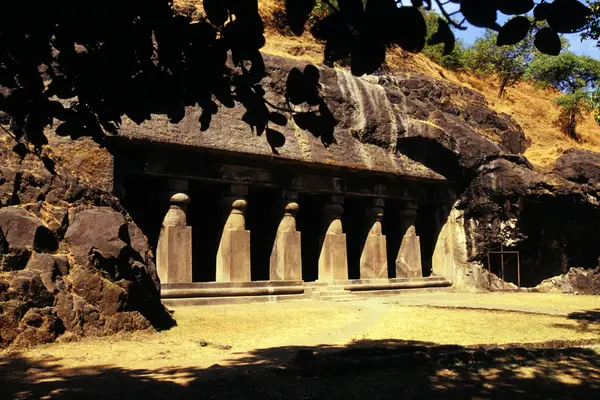
The Elephanta Caves are a group of seven rock-cut caves carved into basalt hills on Elephanta Island. They fall into two groups:
- Five Hindu caves (Caves 1 to 5) on the western hill, sometimes called Cannon Hill, dedicated to Shiva.
- Two Buddhist caves (Caves 6 and 7) on the eastern hill, known as Stupa Hill, along with the remains of a stupa.
Cave 1, the Great Cave, is by far the most important and the best preserved. Many sculptures across the site were damaged over the centuries, but what survives in the Great Cave is among the finest rock-cut art in India.
History of the Elephanta Caves
Who built the caves, and when?
No inscription records who made the caves, so their date and patron are still debated. The ASI dates them to about the 6th to 7th centuries CE. Many historians credit the Kalachuri dynasty, and in particular King Krishnaraja, while older theories pointed to the Chalukyas of Badami or the Rashtrakutas. The ASI notes that the island later passed through the hands of many powers, including the Konkan Mauryas, Chalukyas, Silaharas, Rashtrakutas, Yadavas, the sultans of Gujarat, the Portuguese, the Marathas and finally the British.
How the island got the name “Elephanta”
The island’s local name is Gharapuri, usually translated as “city of caves”. The Portuguese, who took control in the 16th century, named it Elephanta after a large stone elephant they found near the landing place. That elephant was later moved to the mainland; damaged during an attempt to ship it to England, it was reassembled and now stands in the Jijamata Udyan (Byculla), outside the Dr Bhau Daji Lad Museum.
Damage and restoration
The caves suffered serious damage during the Portuguese period, and by the time the island passed to the British in the 17th century many sculptures were broken. British officials began protecting the site in 1909. In the 1970s the Government of India restored the Great Cave and repaired other caves. UNESCO inscribed the Elephanta Caves as a World Heritage Site in 1987.
What to see at the Elephanta Caves
Cave 1: the Great Cave
The Great Cave has its main entrance on the north, with further openings on the east and west. Inside is a large pillared hall. Key sculptures include:
- The Maheshmurti (Trimurti): a colossal three-headed bust of Shiva on the south wall, facing the main entrance. It is usually described as roughly 6 to 7 metres (about 20 feet) high. The three faces are commonly read as Shiva in his creative, protective and destructive aspects.
- The linga shrine: a square shrine towards the west of the hall, with a Shiva linga inside and large door-guardian (dvarapala) figures at its entrances.
- Large relief panels showing stories of Shiva, including Nataraja (Shiva as cosmic dancer), Yogishvara (Shiva as lord of yoga), Ardhanarishvara (half Shiva, half Parvati), Gangadhara (Shiva receiving the river Ganga), Ravana shaking Mount Kailash, and the marriage of Shiva and Parvati.
Caves 2 to 5
The smaller Hindu caves near the Great Cave have pillared halls (mandapas), but they are less elaborate and several are badly damaged or unfinished.
Caves 6 and 7 on Stupa Hill
Cave 6, also called the Sitabai temple, has a hall with three chambers at the back, the central one a shrine. Cave 7 nearby is incomplete. These Buddhist caves, with the stupa remains, show the island’s older Buddhist history.
Cannon Hill and the site museum
A path from the main cave group leads up Cannon Hill, where old cannons stand and there are views across the harbour towards the Mumbai skyline. A small site museum near the ticket counter explains the caves and their sculptures.
How to reach the Elephanta Caves
Elephanta can only be reached by boat. Ferries leave from the Gateway of India in Colaba, and the crossing takes about an hour. From the island jetty you walk (or take a small tourist toy train) to the foot of the hill, then climb about 120 steps to the caves. The caves are closed on Mondays, so plan your trip for another day. Ferry services can stop at short notice in rough weather, especially during the monsoon.
For ferry timings, the island’s villages, food and a suggested half-day plan, see our guide to visiting Elephanta Island.
Tips for visiting
- Go early. Taking one of the first ferries gives you more time in the caves before the midday heat and crowds.
- Wear good shoes. The climb is on steps lined with stalls, and the cave floors are uneven.
- Carry water and a hat. There is little shade on the way up.
- Do not touch the sculptures. They are fragile and protected under Indian law.
- Photography: Check at the ticket counter for the current rules and any charges for video cameras and tripods.
Nearby places
- Ferries leave from the Gateway of India, so you can see the monument before or after your trip.
- Mumbai’s other great cave site is Kanheri Caves, a Buddhist complex inside Sanjay Gandhi National Park.
- To see Indian sculpture in a museum setting, visit the Chhatrapati Shivaji Maharaj Vastu Sangrahalaya, a short walk from the Gateway.
Frequently asked questions
Are the Elephanta Caves open on Monday?
No. The ASI lists the caves as closed on Mondays. They are open from 9 am to 5 pm on other days.
How old are the Elephanta Caves?
The ASI dates them to about the 6th to 7th centuries CE, which makes them roughly 1,400 years old. Some scholars place them a little earlier, in the 5th to 6th centuries.
Who built the Elephanta Caves?
No inscription names the builders. Many historians attribute them to the Kalachuri dynasty, especially King Krishnaraja, though the Chalukyas and Rashtrakutas have also been suggested.
Why is it called Elephanta?
The Portuguese named the island after a large stone elephant found near the landing place. The elephant now stands in the Jijamata Udyan in Byculla, Mumbai.
How many caves are there at Elephanta?
Seven: five Hindu caves on the western hill and two Buddhist caves on the eastern hill. Cave 1, the Great Cave, is the main attraction.
Timings, fees and history in this guide were checked in October 2026 against the Archaeological Survey of India’s Elephanta Caves page and published histories of the site. Ferry services and fees change, so check before you travel.