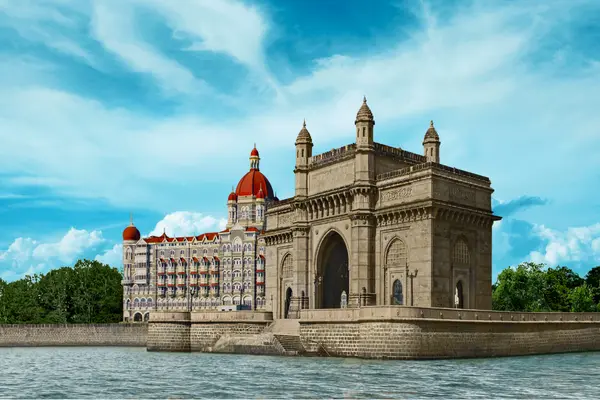
Quick answer: The Gateway of India is a 26-metre basalt arch on the Apollo Bunder waterfront in Colaba, South Mumbai, built to commemorate the landing of King George V and Queen Mary in December 1911 and opened in 1924. It is an open-air monument with no entry ticket, and the waterfront plaza is the departure point for ferries to Elephanta Island. Security is tight around the monument, and you can view the arch from the plaza but not enter it.
Gateway of India at a glance
| Detail | What to know |
|---|---|
| Location | Apollo Bunder, Colaba, South Mumbai, facing Mumbai Harbour |
| Built | Foundation stone 31 March 1913; completed 1924; opened 4 December 1924 |
| Architect | George Wittet |
| Height | 26 metres (85 feet) |
| Entry fee | None |
| Protected by | Department of Archaeology and Museums, Government of Maharashtra |
| Best time to visit | Early morning or evening, October to March |
| Time needed | 30 minutes to an hour (longer with a harbour boat ride) |
History of the Gateway of India
King George V and Queen Mary landed at Apollo Bunder on 2 December 1911, on their way to the Delhi Durbar. It was the first visit to India by a reigning British monarch. The city decided to build a permanent monument on the spot to mark the occasion.
The Governor of Bombay, Sir George Sydenham Clarke, laid the foundation stone on 31 March 1913. George Wittet’s final design was approved in August 1914, but building work only started around 1915. The foundations were finished in 1920 and the arch in 1924, at a cost of about ₹21 lakh. The Viceroy, Lord Reading, opened it on 4 December 1924.
An earlier version of this article said the foundation stone was laid in 1911, the same year as the royal visit. That is not correct; it was laid in 1913.
The end of British rule
The Gateway also marks the end of the Raj. On 28 February 1948, the last British troops in India, the First Battalion of the Somerset Light Infantry, marched through the arch to board ships home.
The Gateway area since then
In 1961 a statue of Chhatrapati Shivaji Maharaj was unveiled on the waterfront nearby, and a statue of Swami Vivekananda also stands in the area. The Taj Mahal Palace hotel, opened in 1903, faces the Gateway across the plaza. Security around the monument was tightened after the 2008 Mumbai attacks.
Architecture
The Gateway was designed by George Wittet, the Scottish architect who also designed the Prince of Wales Museum (now the Chhatrapati Shivaji Maharaj Vastu Sangrahalaya). It is a triumphal arch in the Indo-Saracenic style, mixing Indian and Islamic design with European elements, with clear influences from Gujarati architecture.
- The arch is 26 metres (85 feet) high, and its central dome is about 15 metres (49 feet) in diameter.
- It is built of yellow basalt with reinforced concrete, which gives it its golden-brown colour.
- Four turrets and intricate latticework (jali) decorate the structure. The lattice screens cast patterned shadows inside the arch.
- Visitors can walk around the arch, but are not allowed inside the structure.
Conservation and current works
The Gateway is not an ASI monument. In 2023 the Union Ministry of Culture told the Lok Sabha that the Gateway is protected by Maharashtra’s Department of Archaeology and Museums. An inspection had found a few cracks on the surface, though the structure was in a good overall state of preservation, and the state approved a conservation and repair estimate of nearly ₹9 crore in March 2023.
Separately, the state is building a new passenger jetty and terminal near the Radio Club in Colaba, close to the Gateway. In 2025 the Bombay High Court dismissed residents’ challenges to the project, and the Supreme Court declined to interfere. The project was expected to take about 30 months. Once it opens, some ferry departures from the Gateway area may move to the new jetty.
Things to do at the Gateway of India
- Take the ferry to Elephanta. Boats to Elephanta Island and the UNESCO-listed Elephanta Caves leave from the jetties beside the Gateway (the caves are closed on Mondays).
- Go on a harbour ride. Short boat trips around the harbour also leave from the Gateway jetties. Agree the price and duration before boarding, and wear a life jacket.
- Watch the sunset and the lights. The Gateway is lit up after dark, and on special occasions it is illuminated in themed colours, such as the tricolour around national days.
- Photograph it. Professional photographers on the plaza offer instant photos for a fee; agree the price first.
- Explore Colaba. Walk to Colaba Causeway for street shopping and cafés, or to the Kala Ghoda art district.
An earlier version of this article recommended specific yacht parties, sailing classes and water-sports operators. We could not verify these, so they have been removed. If you book a private boat, use a licensed operator.
How to reach the Gateway of India
- Suburban rail: Churchgate (Western line) and Chhatrapati Shivaji Maharaj Terminus (CSMT, Central and Harbour lines) are the nearest major stations. Take a taxi or bus from either.
- Metro: Mumbai Metro Line 3 (the Aqua Line) runs through South Mumbai, with stations including Churchgate, Hutatma Chowk and CSMT; the Gateway is a taxi ride from these.
- By road: Taxis and app cabs drop you near the Gateway. Vehicle access to the plaza itself is restricted.
Tips for visiting
- Visit early in the morning or in the evening to avoid the midday heat.
- Security is tight around the Gateway, so carry as little as you can.
- Weekends and holidays are crowded, particularly in the evening.
- Keep an eye on your belongings in crowds.
Frequently asked questions
Is there an entry fee for the Gateway of India?
No. The Gateway is an open-air monument, and visiting the plaza is free. Ferries and boat rides from the jetties are paid separately.
Why was the Gateway of India built?
To commemorate the landing of King George V and Queen Mary at Apollo Bunder on 2 December 1911, the first visit to India by a reigning British monarch.
Who designed the Gateway of India?
The Scottish architect George Wittet. The foundation stone was laid in 1913 and the monument was opened in 1924.
How tall is the Gateway of India?
About 26 metres (85 feet), with a central dome about 15 metres in diameter.
Can you go inside the Gateway of India?
No. You can walk around the plaza and view the arch, but visitors are not allowed inside the structure.
Details checked in October 2026 against published records of the monument, the Union Culture Ministry’s 2023 reply to the Lok Sabha as reported in the press, and court reporting on the Radio Club jetty. Security arrangements and ferry points can change, so check before visiting.