There are six national parks in Uttarakhand: Corbett, Rajaji, Nanda Devi, Valley of Flowers, Gangotri and Govind. Every official register we read gives the same six, including the state Forest Department’s newest statistics book (Uttarakhand Forest Statistics 2023-24, dated November 2025), which puts their combined area at about 5,028 km².
Where lists disagree is on areas and years. The department’s own web page still shows older figures, and two parks, Rajaji and Govind, received their final notifications decades after their first ones. This guide gives each park’s district, area and dates from the department’s tables, explains the Govind park-and-sanctuary confusion, and covers the official booking sites, seasons and prices as we read them on 20 November 2026.
Key takeaways
- Six national parks: Gangotri (the largest, 2,390.02 km²), Rajaji, Nanda Devi, Govind, Corbett and Valley of Flowers (the smallest, 87.5 km²).
- Corbett began in 1936 as Hailey National Park, and its official site calls it the first national park in India.
- Nanda Devi and Valley of Flowers together form one UNESCO World Heritage Site, inscribed in 1988 and extended in 2005.
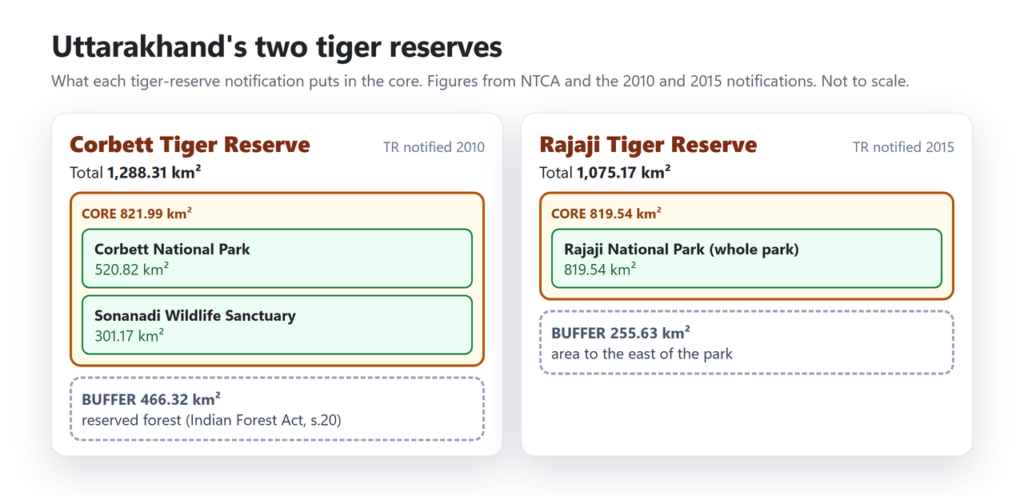
- Corbett and Rajaji national parks sit in the state’s two tiger reserves (1,288.31 km² and 1,075.17 km² on NTCA’s list). Rajaji park is the whole core of its reserve; Corbett’s core also includes Sonanadi sanctuary.
- Govind National Park and Govind Wildlife Sanctuary are two separate protected areas. The often-quoted 958 km² is both together.
- Book Corbett on corbettgov.org and Rajaji on rajajitigerreserve.uk.gov.in. The Valley of Flowers site linked by the department did not load when we checked.
List of national parks in Uttarakhand
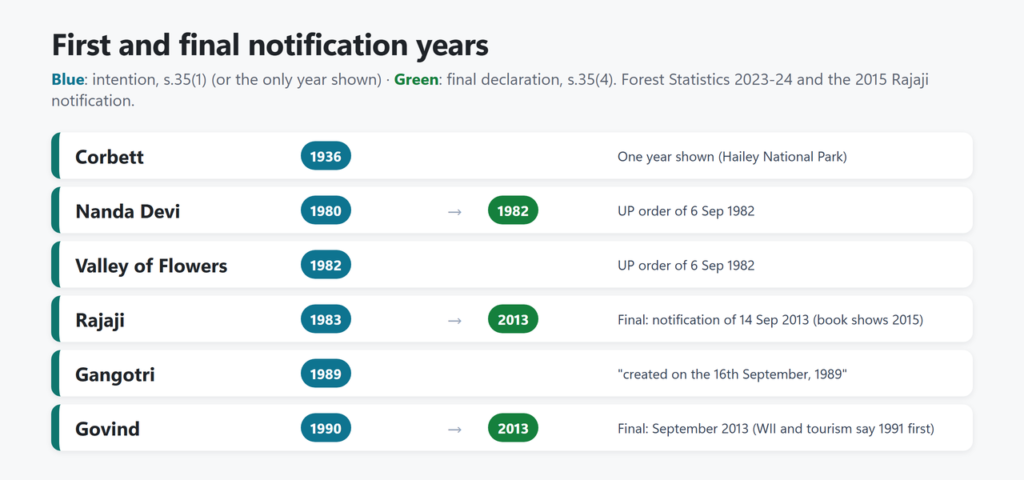
The Forest Department’s 2023-24 statistics book (Table 7.1.1) lists the six parks with two notification columns: section 35(1), when the state announced its intention, and section 35(4), the final declaration under the Wild Life (Protection) Act, 1972. Where the book shows a single year across both columns, we show one year.
| National park | District(s) | Area | Notification year(s) |
|---|---|---|---|
| Corbett | Garhwal, Nainital | 520.82 km² | 1936 |
| Nanda Devi | Chamoli | 630.00 km² | 1980 intention, 1982 final |
| Valley of Flowers | Chamoli | 87.50 km² | 1982 |
| Rajaji | Haridwar, Dehradun, Garhwal | 840.80 km² | 1983 intention; final 14 Sep 2013 (book prints 2015) |
| Gangotri | Uttarkashi | 2,390.02 km² | 1989 |
| Govind | Uttarkashi | 558.88 km² | 1990 intention, 2013 final |
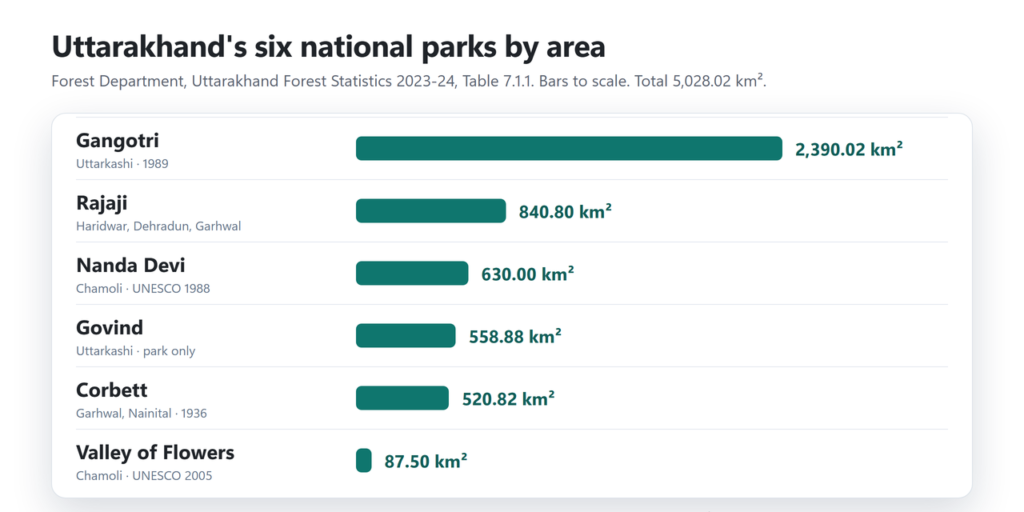
Many lists (and the department’s web page) show older areas: Nanda Devi 624.60 km², Rajaji 820.42 km² and Govind 472.08 km², for a total of 4,915.44 km². Those match the department’s 2011-12 statistics. Rajaji and Govind both had final notifications in 2013, and a 2016 department order says Govind’s final notification changed the boundaries and area of both the park and the sanctuary. But no source we read explains the exact 2023-24 figures: Rajaji’s own 2013 final notification gives 819.54 km², not 840.80 km², and nothing explains Nanda Devi’s 630.00 km².
The six parks at a glance
Corbett National Park
Corbett’s official site says the park was “originally established as Hailey National Park in 1936” and calls it “the first national park in India”. Its timeline shows it was renamed Ramganga National Park in 1954-55 and Corbett National Park in 1956, after Jim Corbett, and that its area grew to 520.82 km² in 1966. The 2010 tiger-reserve notification records that 1966 enlargement as a notification under section 5 of the Uttar Pradesh National Park Act, 1935. The site’s timeline dates the launch of Project Tiger at Corbett to 1 April 1973 (the same page also says 1974).
The department’s statistics put the park in Garhwal and Nainital districts. The zone pages name Ramnagar as the nearest city, with Ramnagar railway station and bus stand. The department’s 2023-24 visitor table records 3,44,655 visitors for Corbett Tiger Reserve (the reserve, not the park alone), the highest row in that table. Corbett also appears in our overview of the best national parks in India.
Rajaji National Park
Rajaji’s official site says the intention notification came in 1983, merging the Rajaji, Motichur and Chilla sanctuaries, and that the park was named after C. Rajagopalachari. The 2015 tiger-reserve notification says the park, 819.54 km², was finally declared by a notification dated 14 September 2013. The 2023-24 statistics book gives 2015 as its final year instead, which is the year of the tiger-reserve notification, so treat 2013 as the date of the final park declaration.
Nanda Devi National Park
In Chamoli district, Nanda Devi “came into being” by a Uttar Pradesh order dated 6 September 1982, according to a 2018 Ministry of Environment notification, which gives its area as about 624.62 km² and its World Heritage listing as 1988. The same notification says the park “comprises of 16 magnificent peaks”. The department recorded only 12 visitors to it in 2023-24, and we found no official permit page.
Valley of Flowers National Park
Also in Chamoli, the 87.5 km² Valley of Flowers was created by a Uttar Pradesh order dated 6 September 1982, a 2015 Ministry of Environment draft notification says. It describes about 300 species flowering “from May to October” and calls the valley the second core zone of the Nanda Devi Biosphere Reserve. The notification places Ghangaria (Bhyundar valley) to its south. It had 13,181 visitors in 2023-24.
Gangotri National Park
Gangotri, in Uttarkashi district, “was created on the 16th September, 1989 and covers an area of 2390.02 square kilometers”, says a 2019 Ministry of Environment notification. It adds that Gaumukh, the glacier where the Ganga begins, lies inside the park, and names snow leopard, musk deer, bharal (blue sheep) and Himalayan tahr among its animals. One state tourism page gives 1,553 km², which conflicts with every Forest Department and ministry figure we read. The department recorded 33,180 visitors in 2023-24.
Govind National Park
Govind is the source of most confusion. The upper Tons valley in Uttarkashi has two protected areas: Govind Wildlife Sanctuary (also called Govind Pashu Vihar), first notified in 1955, and Govind National Park, first notified in 1990 by the department’s tables (the Wildlife Institute of India and the state tourism site say 1991). Both received final notifications in September 2013, according to the 2016 department order. The 958 km² figure in many lists is the park and sanctuary together; the park alone is 558.88 km² in the 2023-24 book. The 2023-24 visitor table lists 21,387 visitors under the sanctuary’s name.
Is Corbett India’s first national park?
Yes, in the official sources we read: the Corbett Tiger Reserve site and the Forest Department’s wildlife page both describe it as the first national park of India, established in 1936. The Corbett site also calls it “mainland Asia’s first National Park” on the same page, so wording varies. For exams, “India’s first national park, established in 1936 as Hailey National Park” matches the official site.
Tiger reserves and the UNESCO site
Uttarakhand has two tiger reserves, and each contains a national park. NTCA’s list (last updated 19 November 2026) gives these figures:
| Tiger reserve (notified) | Core | Buffer | Total |
|---|---|---|---|
| Corbett (2010) | 821.99 km² | 466.32 km² | 1,288.31 km² |
| Rajaji (2015) | 819.54 km² | 255.63 km² | 1,075.17 km² |
The Corbett notification of 2010 lists Corbett National Park (520.82 km²) and Sonanadi Wildlife Sanctuary (301.17 km²) as the core, which together make 821.99 km². The Rajaji notification of 2015 says the core is the whole of Rajaji National Park and the buffer lies to the east of it. One Rajaji zone page on its own site says the reserve was declared in 2017; its About page and NTCA both say 2015.
The UNESCO World Heritage Site is named “Nanda Devi and Valley of Flowers National Parks”. The Ministry of Culture’s list (via PIB, July 2024) gives the years of inscription as 1988 and 2005: Nanda Devi first, then the extension to Valley of Flowers. This is a World Heritage listing, separate from the Nanda Devi Biosphere Reserve, which Uttarakhand Tourism and a 2015 ministry notification describe as having the two parks as its core zones.
How to visit the national parks in Uttarakhand
The Forest Department’s “Online Booking” menu links these sites. Type them yourself; do not pay through a site that is not on the department’s list.
| Park | Official site (department menu) | What we found |
|---|---|---|
| Corbett | corbettgov.org | Live; jeep, canter and stay booking |
| Rajaji | rajajitigerreserve. | Live; safari booking and tariff |
| Nanda Devi, Valley of Flowers | valleyofflower. | Did not load on 20 November 2026 |
| Govind | gwsandnp.in | Did not load on 20 November 2026 |
| Gangotri | No booking link in the menu | No official page found; the mountaineering portal did not load |
Corbett: zones, seasons and prices
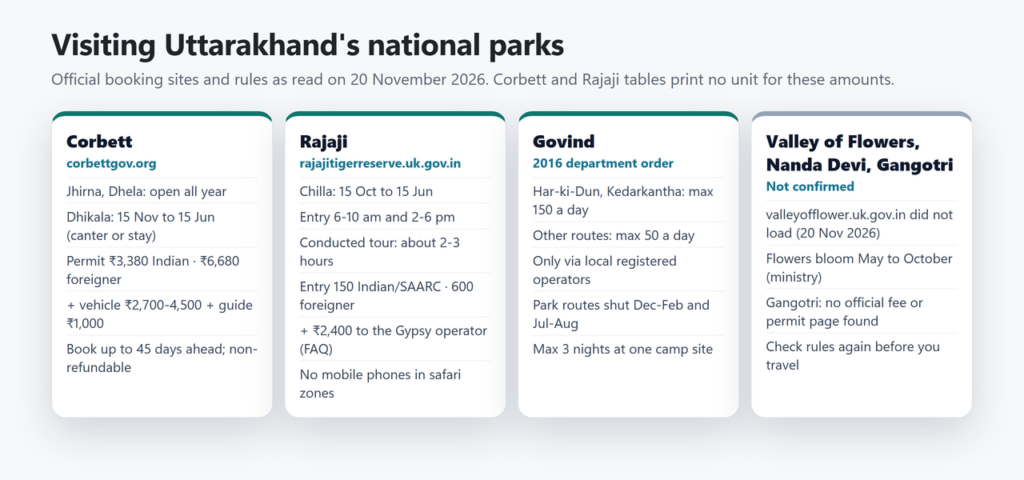
Corbett has eight tourism zones. Its booking rules say jeep safaris can be booked up to 45 days ahead, a permit covers up to six people (including up to two children under 12), private vehicles are not allowed, and tickets are non-refundable. Dhikala has no day-safari permits; visitors go by the canter (a 16-seat bus) or stay overnight.
- Jhirna and Dhela: open through the year, the site says (Jhirna “subject to road and weather conditions”).
- Dhikala: 15 November to 15 June; closed in the monsoon.
- Bijrani, Garjia, Durgadevi, Sonanadi, Pakhro: closed for the monsoon. The site’s own pages disagree on opening and closing dates (opening mid-October or mid-November, closing 15 or 30 June, depending on the page), so check the booking calendar.
| Day safari (corbettgov.org) | Amount |
|---|---|
| Permit, Indian | ₹3,380 |
| Permit, foreigner | ₹6,680 |
| Vehicle charge | ₹2,700 to ₹4,500, by zone |
| Guide charge | ₹1,000 |
The site lists discounts for Indian senior citizens (₹250 per person) and students aged 12 to 18 (₹375 per person), and charges OCI card holders and SAARC nationals at Indian rates. It also says “permits including any foreign nationals will incur foreign rates for all passengers”. A Dhikala canter seat is ₹1,500 plus 18% GST for Indians. Bookings ask for name, gender, country, ID proof type, ID number and age, and new night-stay slots open every Monday at 10:00 am, the process page says.
Rajaji: the Chilla range
Rajaji’s tariff lists an entry fee of 150.00 for Indian and SAARC visitors and 600.00 for foreigners, plus vehicle, driver and online charges; the table does not print a unit. Its FAQ adds “an additional ₹2,400 is payable to the Gypsy operator”. The booking page gives the safari entry timing as 6 am to 10 am and 2 pm to 6 pm, and the Chilla page says a conducted tour generally lasts 2 to 3 hours after entry. The booking page says the Chilla range is open from 15 October to 15 June; we did not confirm seasons for the other ranges, and the site’s pages disagree on how many safari zones there are (four, five or six).
For getting there, Rajaji’s site names Haridwar, Rishikesh and Dehradun as the nearest railheads and Jolly Grant (Dehradun) as the nearest airport, about 40 km from Chilla.
Valley of Flowers and Nanda Devi
We could not confirm opening dates, fees or permits, because valleyofflower.uk.gov.in did not load on 20 November 2026. The ministry’s 2015 notification says flowers bloom from May to October, and the state tourism site says they are most abundant from July to September. Those are flowering seasons, not official opening dates.
Govind and Gangotri
A Forest Department order of 10 May 2016 for Govind, approved by the Chief Wildlife Warden (the newest we found, so check it is still current), sets these rules:
- No more than 150 tourists a day on the busiest routes, Har-ki-Dun and Kedarkantha, and 50 a day on other routes.
- Entry only through locally registered tour operators.
- The 16 routes mainly inside the national park close from December to February and in July and August.
- Camping only at fixed sites, for no more than three nights at one place.
The state tourism site says visitors must register online and collect a permit at the Purola head office; we could not open the registration site. For Gangotri we found no official fee or permit page, and the department’s mountaineering portal did not load.
Common mistakes in national park lists
| You may read | What the official sources say |
|---|---|
| Govind National Park, 958 km² | 958 km² is the park and sanctuary together; the park is 558.88 km² (2023-24) |
| Govind established in 1955 | 1955 is the sanctuary; the park was first notified in 1990 (or 1991) |
| Rajaji established in 1983 | 1983 was the intention; the final declaration was dated 14 September 2013 |
| Gangotri 1,553 km² | 2,390.02 km² in the ministry’s 2019 notification and the department’s tables |
| Nanda Devi 630.33 km² | Not in any official source we read (624.60, about 624.62, or 630.00) |
| Nanda Devi Biosphere Reserve is the national park | The park is one core zone of the biosphere reserve |
| Rajaji tiger reserve in 2017 | 2015 (notification of April 2015 and NTCA list) |
For parks elsewhere, see our guides to national parks in Rajasthan, Madhya Pradesh, Assam and Maharashtra, or the overview of the best national parks in India.
How many national parks are there in Uttarakhand?
Six: Corbett, Rajaji, Nanda Devi, Valley of Flowers, Gangotri and Govind, according to the Uttarakhand Forest Department’s web page and its 2011-12 and 2023-24 statistics.
Which is the largest national park in Uttarakhand?
Gangotri National Park in Uttarkashi district, at 2,390.02 km² in the Forest Department’s tables and the Ministry of Environment’s 2019 notification.
Which is the smallest national park in Uttarakhand?
Valley of Flowers National Park in Chamoli district, at 87.5 km².
Which national park in Uttarakhand is a UNESCO World Heritage Site?
Nanda Devi and Valley of Flowers, listed together as “Nanda Devi and Valley of Flowers National Parks”, inscribed in 1988 and extended in 2005.
Which national parks in Uttarakhand are tiger reserves?
Corbett (tiger reserve notified 2010, 1,288.31 km² in all) and Rajaji (notified 2015, 1,075.17 km²), on NTCA’s list. Rajaji park is the whole core of its reserve; Corbett’s core is the park plus Sonanadi Wildlife Sanctuary.
Is Govind Pashu Vihar a national park or a sanctuary?
Both names exist. Govind Pashu Vihar is the Hindi name of Govind Wildlife Sanctuary (1955). Govind National Park is a separate, later area (first notified in 1990). Both had final notifications in 2013.
Where do I book a Corbett safari?
On corbettgov.org, the site the Forest Department links for Corbett. Jeep safaris open up to 45 days ahead, and tickets are non-refundable.
Summary
Uttarakhand’s six national parks are Corbett, Rajaji, Nanda Devi, Valley of Flowers, Gangotri and Govind. Use the 2023-24 Forest Department figures for areas, remember that Rajaji and Govind were only finally declared in 2013, and keep Govind’s park and sanctuary apart. For a visit, book Corbett and Rajaji only on their official sites, and check the Valley of Flowers and Govind rules again before you travel.
Sources checked on 20 November 2026: the Uttarakhand Forest Department’s wildlife-management page, its Forest Statistics 2011-12 and 2023-24, its booking menu and its 2016 Govind tourism order; Ministry of Environment notifications for Nanda Devi (2018), Valley of Flowers (2015 draft) and Gangotri (2019); the NTCA tiger reserve list and the Corbett (2010) and Rajaji (2015) tiger-reserve notifications; the Ministry of Culture’s UNESCO list (PIB, 2024); corbettgov.org; rajajitigerreserve.uk.gov.in; the Wildlife Institute of India and Uttarakhand Tourism pages. Nothing was booked.