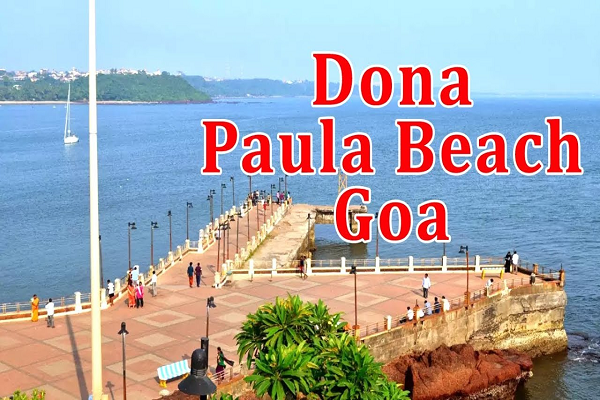
Quick answer: Dona Paula is a rocky headland and small beach in Panaji, Goa’s capital, at the point where the Mandovi and Zuari rivers meet the Arabian Sea. People go for the sea views from the jetty and viewpoint, the 1969 “Image of India” sculpture, sunsets and boat rides, and for the romantic legend behind its name. It is a free public place; Goa Tourism says beaches are open from 7 am to sunset, and the rocks here are for viewing, not swimming.
Dona Paula at a glance
| Detail | What to know (October 2026) |
|---|---|
| Location | Dona Paula, Panaji (Panjim), at the meeting point of the Mandovi and Zuari rivers and the sea |
| Timings | Goa Tourism guidance: beaches open 7 am to sunset; do not enter the water after sunset |
| Entry fee | None for the beach and viewpoint |
| Swimming | Not advisable off the rocks; swim only in lifeguard-flagged zones, never in the monsoon |
| Best time to visit | November to March, early morning or late afternoon |
| Time needed | One to two hours |
The legend and the history of Dona Paula
The popular story, repeated in many guidebooks and in an earlier version of this article, says Dona Paula was a viceroy’s daughter who fell in love with a local fisherman and leapt from the cliff when her father refused to let them marry. It is a romantic tale, but there is no record that supports it.
Accounts of the area’s history name her as Dona Paula Amaral Antónia de Souto Maior. Her wealthy family arrived in Goa in 1744, their land is said to have stretched from today’s Cabo Raj Bhavan towards Caranzalem, and she married in 1756 and died on 21 December 1782. According to local tradition, villagers renamed the area, previously called Oddavell, after her because of her charity towards them. Treat the cliff-jump story as legend, not history.
What to see at Dona Paula
- The viewpoint and jetty: The rocky point looks out over the meeting of the Mandovi, the Zuari and the Arabian Sea, with views along the coast and across the water.
- “Image of India”: A sculpture made in 1969 by Baroness Yrsa von Leistner, standing on the rocks near the jetty. Goa Tourism describes it as showing Mother India and Young India, one looking east and the other west. Some writers have suggested a different subject, so you may see other explanations.
- The beach: A small, sheltered stretch of sand with fishing boats, quieter than the big North Goa beaches.
- National Institute of Oceanography: The headquarters of this national research institute is at Dona Paula. It is a working research campus, so check before you plan a visit.
- Cabo Raj Bhavan: The Governor’s residence stands on the cape at Dona Paula, on a site with a long history: fortifications were proposed here in 1540, and the small chapel of Our Lady of the Cape was founded in 1541. It is an official residence, so public access is limited; the chapel opens for Sunday morning mass and on special occasions.
Dona Paula has also appeared on screen. Much of the 1981 Hindi film Ek Duuje Ke Liye was shot here, and an action sequence from Rohit Shetty’s Singham was filmed at Dona Paula.
Corrections to the earlier version
- It said Dona Paula’s grave is inside the chapel at Cabo Raj Niwas, and also that a tomb built in her memory is in a cemetery at the Cabo de Rama fort. We could not confirm either claim, and Cabo de Rama is a fort in Canacona, far to the south, so both have been removed.
- It listed named bars and a list of hospitals and clinics. We have removed the venues because we could not confirm they still operate. For emergencies, dial 112; Goa’s tourism helpline is 1364.
Things to do
- Watch the sunset from the viewpoint or jetty.
- Take a boat ride in the season. Boat trips, including dolphin-watching trips, run along this coast. Use operators registered with the Department of Tourism, wear the life jacket provided and agree the price first.
- Try water sports such as parasailing, jet skis and water scooters in the season, from registered operators only. Under Goa’s water sports policy (Official Gazette, November 2020), activities run only between 8 am and 6.30 pm or until sunset, whichever is earlier, and not in the monsoon or rough weather. Rates are notified by the Director of Tourism.
- Combine with Miramar. The coast road links Dona Paula with Caranzalem and Miramar, a pleasant drive or ride.
Safety
The rocks at Dona Paula can be slippery and are exposed to breaking waves. Goa’s Department of Tourism advises visitors to avoid damp rocky outcrops, not to jump or dive from rocks into the water, to swim only in zones marked by red-and-yellow flags where lifeguards watch, and never to enter the sea after sunset, after drinking or in the monsoon. In June 2026 Drishti Marine, the state’s lifesaving agency, said swimming in the sea and coastal water sports are prohibited during the monsoon season. Drinking alcohol and smoking on beaches are prohibited.
Best time to visit
November to February is the most pleasant time, with dry weather and calm seas, and March is still comfortable. April and May are hot and humid. The monsoon, roughly June to September, brings heavy rain; the viewpoint is dramatic but the sea is rough. Early morning and late afternoon are the best times of day.
How to reach Dona Paula
- From Panaji: Dona Paula is a short drive from the city centre along the coast road past Miramar and Caranzalem. Take a taxi, auto-rickshaw, local bus or hired two-wheeler.
- By rail: Karmali, near Old Goa, is the closest Konkan Railway station to Panaji; Madgaon (Margao) and Vasco da Gama have more trains.
- By air: Goa International Airport at Dabolim is the nearer airport. Manohar International Airport at Mopa, opened in January 2023, is in the north of the state.
An earlier version gave exact distances and journey times from the bus stand and airport. These could not be verified, so they have been removed.
Places to visit nearby
- Miramar Beach, Panaji’s city beach at the mouth of the Mandovi.
- Dr Salim Ali Bird Sanctuary, a mangrove sanctuary on Chorao island, reached by ferry from Ribandar.
- Reis Magos church and fort at Verem, across the Mandovi.
- Fort Aguada, the Portuguese fort completed in 1612, across the river near Candolim Beach.
See also our guide to the best beaches in Goa.
Frequently asked questions
Why is it called Dona Paula?
It is named after Dona Paula Amaral Antónia de Souto Maior, a member of a wealthy 18th-century family who, by local tradition, was honoured for her charity. The story that she leapt from the cliff for love is a legend with no supporting record.
Can you swim at Dona Paula?
Do not swim off the rocks. Swim only in lifeguard-flagged zones in calm weather, and never in the monsoon or after sunset.
Is there an entry fee for Dona Paula?
No. The beach and viewpoint are free. Boat rides and water sports are paid.
What is the statue at Dona Paula?
The “Image of India” sculpture, made in 1969 by Baroness Yrsa von Leistner.
Which films were shot at Dona Paula?
Much of Ek Duuje Ke Liye was filmed here, as was an action sequence from Singham.
Details checked in October 2026 against Goa Department of Tourism beach guidance, the Goa water sports policy (Official Gazette, November 2020), Drishti Marine’s June 2026 monsoon advisory and published histories of Dona Paula and Cabo Raj Bhavan. Follow local instructions on the day.