Disclosure: this review contains affiliate links (the “Try Semrush” buttons). If you sign up through one, eDefines may earn a commission at no extra cost to you. It does not change what we say about Semrush, including its costs and limits.
Semrush is one of the most complete SEO and online marketing suites available, but it is priced for people who use it every week. Paid plans start at $139 a month ($117.33 a month billed yearly). For a beginner, blogger or small business, the honest answer is usually to start with Semrush’s free account and Google’s own free tools. Upgrade when you have a specific, recurring job that the paid plan does better, such as tracking hundreds of keywords, auditing a site or studying competitors. If you do try it, note that the 7-day trial needs a card and turns into a paid plan unless you cancel. The money-back guarantee covers only first-time annual plans paid by card.
We have not run our own tests of Semrush’s data. This review is based on Semrush’s pricing page, Knowledge Base, terms of service and refund policy, which we read on 12 November 2026, plus Adobe’s announcement and published studies of SEO-tool accuracy. Prices are in US dollars as Semrush listed them on that date.
Semrush in brief
- Plans in 2026: Free, SEO ($139/month), Starter ($199), Pro+ ($299) and Advanced (price on request). The old Pro, Guru and Business plans have been replaced.
- Free account: 10 analytics requests a day, 1 project and 10 tracked keywords, with no card needed.
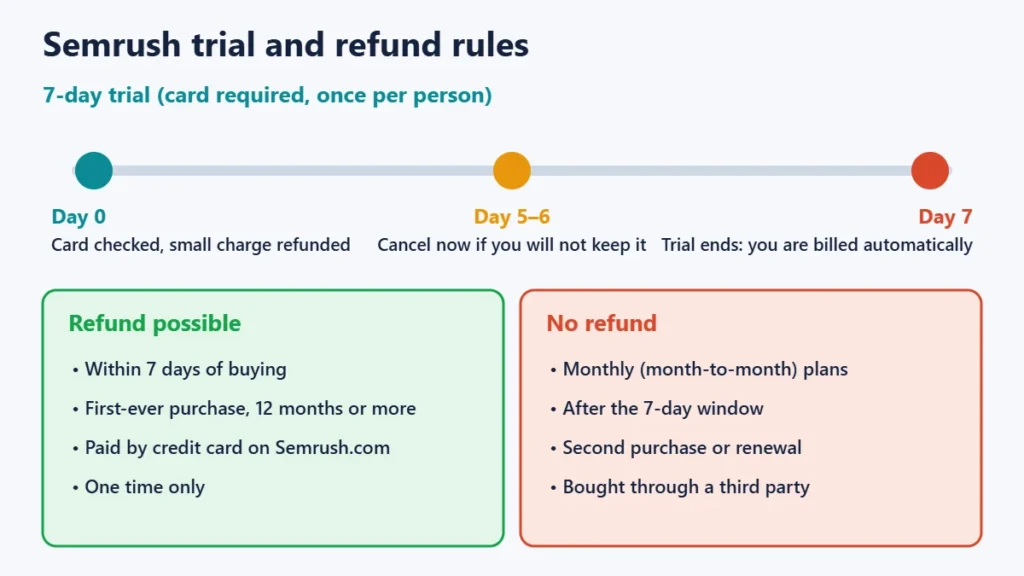
- Trial: 7 days, card required, once per person, and it bills automatically unless you cancel.
- Refund: 7 days, one time only, for first-time purchases of 12 months or longer paid by card on semrush.com. No refunds on monthly plans.
- Ownership: Semrush has been part of Adobe since April 2026.
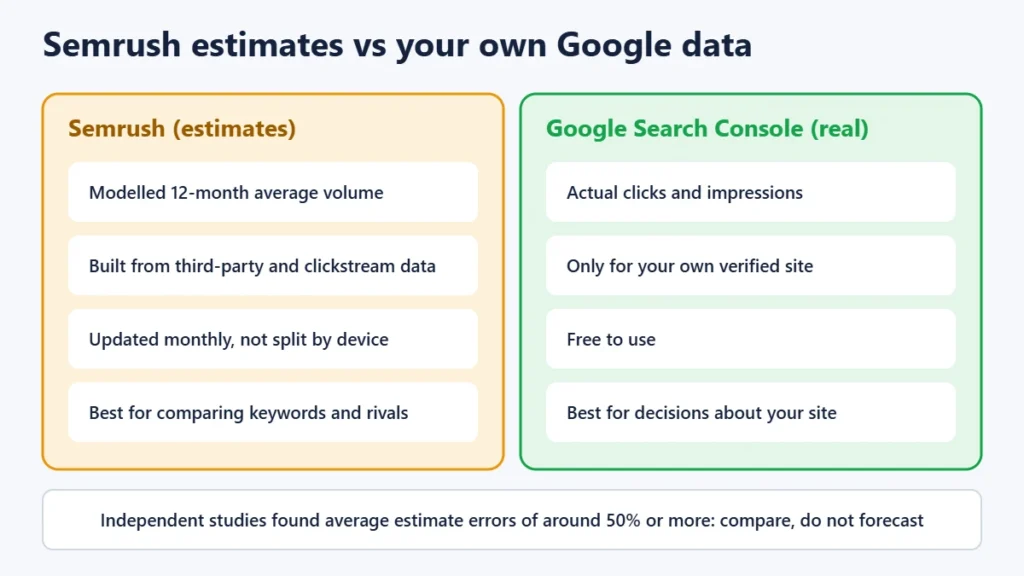
- Data: search volumes and traffic figures are estimates. Use them to compare, not as exact numbers.
Try Semrush (check current plans)
How we reviewed Semrush
We compared Semrush’s current pricing page with its Knowledge Base articles on plan limits, billing and subscriptions. We read its terms of service (last updated 25 August 2026) and its refund rules. We checked Adobe’s newsroom for the acquisition, and Semrush’s documentation for how it estimates search volume. For accuracy we looked at independent studies and say who ran each one. We did not run our own projects in the tool, so we don’t rate the interface or report our own data tests.
What Semrush is, and who owns it now
Semrush is a web-based suite for search engine optimisation (SEO) and online marketing. It covers keyword research, competitor analysis, backlink data, site audits, rank tracking, local SEO and, increasingly, visibility in AI search tools. Adobe completed its acquisition of Semrush on 28 April 2026, and the company now calls itself “Semrush, an Adobe Company”. It is no longer listed on the New York Stock Exchange. Semrush says it has more than 28 million users. For a logged-in user, the product works much as before. The bigger change has been to pricing.
Semrush plans and prices in 2026
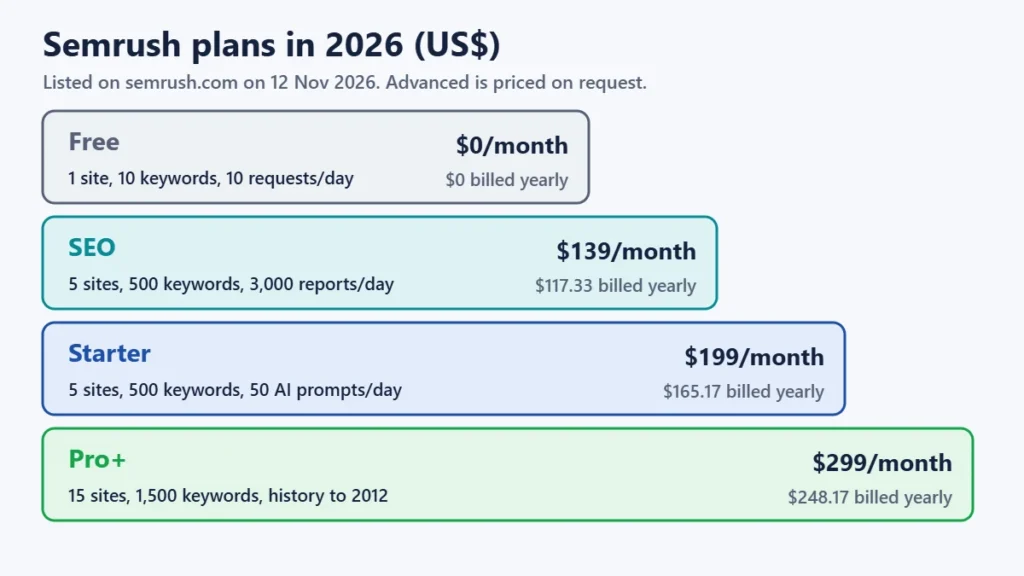
In mid-2026 Semrush replaced its long-running Pro, Guru and Business plans with a new lineup sold as “SEO + AI Search”. Many reviews still quote the old $139.95, $249.95 and $499.95 prices, which no longer apply. These are the plans on Semrush’s pricing page on 12 November 2026:
| Plan | Monthly billing | Annual billing (per month) | Websites monitored | Keywords tracked daily |
|---|---|---|---|---|
| Free | $0 | $0 | 1 | 10 |
| SEO | $139 | $117.33 | 5 | 500 |
| Starter | $199 | $165.17 | 5 | 500 |
| Pro+ | $299 | $248.17 | 15 | 1,500 |
| Advanced | Talk to sales | Custom | 40 | 5,000 |
Other limits that matter to beginners include the following. The SEO plan allows 3,000 analytics reports a day, Pro+ 5,000 and Advanced 10,000. Starter adds tracking of 50 AI-search prompts a day, Pro+ 100 and Advanced 200 (Semrush’s comparison page says unlimited on Advanced). Pro+ adds monthly SEO history back to 2012. Each plan includes one user, and extra users start at $45 a month. Paying yearly saves about 15% to 17%, depending on the plan.
Add-ons cost extra
Some tools aren’t in any plan. They are sold as add-ons, billed annually. The AI Visibility Toolkit costs $99 a month per domain. Local SEO costs $30 or $60 a month per location. The Content Toolkit costs $60 a month, and Traffic & Market, for competitor traffic research, costs $289 a month. A small business that wants SEO, local listings and content help can pay far more than the headline plan price, so add up what you actually need.
Paying from India
Semrush says it bills in US dollars, euros, pounds or other currencies depending on your location, and that you can’t choose the currency yourself. We found no official rupee price list. If your card is charged in dollars, your bank may add a foreign-currency fee. Check the amount on the checkout page before you confirm.
The free account, the trial and refunds
These rules matter most before you sign up.
- Free account: no card required. You get 10 analytics requests a day, one project and 10 keywords in Position Tracking. That is enough to look up a few keywords or check a competitor now and then, and to learn how the tool works.
- 7-day trial: needs a card, which Semrush checks with a small charge that it refunds. You can use it only once per person. Under the terms of service, “at the end of a trial period… you will be automatically charged”. If you only want to look around, put a reminder in your calendar to cancel before day 7.
- Money-back guarantee: a one-time, 7-day guarantee. It covers only first-time purchases of a 12-month or longer plan paid by credit card directly on Semrush.com. Semrush states that “Refunds are not available for month-to-month subscriptions.”
- Renewals: subscriptions renew automatically, and Semrush can apply a new price from the next renewal.
On review sites such as Trustpilot and Capterra, the most common complaints are about charges after a trial ended or after cancelling, and refunds that were refused. These are individual accounts, not verified findings, but they match the strict rules above. Read the terms, and cancel in good time if you don’t want to continue.
What Semrush does well
Keyword research and competitor analysis
This is Semrush’s core. You enter a topic or a competitor’s domain and see which keywords it ranks for, estimated volumes and difficulty, related questions, and how those results change over time. For planning content, seeing which pages bring a competitor its traffic is often more useful than any single number.
Site audit and rank tracking
The site audit crawls your website and lists technical problems such as broken links, missing titles and slow pages, ranked by severity. Position Tracking records your daily rankings for a fixed list of keywords. On the SEO plan that is 500 keywords across five websites, which is plenty for most small businesses.
A very large database
Semrush says its database holds 28.8 billion keywords, 43 trillion backlinks and 808 million domains across 142 country databases. These are Semrush’s own figures, and its pages give slightly different keyword totals. Even so, coverage this wide is why agencies use it to research many markets.
AI search visibility
The 2026 plans add tracking of how often a brand appears in answers from AI search tools, using a set number of daily prompts. This is new and the methods are still settling, but it answers a question many site owners now ask.
Limitations to keep in mind
The numbers are estimates
Semrush’s documentation explains that search volume is a 12-month average. It is estimated by machine-learning models from third-party and clickstream data, updated monthly, and not split by device. That makes it useful for comparing keywords, but not a true count. Independent checks against real Google data have found large gaps. A 2023 study by Altitude Marketing of 87 keywords found Semrush’s volumes off by 99% on average (46% median), mostly too low. A 2024 Promodo study of 184 sites found traffic estimates from Semrush, Ahrefs and Similarweb off by around 50% on average, and least reliable for small sites. Semrush’s own 2022 study calling its data “most accurate” was run by Semrush itself.
The practical rule: use Semrush to see which keyword is bigger or which competitor is growing. For your own site, trust Google Search Console’s real clicks and impressions over any third-party estimate.
It is expensive for occasional use
At $117 to $139 a month before add-ons, Semrush costs more than many small websites earn. If you would log in once a month, the free account, Google Search Console, Google Keyword Planner and Google Trends cover the basics at no cost.
The learning curve
Semrush has dozens of tools and reports. Beginners get the most from it by learning three things first: keyword research, the site audit and Position Tracking. Ignore the rest until you need it.
Pros and cons
| Pros | Cons |
|---|---|
| Keyword, competitor, audit and rank tracking in one tool | Paid plans start at $139/month ($117.33 billed yearly) |
| Very large keyword and backlink database across 142 countries | Volumes and traffic are estimates, and independent checks show big errors |
| Useful free account with no card | Trial needs a card and bills automatically |
| AI search visibility tracking in the 2026 plans | Refunds only for first annual card purchases, within 7 days |
| 500 tracked keywords even on the entry plan | Local, content, AI and traffic tools cost extra |
Which option fits you?
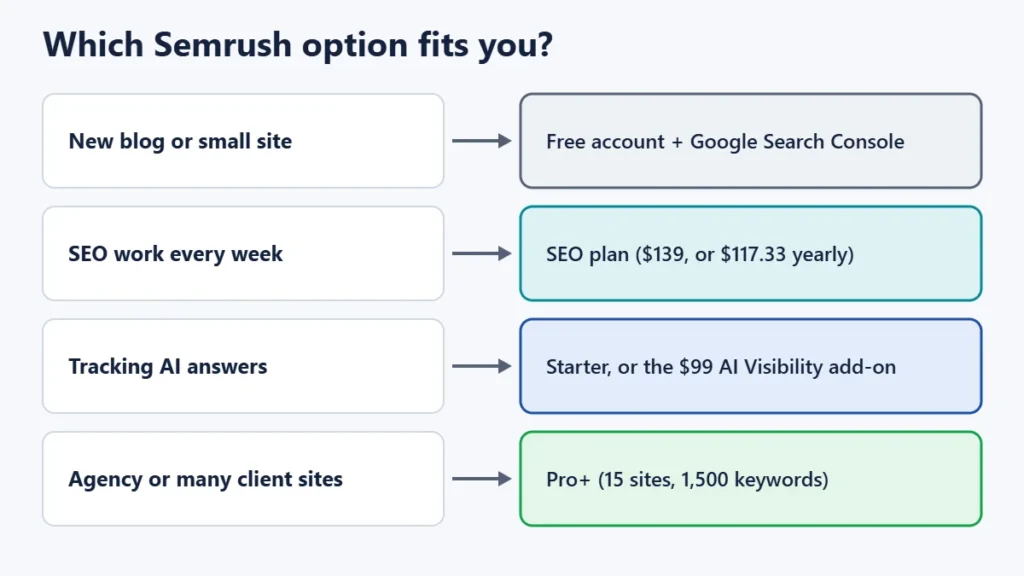
- New blog or small site, under a few hundred visitors a day: use the free account plus Google Search Console. You probably don’t need a paid plan yet.
- Freelancer or small business doing SEO every week: the SEO plan, billed yearly if you’re sure you’ll keep it. Try it on a monthly plan first if you aren’t, accepting that monthly plans can’t be refunded.
- You care about appearing in AI answers: Starter adds prompt tracking. Compare it with the $99-a-month AI Visibility add-on before choosing.
- Agency or several client sites: Pro+ for 15 websites, 1,500 tracked keywords and history back to 2012.
Semrush is only one part of growing a site. Our guides on marketing a small business online, blogger outreach and managing your online reputation cover the rest. If you are still choosing a CRM, see our list of CRM software.
Frequently asked questions
Is Semrush worth it for beginners?
Usually not at first. A beginner gets more from the free account and Google Search Console. Semrush is worth paying for once SEO is a regular part of your work and you will use rank tracking, audits and competitor research every week.
How much does Semrush cost in 2026?
The SEO plan is $139 a month, Starter $199 and Pro+ $299, or $117.33, $165.17 and $248.17 a month billed yearly. Advanced is priced on request. Add-ons cost extra. These are the prices Semrush listed on 12 November 2026.
Is there a free version of Semrush?
Yes. The free account needs no card and allows 10 analytics requests a day, one project and 10 tracked keywords.
Does the Semrush free trial need a credit card?
Yes. The 7-day trial needs a card, can be used only once per person, and charges you automatically at the end unless you cancel.
Can I get a refund from Semrush?
Only in a narrow case: within 7 days of a first-time purchase of a 12-month or longer plan, paid by credit card directly on Semrush.com, and only once. Monthly plans can’t be refunded.
How accurate is Semrush’s search volume?
It is a modelled estimate, not a count. Independent studies have found large average errors, so use it to compare keywords rather than to forecast exact traffic.
Who owns Semrush now?
Adobe. It completed the acquisition on 28 April 2026, and Semrush now calls itself “Semrush, an Adobe Company”.
Our verdict
Semrush is a powerful, broad SEO suite, and its 2026 plans add AI search tracking. For people who do SEO every week, it saves real time. For most beginners and small sites it is too expensive to buy on day one. Start free, learn what you actually need, and if you upgrade, choose your billing carefully: monthly plans can’t be refunded and the trial bills automatically. Treat every volume and traffic number as an estimate.