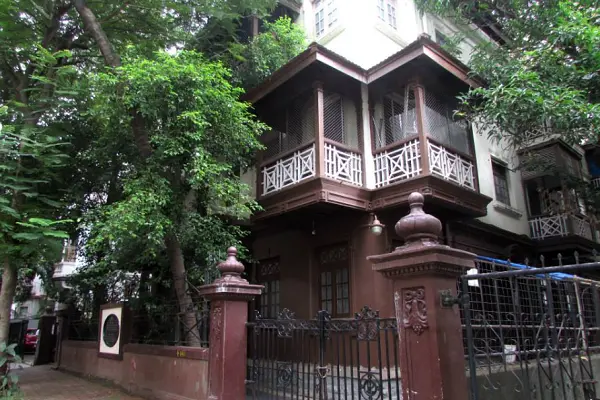
Quick answer: Mani Bhavan, on Laburnum Road in Gamdevi, south Mumbai, was Mahatma Gandhi’s base in Bombay from 1917 to 1934 and is now a museum and library run by the Mani Bhavan Gandhi Sangrahalaya. You can see the room Gandhi used, a gallery of photographs, a series of miniature dioramas of his life, and the terrace where he was arrested on 4 January 1932. As of October 2026 the museum’s website says it is open on all days from 9:30 am to 6 pm; it does not mention an entry fee.
Mani Bhavan at a glance
| Detail | What to know |
|---|---|
| Address | 19 Laburnum Road, Gamdevi, Mumbai 400007 |
| Timings | 9:30 am to 6 pm, all days (museum website, October 2026) |
| Entry fee | Not listed on the museum’s website; check at the entrance |
| Run by | Mani Bhavan Gandhi Sangrahalaya, with the Gandhi Smarak Nidhi |
| Time needed | One to two hours |
| Nearest stations | Grant Road and Charni Road (Western line) |
An earlier version of this article gave the closing time as 5:30 pm. The museum’s own website gives 6 pm, so we have updated it.
Why Mani Bhavan matters
Mani Bhavan is a modest two-storey house that belonged to Revashankar Jagjivan Jhaveri, a devoted follower of Gandhi, who hosted him here. From 1917 to 1934 it was Gandhi’s headquarters whenever he was in Bombay. According to published histories of the house, it was from here that he launched or directed important phases of the Non-Cooperation, Satyagraha, Swadeshi, Khadi and Khilafat movements, and the Congress Working Committee met here several times.
Several turning points in Gandhi’s life happened at Mani Bhavan:
- The spinning wheel: his association with the charkha (spinning wheel), which became a symbol of the freedom movement, began in 1917 while he was staying here.
- The 1921 fast: in November 1921 he undertook a fast at Mani Bhavan.
- The 1932 arrest: in the early hours of 4 January 1932 Gandhi was arrested from the tent where he slept on the terrace.
An earlier version of this article said Gandhi started the Dandi March from Mani Bhavan. That is not correct: the Salt March of 1930 set out from Sabarmati Ashram in Ahmedabad. We have removed the claim.
In 1955 the Gandhi Smarak Nidhi took over the building as a memorial. Notable visitors have included Martin Luther King Jr., during his 1959 tour of India, and US President Barack Obama in November 2010.
What to see at Mani Bhavan
Ground floor: library and bookshop
The ground floor has the museum office, a library and a counter selling books by and about Gandhi, along with stamps and mementoes. The library holds about 40,000 books in reference and lending sections on Gandhi, his philosophy and the freedom movement, including titles that are now hard to find. A statue of Gandhi stands in the library.
First floor: photo gallery and auditorium
A staircase lined with pictures leads to a first-floor gallery of photographs covering the major events of Gandhi’s life, along with letters and documents. The first floor also has an auditorium where films and recordings of his speeches are shown, and the office of the Gandhi Smarak Nidhi. The auditorium is also used for talks, seminars and competitions.
Second floor: Gandhi’s room and the dioramas
The highlight is the room Gandhi used, kept in its original setting and seen through a glass partition. It holds his bed and two spinning wheels. Nearby is an exhibition of miniature figures, a series of small dioramas that tell the story of his life, from his early years to his death, scene by scene.
The terrace
The terrace where Gandhi slept in a tent, and where he was arrested in January 1932, is part of the visit.
Research and study
Mani Bhavan is also a centre for the study of Gandhian thought. Researchers and students use its library, and the auditorium hosts lectures and events organised by Mani Bhavan Gandhi Sangrahalaya and the Gandhi Smarak Nidhi. An earlier version of this article described a research institute “recognised by the University of Mumbai”; we could not confirm that on the museum’s website, so check with the museum if you are interested in formal study.
Tips for visiting
- Weekends and anniversaries such as 2 October (Gandhi Jayanti) and 30 January (his death anniversary) can be busier, so arrive early.
- The museum is in an old house with narrow stairs; allow time if you are visiting with elderly relatives.
- Keep your voice down in Gandhi’s room and the library.
- Ask at the entrance about any library restrictions before you plan a research visit.
How to reach Mani Bhavan
- By suburban rail: Grant Road and Charni Road stations on the Western line are the nearest. From either, it is a short taxi or auto-rickshaw ride, or a walk, to Laburnum Road in Gamdevi.
- By metro: Metro Line 3 (the Aqua Line) has stations at Grant Road and Girgaon.
- By road: taxis and app cabs can drop you at the gate. BEST buses serve Gamdevi; check the BEST route finder for current routes.
- From the airport: Chhatrapati Shivaji Maharaj International Airport is in the northern suburbs; allow at least an hour by road in traffic.
Places to visit near Mani Bhavan
- The Babulnath Temple, an old Shiva temple a short walk away.
- Girgaon Chowpatty, the beach at the end of Marine Drive.
- Malabar Hill, with Banganga Tank and the Hanging Gardens.
Frequently asked questions
What are the timings of Mani Bhavan?
According to the museum’s website, Mani Bhavan is open to the public on all days from 9:30 am to 6 pm. Check before visiting on public holidays.
How long did Gandhi live at Mani Bhavan?
Mani Bhavan was his Bombay base from 1917 to 1934. He did not live there continuously; he stayed there on his many visits to the city.
Whose house was Mani Bhavan?
It belonged to Revashankar Jagjivan Jhaveri, a friend and follower of Gandhi who hosted him there.
Where was Gandhi arrested at Mani Bhavan?
On the terrace, where he slept in a tent, in the early hours of 4 January 1932.
Is there an entry fee at Mani Bhavan?
The museum’s website does not list one as of October 2026. Check at the entrance before you go in.
Timings, history and details were checked in October 2026 against the Mani Bhavan Gandhi Sangrahalaya’s official website and published histories of the house. Check the museum’s website before you visit, especially on public holidays.