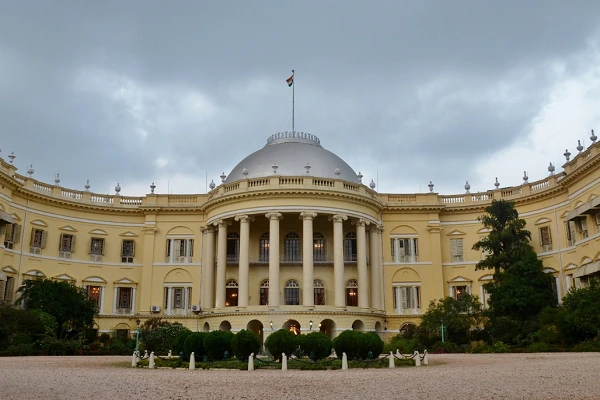
Quick answer: Raj Bhavan Kolkata, renamed Lok Bhavan on 29 November 2025, is the official residence and office of the Governor of West Bengal. It was built between 1799 and 1803 as Government House for the British Governor-General and stands in central Kolkata, near Esplanade and BBD Bagh. It is not a ticketed monument: as of October 2026, the official site says visitors may see the public areas only with prior written permission, between 11:00 am and 12:30 pm, in groups of up to 10, without phones or cameras.
Raj Bhavan is now Lok Bhavan
On 29 November 2025 the Governor of West Bengal issued a notification renaming the Raj Bhavan holdings in Kolkata, Flagstaff House and Darjeeling as “Lok Bhavan” (roughly, “People’s House”). The change followed a Ministry of Home Affairs communication dated 25 November 2025, under which Raj Bhavans across India are being renamed Lok Bhavan. Many maps, signs and older guides still use “Raj Bhavan”, so you will see both names. The official website (rajbhavankolkata.gov.in) now calls itself Lok Bhavan, West Bengal.
The building has had three names: Government House (1803 to 1950), Raj Bhavan (1950 to 2025) and Lok Bhavan (since November 2025).
Lok Bhavan Kolkata at a glance
| Detail | What we found (October 2026) |
|---|---|
| What it is | Official residence and office of the Governor of West Bengal |
| Location | Central Kolkata, between Esplanade and the BBD Bagh (Dalhousie) office district, across the road from Eden Gardens |
| Built | 1799 to 1803, as Government House |
| Visiting | Public areas only, by prior written permission from the Governor’s Secretariat |
| Visiting hours | 11:00 am to 12:30 pm, per the official visit page |
| Entry fee | None mentioned on the official visit page |
| Entry gate | North Gate, facing Telephone Bhavan |
| Phones and cameras | Not allowed inside; deposited at the security check point |
History of Raj Bhavan Kolkata
Before 1799, the Governor-General of Fort William lived in a rented house called Buckingham House, on land belonging to Mohammed Reza Khan, a Nawab of Chitpur. Richard Wellesley, Marquess Wellesley, who became Governor-General in 1798, wanted a residence that showed the power of the East India Company. He is often quoted as saying that India should be governed from a palace, not from a country house. Work on a new mansion began in 1799.
According to the official Lok Bhavan website, Government House was completed on 18 January 1803, and Wellesley moved in that year before the last artisans had left. The cost is usually given as about £63,000 (Wikipedia gives £63,291, or about Rs 13 lakh at the time). The Company’s directors objected to Wellesley’s spending, and he was recalled to England in 1805. Kolkata was left with one of the grandest buildings of the colonial era.
After 1858, when the British Crown took over from the Company, Government House became the residence of the Viceroy of India. The official site says 23 Governors-General and Viceroys lived here until the capital moved to Delhi in 1912 (the move was announced in 1911). After that the building became the home of the Governor of Bengal. On 15 August 1947, C. Rajagopalachari became the first Indian Governor of West Bengal, and the house was later renamed Raj Bhavan.
Architecture and design
Government House was designed by Captain Charles Wyatt in a neoclassical style with Baroque touches. The official website notes that it was modelled on Kedleston Hall in Derbyshire, England, the ancestral home of the Curzon family. Lord Curzon later lived here as Viceroy (1899 to 1905), almost exactly a century after Wellesley.
Key facts about the building, from the official website unless stated otherwise:
- Size: the campus covers 27 acres and the building has about 84,000 square feet of floor space.
- Layout: three storeys, with a large central block of halls, curved corridors on all four sides and four detached wings, each of which works almost as a separate house.
- Rooms: the building is commonly described as having around 60 rooms, not counting corridors and verandas.
- Gates: tall wrought-iron gates topped with large lions. The North Gate is the main entrance.
- Dome: the metal dome was added in the 1860s, during the time of Viceroy Lord Elgin.
- Lift: the Otis Elevator Company says it installed India’s first elevator here in 1892. This ornate “birdcage” lift has been modernised but is still in use.
An earlier version of this article linked the first lift to Lord Curzon. Curzon became Viceroy only in 1899, seven years after the 1892 lift was installed. He is credited with bringing electricity to the house.
Inside the building
- Ground floor: the Marble Hall, in the central area, used for state and private meetings.
- First floor: the Throne Room, the Banquet Hall, the Blue Drawing Room and the Brown Dining Room in the centre, and the Council Chamber in the north-east corner, where important decisions of the British government in India were once taken. The Throne Room holds Wellesley’s throne and a throne associated with Tipu Sultan.
- Prince of Wales Suite: on the first floor in the north-west wing, used by visiting dignitaries such as the President and heads of state. It was renamed the Rabindranath Tagore Kaksh in 2017.
- Second floor: the Governor’s private apartments, the Ball Room and residential suites in the four corners.
Can you visit Lok Bhavan Kolkata?
Yes, but only by prior permission, and only the public areas. As of October 2026, the “For Visit to Lokbhavan” page on the official website says the following:
- Write to the Additional Chief Secretary to the Governor of West Bengal. Give your preferred date, the purpose of the visit, the number of people, your address and a contact number.
- Foreign nationals must attach a photocopy of their passport and bring the original on the day.
- Groups can have up to 10 people. School groups sponsored by their school are exempt from this limit.
- Visits take place between 11:00 am and 12:30 pm. Enter through the North Gate, which faces Telephone Bhavan.
- Carry a valid government photo ID.
- Mobile phones and cameras are not allowed. Phones and bags must be left at the security check point.
The Governor’s Secretariat can accept or refuse a request, and can cancel a permission at any time without giving a reason. The official page does not mention an entry fee. Contact details for visit requests are listed on rajbhavankolkata.gov.in; check there before you plan a visit, because the rules can change.
If you do not have permission, you can still see the building from the street. The view from the North Gate takes in the lawns, the rows of trees and the front of the mansion. Photography of a working government residence may be restricted near the gates, so follow the instructions of the security staff.
Places to visit near Raj Bhavan Kolkata
Lok Bhavan sits in the old heart of colonial Calcutta, so many landmarks are within walking distance:
- Eden Gardens: Kolkata’s famous cricket stadium is across the road. See our guide to Eden Gardens.
- The Maidan: the city’s largest open green space begins at Lok Bhavan and runs south. Read more in our guide to the Maidan and Brigade Parade Ground.
- Shaheed Minar: the 48-metre column at Esplanade, built in 1828 as the Ochterlony Monument.
- St John’s Church: one of Kolkata’s oldest churches, close to Lok Bhavan.
- Writers’ Building and the General Post Office: colonial landmarks around BBD Bagh.
- Millennium Park: a riverside park on the Hooghly. See our Millennium Park Kolkata guide.
- Fort William: the British-era fort to the south-west is the headquarters of the Indian Army’s Eastern Command, so public entry is restricted.
Shopping and food nearby
New Market, one of Kolkata’s best-known markets, and the Chandni Chowk electronics market are both in the Esplanade area, a short distance from Lok Bhavan. For food, Dacres Lane near Esplanade is known for its street-food stalls serving office workers, and the area has several long-running Chinese and Mughlai restaurants. Opening hours change, so check before you go.
How to reach Raj Bhavan Kolkata
- Metro: Esplanade is the nearest major station and an interchange between the Blue Line and the Green Line. Mahakaran station, on the Green Line between Esplanade and Howrah, serves the BBD Bagh area. Both are within walking distance.
- Circular railway: BBD Bagh and Eden Gardens stations on Kolkata’s Circular Railway are nearby.
- Bus: many city buses run to Esplanade, from where Lok Bhavan is a short walk.
- Ferry: river ferries from Howrah call at Babughat. From there, walk east past Eden Gardens.
- Taxi or app cab: ask for Lok Bhavan, or Raj Bhavan, near Esplanade.
- From the airport and main stations: Netaji Subhas Chandra Bose International Airport, Howrah station and Sealdah station all have taxi services. Howrah and Sealdah are also on the Green Line metro to Esplanade.
Frequently asked questions
Why was Raj Bhavan Kolkata renamed Lok Bhavan?
The Ministry of Home Affairs asked for Raj Bhavans across India to be renamed Lok Bhavan, and the Governor of West Bengal notified the change for Kolkata, Flagstaff House and Darjeeling on 29 November 2025. “Lok Bhavan” means roughly “People’s House”.
Is there an entry fee for Raj Bhavan Kolkata?
The official visit page, as of October 2026, does not mention any fee. Visits need prior permission from the Governor’s Secretariat and are limited to the public areas.
What are the visiting hours?
According to the official website, approved visits take place between 11:00 am and 12:30 pm. The page does not list fixed visiting days, so confirm the date when you get permission.
Who designed Raj Bhavan Kolkata?
Captain Charles Wyatt designed it for Governor-General Wellesley. It was built between 1799 and 1803 and modelled on Kedleston Hall in Derbyshire.
Can I take photos inside?
No. Mobile phones and cameras are not allowed inside and must be deposited at the security check point.
Details checked in October 2026 against the official Lok Bhavan, West Bengal website, the renaming notification of 29 November 2025, Otis Elevator Company’s account of the 1892 lift and Kolkata Metro records. Visiting rules can change, so check the official website before you go.