Quick answer: Chhatrapati Shivaji Maharaj Terminus (CSMT), formerly Victoria Terminus, is Mumbai’s grand Victorian Gothic railway station and the headquarters of the Central Railway. Designed by Frederick William Stevens and built between 1878 and 1888, it was inscribed as a UNESCO World Heritage Site in 2004. It is a working station, so you can see it at any time; you need a valid train or platform ticket to go on to the platforms, and visits to its heritage museum should be confirmed with the Central Railway in advance.
CSMT at a glance
| Detail | What to know |
|---|---|
| Location | Fort, South Mumbai, near Dadabhai Naoroji Road |
| Built | 1878 to 1888; opened 20 May 1888 |
| Architect | Frederick William Stevens |
| Heritage status | UNESCO World Heritage Site (2004) |
| Function | Working railway terminus and Central Railway headquarters; 18 platforms (7 suburban, 11 long-distance) |
| Timings | Station open round the clock; heritage museum visits by arrangement (check with Central Railway) |
| Entry fee | No fee to see the building from outside or enter the concourse; a valid ticket or platform ticket is needed for platforms |
| Best time to visit | Early morning or late evening, when the facade is lit and crowds are thinner |
| Time needed | 30 minutes outside; one to two hours with a heritage tour |
Names: Bori Bunder, Victoria Terminus, CST and CSMT
The station has had four names:
- Bori Bunder: the small Great Indian Peninsula Railway (GIP) station on this site, with a single pair of tracks. India’s first commercial passenger train ran from Bori Bunder to Thane on 16 April 1853, a 34 km journey with about 400 passengers in 14 carriages. The old station was demolished after 1877 to make way for the new terminus.
- Victoria Terminus (VT): named after Queen Victoria; the building was completed in the period of her Golden Jubilee (1887).
- Chhatrapati Shivaji Terminus (CST): the name from 1996, honouring Chhatrapati Shivaji, the founder of the Maratha Empire.
- Chhatrapati Shivaji Maharaj Terminus (CSMT): the current name, adopted in 2017 after a state government resolution and a Home Ministry letter.
Many Mumbaikars still call it VT or CST.
History of the building
As Bombay’s port and trade grew in the 19th century, the GIP Railway needed a much larger headquarters and terminus than Bori Bunder. Construction began in May 1878. The building is usually described as completed in 1887, the year of Queen Victoria’s Golden Jubilee, and it opened to the public on 20 May 1888. It cost about Rs 16.14 lakh at the time.
The GIP Railway was merged into the newly formed Central Railway on 5 November 1951, and the terminus became the Central Railway’s headquarters, which it remains today.
An earlier version of this article called the building “133 years old”. That figure dates quickly; the station opened in 1888, so it is now well over 135 years old.
The 26 November 2008 attack
On the night of 26 November 2008, two gunmen linked to the terrorist group Lashkar-e-Taiba attacked the station’s passenger hall with assault rifles and grenades, as part of the coordinated attacks on Mumbai. They killed 58 people and injured 104 at the station. A railway announcer’s warnings helped many passengers escape. One of the gunmen, Ajmal Kasab, was captured, sentenced to death in 2010 and hanged in 2012. A memorial at the station honours those who died.
Architecture
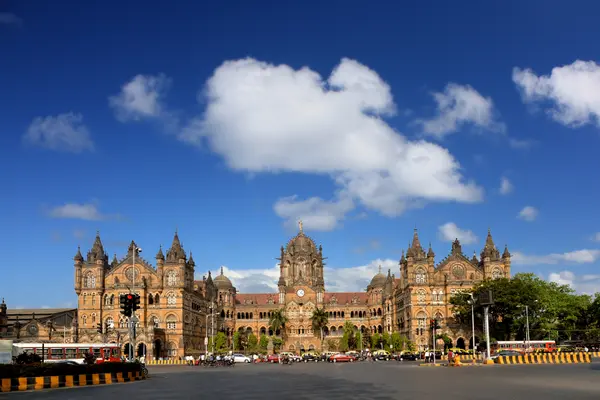
CSMT is built in the Victorian Gothic Revival style, with influences from Romanesque and traditional Indian architecture; its skyline, turrets, pointed arches and unusual ground plan echo Indian palace buildings. Frederick William Stevens designed it, working from a watercolour sketch by the artist Axel Haig, and UNESCO inscribed it as a World Heritage Site in 2004.
Look for:
- The central dome, an octagonal ribbed structure crowned by an allegorical female figure representing Progress. The figure is often mistaken for Queen Victoria.
- The turrets at the corners of the wings, which frame the central dome.
- Allegorical statues and carvings: figures representing Commerce, Agriculture, Engineering and Science, stone arches covered in carved foliage and grotesques, and a lion (for Britain) and a tiger (for India) flanking the entrance.
- The craftsmanship of the Sir J. J. School of Art: its students made much of the decorative work, including sculpture, wood carving, the ticket-office grilles and the staircase balustrades, under the guidance of John Lockwood Kipling.
The building is lit up at night, and its facade is one of Mumbai’s most photographed sights. An earlier version of this article said it is the second most photographed monument in India after the Taj Mahal; we could not find a reliable source for that ranking, so we have removed it.
On screen
The station has appeared in many films, including the “Jai Ho” sequence of Slumdog Millionaire (2008) and Ra.One (2011).
Heritage museum and tours
The Central Railway maintains a heritage museum inside the building that covers the history of the railways and of the building itself. Private operators also run guided walks inside the building.
An earlier version of this article said one-hour guided heritage tours run Monday to Saturday. We could not find current official timings or charges from the Central Railway, so check with the Central Railway (CSMT) or an authorised tour operator before you go, and book in advance.
Visiting tips
- See the facade from across the road at the junction with D.N. Road for the best full view; it is especially striking when lit at night.
- The station is extremely crowded during weekday rush hours, roughly mornings and early evenings; visit on a weekend morning for a calmer look.
- You need a valid ticket or platform ticket to go on to the platforms. Follow security instructions and do not photograph in restricted areas.
How to reach CSMT
- Suburban rail: CSMT is the southern terminus of the Central and Harbour suburban lines.
- Metro: Chhatrapati Shivaji Maharaj Terminus station on Mumbai Metro Line 3 (Aqua Line), which has run its full length to Cuffe Parade since October 2025.
- Long-distance trains: Many mail and express trains start and end here.
- Bus and taxi: BEST buses and taxis serve the station round the clock.
Places to visit near CSMT
- Flora Fountain: The 1864 fountain at Hutatma Chowk is a short walk away; see our Flora Fountain guide.
- Crawford Market: The historic Mahatma Jyotiba Phule Mandai (Crawford Market) lies just to the north.
- Asiatic Society: The Town Hall at Horniman Circle; see our Asiatic Society guide.
- Museum and Gateway: The Chhatrapati Shivaji Maharaj Vastu Sangrahalaya and the Gateway of India are further south.
Frequently asked questions
Who designed Chhatrapati Shivaji Maharaj Terminus?
Frederick William Stevens, working from a watercolour sketch by Axel Haig. Students of the Sir J. J. School of Art made much of the decorative work.
When did CSMT become a UNESCO World Heritage Site?
In 2004.
Why was Victoria Terminus renamed?
It was renamed Chhatrapati Shivaji Terminus in 1996 to honour Chhatrapati Shivaji, the founder of the Maratha Empire, and Chhatrapati Shivaji Maharaj Terminus in 2017.
Is there an entry fee to see CSMT?
No fee is needed to see the building or enter the concourse, but you need a valid ticket or platform ticket for the platforms. Heritage tours may be charged; check before you go.
Where did India’s first passenger train run from?
From Bori Bunder, the station that stood on this site, to Thane on 16 April 1853.
Details checked in October 2026 against published records of the UNESCO listing, histories of the Great Indian Peninsula Railway and the station, and Mumbai Metro Line 3 records. Tour arrangements change, so confirm with the Central Railway before you visit.