Quick answer: Rabindranath Tagore (7 May 1861 – 7 August 1941) was a Bengali poet, writer, composer, painter and educator from Calcutta (now Kolkata). In 1913 he became the first Indian, and the first non-European, to win the Nobel Prize in Literature, mainly for the English Gitanjali. He wrote India’s national anthem, “Jana Gana Mana”, and Bangladesh’s, “Amar Shonar Bangla”, and stories such as “Kabuliwala” that are still read and filmed today.

Rabindranath Tagore at a glance
- Born: 7 May 1861, at the family mansion in Jorasanko, Calcutta
- Died: 7 August 1941, in Calcutta, aged 80
- Known for: poetry, songs (Rabindra Sangeet), short stories, novels, plays and, late in life, painting
- Nobel Prize in Literature: 1913
- Founded: the school at Santiniketan (1901) and Visva-Bharati (1921)
- Married: Mrinalini Devi, in 1883
Early life and education
Tagore was the youngest of thirteen surviving children in a prominent Calcutta family. He disliked formal schooling. His time at Presidency College in Calcutta lasted a single day, and in 1878 he went to England, where he attended a school in Brighton and briefly read law at University College London before leaving to study on his own. He returned to Bengal in 1880 without a degree. An earlier version of this article said he attended “law school” for a few months; he did study law in London, but only briefly.
At home, his older brother Hemendranath tutored him and kept him physically active: Tagore swam in the Ganges, trekked in the hills and practised gymnastics, judo and wrestling. The original article said he “never liked the English language”; more precisely, English was his least favourite subject as a boy, which makes his later fame through English translations all the more striking.
During his own reading he studied Shakespeare’s Coriolanus and Antony and Cleopatra, and Thomas Browne’s Religio Medici.
A writer from childhood
Tagore began writing poetry at the age of eight. At sixteen he published his first substantial poems under the pen name Bhanusimha, later presenting them as the lost work of an imaginary 17th-century poet. Over the next six decades he wrote poems, songs, short stories, novels, plays and essays, almost all of it first in Bengali.
He married Mrinalini Devi in 1883, when he was in his early twenties. An earlier version of this article said he married at 42; that was wrong.
The Nobel Prize and later life
The Swedish Academy awarded Tagore the 1913 Nobel Prize in Literature “because of his profoundly sensitive, fresh and beautiful verse, by which, with consummate skill, he has made his poetic thought, expressed in his own English words, a part of the literature of the West”. He was the first Indian and the first non-European to receive any Nobel Prize. You can read his biography on the Nobel Prize website: Rabindranath Tagore.
The British knighted him in 1915. He gave up the knighthood in 1919 in protest against the Jallianwala Bagh massacre in Amritsar.
In 1901 he founded a school at Santiniketan in rural Bengal, where he wanted to bring together the best of Indian and Western learning. He believed teaching should awaken curiosity rather than rely only on textbooks, a point the original article made. In 1921 this grew into Visva-Bharati, which he intended as a “world university”. UNESCO now lists Santiniketan as a World Heritage Site. If you plan to visit, see our guide to Shantiniketan.
The national anthems
The original article said Tagore wrote the national anthems of three countries. Two are certain:
- India: “Jana Gana Mana” is the first stanza of a Bengali hymn Tagore wrote, first sung at the Calcutta session of the Indian National Congress in 1911 and adopted as the national anthem in 1950.
- Bangladesh: “Amar Shonar Bangla” is a Tagore song.
Sri Lanka’s anthem, “Sri Lanka Matha”, is credited to Ananda Samarakoon, who had studied under Tagore at Santiniketan. Most accounts say Samarakoon was inspired by Tagore; a few claim Tagore wrote the music or even the whole song, and some historians reject any direct role. So it is more accurate to say Tagore influenced Sri Lanka’s anthem than that he wrote it.
Painting in his sixties
Tagore took up drawing and painting at around sixty. His work was first exhibited in Paris and then shown in other European cities. He drew on many styles, including scrimshaw by the Malanggan people of northern New Ireland (Papua New Guinea), Haida carvings from the Pacific Northwest of North America, and woodcuts by the German artist Max Pechstein.
Translations
Tagore wrote mainly in Bengali, and his work has been widely translated, into English (partly by Tagore himself), Hindi and many other Indian and European languages. An earlier version of this article listed Bengali among the translations; Bengali was the language he wrote in.
Books by Rabindranath Tagore
Gitanjali
Gitanjali is a collection of devotional poems. The Bengali original was published in 1910, and Tagore’s own English prose translations appeared as Gitanjali: Song Offerings. It was the English book that brought him to the attention of Western readers and the Nobel committee.

The poems speak to God directly, often as a friend, lover or lord, and return again and again to longing, pain, hope, faith, devotion and joy. Many of them describe the wish to move beyond habit and narrow walls towards a freer, larger life. The verses are short and simple on the surface but reward slow reading.
Kabuliwala
“Kabuliwala” is a short story, not a novel as an earlier version of this article said. Tagore wrote it in 1892, and it was published in the Bengali journal Sadhana. It is one of his best-loved stories.
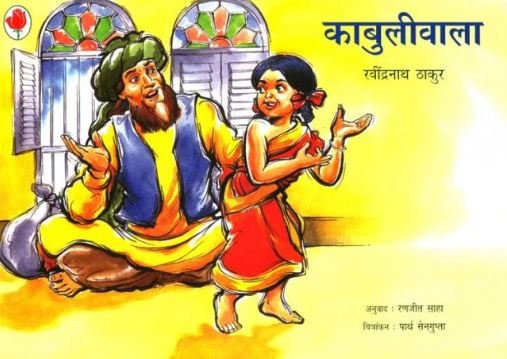
The story is set in Calcutta (now Kolkata). Its main characters are Rahmat, a Pashtun dry-fruit seller from Kabul in Afghanistan, and Mini, the chatty five-year-old daughter of the narrator. Mini is afraid of Rahmat at first because of the big bag he carries, but the two become close friends; he misses his own daughter back home.
Rahmat is later jailed after a fight with a man who owed him money, and he is released eight years later. He comes to see Mini on the day of her wedding. She has grown up and no longer recognises him. Moved, her father gives Rahmat money so that he can go home to his own daughter. The story is about affection across class and country, and about the quiet pain of both the vendor and the child. You can read more about the story on Wikipedia: Kabuliwala.
“Kabuliwala” has been filmed several times. The best-known Hindi version is Kabuliwala (1961), directed by Hemen Gupta and produced by Bimal Roy, with Balraj Sahni as the vendor. There were also Bengali films in 1957, 2006 and 2023, and the Hindi film Bioscopewala (2018) was based on the story.
If you are in Kolkata, places linked to his name include Rabindra Sadan and Rabindra Sarobar.
Frequently asked questions
Why did Rabindranath Tagore win the Nobel Prize?
He won the 1913 Nobel Prize in Literature for his poetry, in particular the English Gitanjali, which the Swedish Academy praised as “profoundly sensitive, fresh and beautiful verse”.
Did Tagore write three national anthems?
He wrote two: India’s “Jana Gana Mana” and Bangladesh’s “Amar Shonar Bangla”. Sri Lanka’s anthem is credited to Ananda Samarakoon, a former student of Tagore, and Tagore’s role in it is disputed.
When was Rabindranath Tagore born and when did he die?
He was born on 7 May 1861 in Calcutta and died there on 7 August 1941.
Is Kabuliwala a novel or a short story?
It is a short story, written in 1892.
What is Santiniketan?
Santiniketan is the place in West Bengal where Tagore founded a school in 1901 and Visva-Bharati in 1921. It is now a UNESCO World Heritage Site.
Checked in November 2026 against the Nobel Prize facts page for Tagore, UNESCO’s World Heritage listing for Santiniketan, and published biographies of Tagore.