
Introduction
Transitioning to a senior manager position is an important milestone in one’s career path. As opposed to the lower levels in the organizational hierarchy, where professional success depended on personal skills and efficiency in performing tasks, the new position implies guiding a team, making decisions, dealing with ambiguity, and linking daily activities to business objectives.
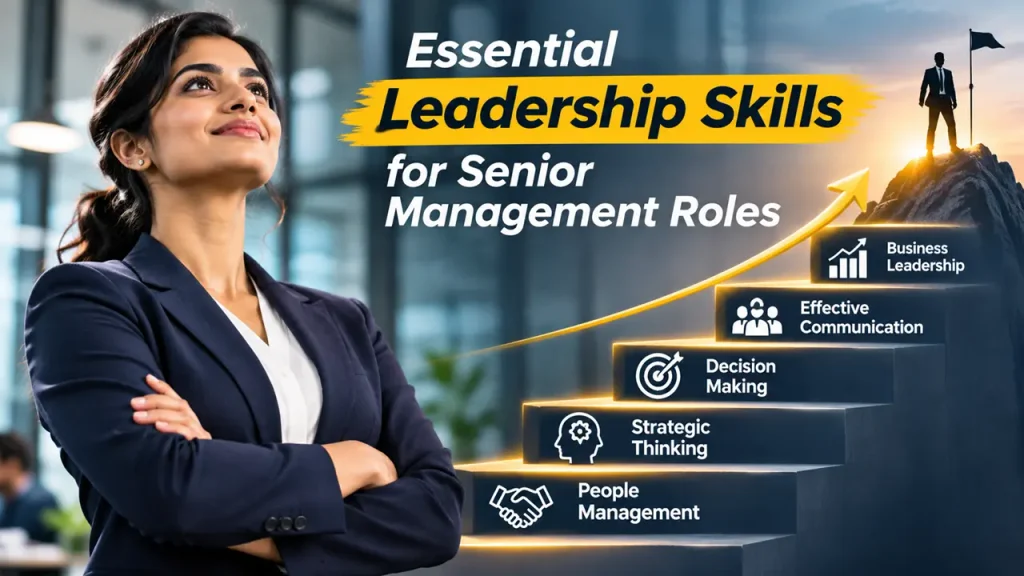
Such change calls for professionals to widen their perspectives on leadership. With Leadership Courses, the necessary competencies may be enhanced in order to go beyond mere responsibility management and into people and function leadership, along with strategy formulation and implementation. With the right leadership skills, professionals will have the capability to speak confidently, make decisions, and make an impact.
Why Leadership Skills Matter for Senior Management
Management positions demand from professionals to go beyond the obvious. They have to comprehend interdependencies between various functions, how decisions impact employees and clients, and how present priorities fit into the future strategy.
Technical knowledge can be beneficial for the career growth of an individual at the earlier levels of his or her career, but higher positions need a more varied set of skills such as strategy, communication, decision-making, and human resource management.
Formalized leadership courses can assist professionals to adopt this holistic approach.
Key Leadership Skills for Senior Management Roles
Professionals preparing for senior management should focus on developing skills that help them lead people while also contributing to organizational priorities.
Strategic Thinking
Senior managers must have the capacity to look beyond their daily activities and comprehend the bigger picture. Strategic thinking consists of looking at priorities, market dynamics, and the strengths of the organization, among other things.
Such professionals have the ability to relate the activities of their teams to organizational goals. Rather than just concentrating on the immediate needs, they try to think about the future directions of the organization and the decisions it would take to get there.
Decision Making
Leadership is a process that entails making choices based on incomplete information or changing circumstances. Managers at higher levels of management should not find themselves at ease when it comes to evaluating the situation.
Good decision-making requires accepting responsibility for the consequences as well. Professionals should have the courage to make hard decisions but also be open to reassessing their decision when more information comes to light.
Communication
With professional advancement into positions of leadership, communication plays an important role. High-level managers deal with their employees, colleagues, superiors, clients, and other stakeholder groups.
Effective communication includes not only the ability to communicate one’s ideas well but also listening skills, understanding others’ opinions, simplifying complicated matters, and prioritization.
Strong communication can help leaders build clarity and alignment across teams.
Emotional Intelligence
Leadership is all about dealing with people. Emotional intelligence enables professionals to learn about themselves and how other people react in their work environment.
Leaders must be able to address conflicts, pressure, organizational change, and tough discussions in a thoughtful manner. Self-awareness, empathy, and emotional management skills will allow leaders to build better professional relationships and make sound judgments.
People Management
Being a senior manager is about succeeding not through the talents of oneself but through the talents of others.
Leaders should know how to delegate duties, develop talent, foster teamwork, mentor and create conditions for effective contribution of employees.
Good people management also requires leaders to recognize different strengths within their teams and create opportunities for individuals to grow.
Business Acumen
Senior management must have an idea about how their decision is related to the whole business. It includes knowledge about customers, operations, finances, competition, organizational priorities, and value creation.
Business savvy makes professionals more confident when they are participating in strategic discussions. Moreover, business acumen enables professionals to assess decisions based on organizational perspective rather than taking into consideration the interests of their own department.
Change Management
Organizations today frequently undergo changes in terms of technology, customer needs, processes, strategies, and how work is done. Senior executives can play a key role in guiding the transition.
Change leadership requires clarity, communication, adaptability, and empathy from leaders. They need to ensure that people understand why change is important while not losing sight of organizational goals.
Problem Solving
Senior level managers are faced with problems that may not necessarily have an easy solution. One has to identify the root cause of the problem and look at things from different angles to find ways of solving the problem without compromising future outcomes.
Effective problem solving helps one think logically rather than make decisions based on assumptions or temporary considerations.
Influence and Stakeholder Management
It is uncommon for top executives to meet their objectives alone. This requires the assistance of individuals from diverse functional areas and organizational levels.
The skill to have influence without relying completely on position power is key. The leaders should know what the stakeholders want, how to sell the ideas to them, and how to establish common ground when differences arise.
How Leadership Training Supports Career Growth
Leadership skills development is a continuous process. Learning can be gained through experience, however, Leadership training can help individuals look into their leadership style in a more formal way.
This will enable them to see past their functional knowledge and learn more about strategy, people, communication, organizational change and decision-making.
Likewise, leadership training can offer an organized setting through which the mindset necessary for handling increased management tasks can be developed by working professionals. The aim here is not to understand the principles of leadership, but rather to gain a certain mindset that will help the professional handle tasks effectively.
Moving From Manager to Senior Leader
A move to senior management can be accompanied by a change in the mindset. The manager focuses on the results achieved by the team. The senior executive needs to consider the way those decisions made by the team relate to other functions within the organization.
Those who are planning this change need to be more strategic, collaborative, adaptable, and accountable.
It is this wider view that may allow them to move from managing tasks to leading people and decision-making.
Conclusion
Being in senior management goes beyond professional experience and knowledge. Professionals must be capable of strategic thinking, effective communication, decision making, managing people, having an understanding of business priorities, managing change, and having influence.
Professional development in terms of leadership skills may be of great assistance to people in improving these qualities and in gaining the necessary confidence. Professionally developed leadership programs may facilitate this process by assisting people in linking leadership concepts with strategic thinking.
Becoming a senior leader essentially boils down to changing your mindset, communication, decision-making process, and influence. Professionals that purposely cultivate such leadership traits can ready themselves for more significant roles and meaningful contributions to their organizations.
