Quick answer: The maths skills that matter most for success in everyday life and work are number sense and mental estimation, percentages and ratios, the maths of money (interest, loans and inflation), reading data and averages, basic probability, and logical problem-solving. You do not need advanced calculus for most careers, but these core skills help you make better decisions, avoid being misled and run a business or household with confidence.
Many people wonder why maths is compulsory at school and in many university courses. The reason is not that everyone will solve equations at work. It is that mathematical thinking, the habit of reasoning carefully with numbers and logic, is useful almost everywhere.

The place of mathematics among the sciences
Mathematics is a foundation for the natural sciences. Physics, chemistry, biology, economics and computer science all use its methods. Maths deals with abstract ideas such as numbers, shapes and relationships, which are not physical objects. Yet as soon as it is applied, it describes, models and predicts very real processes, from the path of a satellite to the spread of a disease. That is why at least solid primary maths tuition or classroom grounding is so valuable.
Mathematics is also a way of understanding the world. It does not tolerate arbitrary claims: a statement is either proved or it is not. Once we describe a natural process with numbers, we can build a model, test it and predict what will happen next.
Albert Einstein’s work is a famous example. A widely told story, which may be apocryphal, says that when asked where his laboratory was, he pointed to his pen and paper. What is documented is that his general theory of relativity, published in 1915, was a mathematical theory first. Its prediction that starlight bends around the Sun was supported by observations of the 1919 solar eclipse, decades before the first spaceflight, and later space-age experiments tested it with far greater precision. An earlier version of this article said the equations were confirmed only after humans began to explore space; the first confirmation came well before that.
In short, much of the technology we rely on, from bridges and buildings to phones and satellites, rests on mathematics.
Six maths skills you need to be successful
1. Number sense and estimation
Number sense is a feel for how big numbers are and whether an answer is reasonable. It lets you check a bill in your head, spot a misplaced zero in a spreadsheet and understand large figures in the news. For example, knowing roughly how much 1 billion dollars is in Indian rupees helps you judge headlines about company valuations or budgets.
2. Percentages, ratios and proportions
Discounts, taxes, marks, interest rates and price rises are all percentages. A common trap: a 20% discount followed by a further 10% discount is not 30% off. On a ₹1,000 item you pay ₹800 after the first discount and ₹720 after the second, a total discount of 28%. Ratios and proportions help with recipes, mixing solutions in a lab (see our guide to the mass percent formula), maps and scaling a business plan.
3. The maths of money
Compound interest is one of the most useful ideas you can learn. ₹1,00,000 growing at 8% a year, compounded annually, becomes about ₹2,15,892 after 10 years, compared with ₹1,80,000 under simple interest. The same arithmetic works against you on loans: a ₹5,00,000 loan at 9% a year repaid over five years has an equated monthly instalment (EMI) of about ₹10,379, so you repay roughly ₹6,22,750 in total, including about ₹1,22,750 in interest. Understanding these numbers helps you compare loans, savings and investments sensibly. These are illustrative calculations, not financial advice; actual rates and terms vary.
4. Reading data, averages and charts
Basic statistics helps you see through misleading claims. An average (mean) can be pulled up by a few very large values, which is why the median is often a fairer “typical” figure for salaries or house prices. A rise from 2% to 3% is one percentage point but a 50% increase, and the way a figure is reported can change how dramatic it sounds. Learn to read a chart’s axes before you trust its shape.
5. Probability and risk
Probability helps you think clearly about chance: insurance, medical test results, weather forecasts, lotteries and investments. Knowing that a 1-in-100 event is not impossible, and that past luck does not change future odds in a fair game, protects you from poor decisions and from schemes that promise “guaranteed” returns.
6. Logical reasoning and problem-solving
Mathematics trains logical thinking: breaking a problem into steps, identifying assumptions and checking whether a conclusion really follows. This is the skill that transfers most widely, to law, management, programming and everyday arguments.
Why maths matters to you personally
Studying mathematics develops analytical, deductive and critical thinking, along with the ability to think several steps ahead. It strengthens concentration and the ability to hold several ideas in your head at once.
Logical thinking organises your thoughts into a system of connected ideas. Without it, it is hard to draw sound conclusions or compare different kinds of claims, and it is easier to be misled by swindlers and charlatans whose arguments do not add up. Maths does not make you immune to deception, but it makes the gaps in a bad argument much easier to spot.
These skills help even if you build a career in the humanities, where logic and structured argument are essential. Lawyers, for example, use careful reasoning to build cases and interpret complex rules.
Everyone can master the basic skills of mathematical thinking; for some it simply takes more practice. Balance matters too: strong reasoning works best alongside good communication and practical judgement.
Maths in business
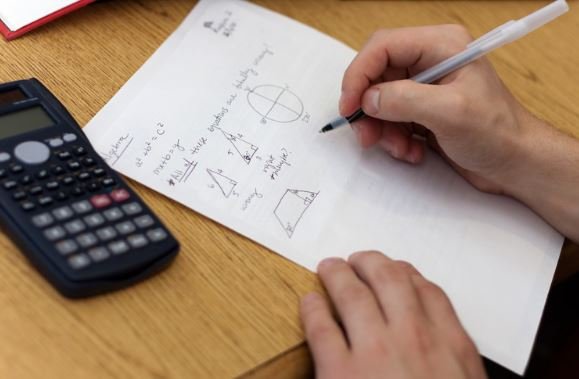
Mathematics is essential in business. If you start your own business, you will need to work out costs, prices, margins, break-even points, cash flow and forecasts. You can hire accountants and analysts, but you still need enough understanding to check their work and make decisions.
A business is an ordered system. Building one requires structured thinking, the ability to generalise and the ability to see how one number affects another, for example how a small price change affects profit.
Maths is not only calculations and formulas. It is first of all logic and order: a set of habits that makes your thinking consistent and helps you reason, explain your ideas and keep complex relationships clear.
How to build these skills as an adult or student
- Practise mental maths daily. Estimate bills, tips and travel times before you check them.
- Use real numbers. Work out the interest on your own savings account or the true cost of a loan offer.
- Revisit school topics that matter. Percentages, ratios, algebra and basic statistics cover most daily needs. Students preparing for board exams can use our list of important maths chapters for Class 12 CBSE.
- Connect maths to other subjects. Physics, chemistry and economics all become easier with stronger maths; our tips to learn physics efficiently show how closely the two are linked.
Frequently asked questions
Do I need advanced maths to be successful?
Not for most careers. Engineering, data science, finance and the physical sciences need advanced maths, but most people mainly need confident arithmetic, percentages, money maths, basic statistics and logical reasoning.
What is the most useful maths skill in daily life?
Percentages, closely followed by understanding interest. They appear in shopping, salaries, taxes, loans, savings and news reports.
Can I improve at maths as an adult?
Yes. Regular practice with real-life problems, starting from the basics, steadily builds confidence and speed.
Why is maths important in business?
Pricing, budgeting, forecasting, profit margins and cash flow all depend on maths, and owners need enough understanding to check reports and make decisions.
This article was checked in October 2026. The worked examples were recalculated for this update, and the history of general relativity was checked against standard reference sources. Money examples are illustrative general information, not financial advice.