
Quick answer: You do not need to carry the paper Aadhaar letter. UIDAI’s Aadhaar app keeps your Aadhaar on your phone behind a 6-digit PIN and lets you share only the details a verifier needs, and an Aadhaar-verified DigiLocker account holds a copy too. If you prefer something physical, the official Aadhaar PVC card (₹75) fits in a wallet. UIDAI treats the letter, the PVC card, e-Aadhaar and the Aadhaar app as equally valid.
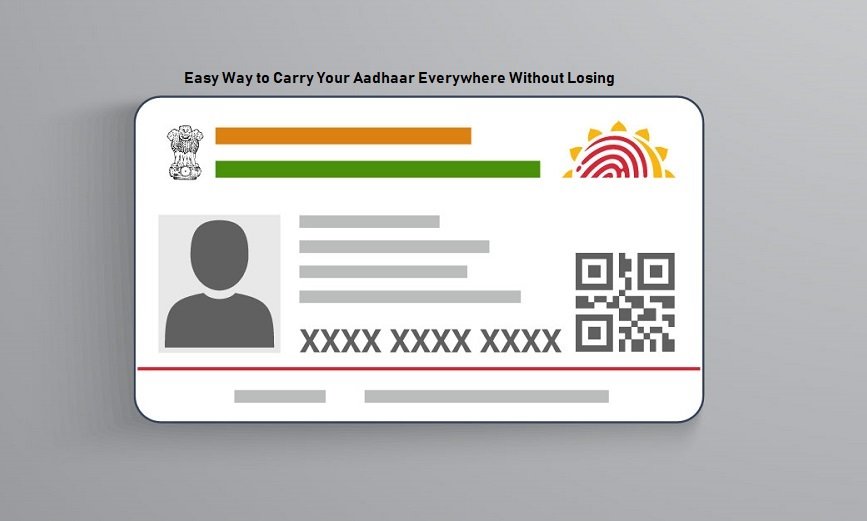
Why carry Aadhaar digitally?
Aadhaar is asked for in many everyday situations, from hotel check-ins to government schemes, and a paper letter in your pocket wears out or goes missing. A digital Aadhaar cannot be torn, and if your phone is lost you can set it up again on a new one. It can also be safer: the Aadhaar app lets you share selected details instead of handing over a photocopy with your full Aadhaar number.
According to the Unique Identification Authority of India (UIDAI), there are four forms of Aadhaar: the Aadhaar letter, the Aadhaar PVC card, e-Aadhaar and the Aadhaar app. All four are equally valid, and you can choose any of them.
Option 1: The Aadhaar app
This article originally described mAadhaar, UIDAI’s earlier mobile app. UIDAI launched a new Aadhaar app on 28 January 2026, and it is replacing mAadhaar. If you still have mAadhaar, install the new app.
What the Aadhaar app does
According to UIDAI’s Aadhaar app FAQ, the app lets you:
- show and share your Aadhaar with an organisation by scanning its QR code, including selective sharing, where you choose which details (for example, only your name and photo, or only proof that you are over 18) are shared;
- lock and unlock your biometrics in one tap;
- check your authentication history, which shows when and where your Aadhaar was used;
- download e-Aadhaar;
- update your mobile number (if you can still receive OTPs on the old one) and your address;
- scan the QR code on an e-Aadhaar or PVC card to check that it is genuine;
- hold up to five Aadhaar profiles on one phone, so a family can share a device.
UIDAI’s FAQ says the app can be used at places where physical copies of Aadhaar are currently requested, because it lets you share your Aadhaar data securely with the organisation, with your consent.
How to set up the Aadhaar app
- Install the Aadhaar app published by UIDAI from the Google Play Store or Apple App Store. It needs Android 9 or later, or iOS 16 or later.
- Choose your language. The app is available in English and 12 Indian languages.
- Enter your Aadhaar number and accept the terms and privacy policy.
- Choose the SIM card in your phone. The app binds itself to the SIM, which is why it asks for call and SMS permissions.
- Complete face authentication with your phone’s camera.
- Set a 6-digit PIN. You will use this PIN to open the app.
Two limits to know: the app cannot be used outside India, and a mobile number cannot be added to Aadhaar for the first time through the app. If no mobile number is linked to your Aadhaar, link one at an Aadhaar centre first; a separate mobile number update costs ₹75, according to UIDAI’s charges.
Option 2: DigiLocker
DigiLocker is the government’s digital document wallet, available at digilocker.gov.in and as an app. Once your DigiLocker account is verified with your Aadhaar and an OTP, your Aadhaar appears among your issued documents, alongside others such as your driving licence or marksheets if the issuers provide them.
DigiLocker’s terms of use say documents issued through it are legally equivalent to physical originals under the Digital Locker rules of 2016. Linking Aadhaar to DigiLocker is voluntary, but it is needed to fetch issued documents. DigiLocker is a good choice if you want several government documents in one place.
Option 3: A saved e-Aadhaar PDF
You can also keep a downloaded e-Aadhaar PDF on your phone. It stays password-protected (the first four letters of your name in capitals plus your year of birth), and it is digitally signed by UIDAI. For everyday use, download the masked version, which shows only the last 4 digits of your Aadhaar number. Our e-Aadhaar explainer covers masked Aadhaar, the Virtual ID and the QR code.
Option 4: The official Aadhaar PVC card
If you would rather carry a card, order the Aadhaar PVC card from UIDAI. It costs ₹75 including GST and speed post, carries a tamper-proof QR code and other security features, and is as valid as the letter. Avoid plastic Aadhaar cards made at print shops: UIDAI warned in 2018 that their QR codes often do not work and that giving your details to unauthorised printers risks misuse. Our guide to printing Aadhaar and ordering the PVC card has the steps.
Safety tips for carrying Aadhaar
- Never share your OTP or app PIN. No genuine UIDAI officer, bank or delivery agent needs them.
- Share as little as possible. Use selective sharing in the Aadhaar app or a masked e-Aadhaar when the full number is not needed. Use a Virtual ID in place of your Aadhaar number for online authentication where it is accepted.
- Lock your biometrics. Locking fingerprints, iris and face authentication stops anyone from using them until you unlock them. You can do this in the Aadhaar app or on the myAadhaar portal. Read more about Aadhaar authentication and biometric locking.
- Check your authentication history in the app every so often. If you see a use you do not recognise, call UIDAI’s toll-free helpline 1947 or email help@uidai.gov.in.
- Do not post your Aadhaar on social media. UIDAI advises people to use Aadhaar freely to prove identity, but not to put it on public platforms.
- Install only the official app. Check that the Aadhaar app’s publisher is UIDAI before installing.
If you have already lost your Aadhaar letter or forgotten your Aadhaar number, see what to do when your Aadhaar card is lost.
Frequently asked questions
Is the Aadhaar app accepted as valid Aadhaar?
Yes. UIDAI lists the Aadhaar app as one of the four equally valid forms of Aadhaar. Whether a particular counter has the means to scan or receive your shared details is up to that organisation, so carry a backup if you are unsure.
Does the Aadhaar app work without the internet?
The app needs internet connectivity, according to UIDAI’s FAQ. UIDAI’s QR code reader tools can verify the QR code on an e-Aadhaar or PVC card offline.
What happens to my mAadhaar data?
Your Aadhaar details are held by UIDAI, not by the app. Installing the new Aadhaar app and registering with your Aadhaar number and face authentication gives you access to the same Aadhaar record.
Can I add my child to my Aadhaar app?
Yes, in many cases. UIDAI says a minor can be added if their relationship with the guardian was established through biometric authentication at enrolment; the guardian completes face authentication to add the profile.
Do I need DigiLocker if I have the Aadhaar app?
Not for Aadhaar alone. The Aadhaar app is the dedicated tool for Aadhaar. DigiLocker is useful if you also want other government-issued documents on your phone.
This guide was checked in October 2026 against UIDAI’s Aadhaar app FAQ (last updated September 2026), the government’s January 2026 announcement of the new Aadhaar app, UIDAI’s online services FAQ and DigiLocker’s terms of use. App features are being added in phases, so check the official app listing for the latest services.