Quick answer: Churchgate is a South Mumbai neighbourhood named after one of the gates of the old Bombay Fort, which led to St Thomas Cathedral. Today it is known for Churchgate station (the southern terminus of the Western line), the Art Deco buildings around the Oval Maidan that form part of a UNESCO World Heritage Site, and its closeness to Marine Drive, Wankhede Stadium and Nariman Point. It is a public area with no entry fee or opening hours.
Churchgate at a glance
| Detail | What to know |
|---|---|
| Location | South Mumbai, between the Fort area and the Arabian Sea; Nariman Point lies to the south |
| Known for | Churchgate station, Art Deco architecture, the Oval Maidan, cricket venues, colleges |
| Heritage status | Part of the “Victorian Gothic and Art Deco Ensembles of Mumbai”, a UNESCO World Heritage Site since 2018 |
| Entry fee | None; public streets and open spaces |
| Best time to visit | October to March; early morning or evening |
| Time needed | 2 to 3 hours for a walk around the area and Marine Drive |
History of Churchgate
Until the mid-19th century, the heart of Bombay was a walled town, the Fort, with three main gates. One of them led towards St Thomas Cathedral and was called Church Gate. In the 1860s the fort walls and gates were pulled down to make room for the growing city. Flora Fountain, completed in 1864, stands at the site of the old Church Gate, and the name passed to the area to its west. An earlier version of this article dated the name to “the eighteenth century” and said the walls came down “before 1862”; the more precise account is that the gate was named after the cathedral and demolished in the 1860s.
The railway followed soon after. The Bombay, Baroda and Central India Railway (now Western Railway) extended its line along the shore, and Churchgate station opened on 10 January 1870, close to the site of the demolished gate. The station was rebuilt in 1876, 1931 and 1957. It is the southern terminus of the Western line of the Mumbai Suburban Railway, and Western Railway’s headquarters are at Churchgate.
From the 1930s, land reclaimed from Back Bay to the west of the Oval Maidan was built up with Art Deco apartment blocks and the Eros Cinema. In 2018 UNESCO inscribed these buildings, together with the Victorian Gothic public buildings on the east side of the Oval, as the “Victorian Gothic and Art Deco Ensembles of Mumbai”.
Things to see and do around Churchgate
The Oval Maidan and its two architectural styles
The Oval Maidan, once part of the Esplanade, is a large open ground used for cricket. Stand in the middle and you can see the two halves of the World Heritage Site: Art Deco apartment buildings and the Eros Cinema on the west, and Victorian Gothic landmarks such as the Bombay High Court and the University of Mumbai’s Fort campus on the east.
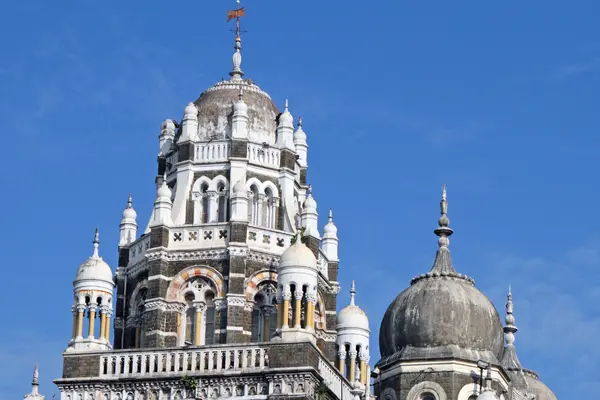
Rajabai Clock Tower
The Rajabai Clock Tower, on the University of Mumbai’s Fort campus, was designed by the English architect Sir George Gilbert Scott and modelled on Big Ben in London. It is 85 metres (280 feet) tall and was completed in 1878, partly funded by the broker Premchand Roychand, who named it after his mother, Rajabai. The tower is closed to the public, but it is easy to see from the Oval Maidan. An earlier version of this article said it was built by the same architect as Big Ben and now rings every 10 minutes; in fact, Scott did not design Big Ben, and the tower is reported to chime every 15 minutes.
Marine Drive
A short walk west of the station brings you to Marine Drive, the curving seafront promenade. It is popular for morning walks and for sunsets, and at night the curve of streetlights is known as the Queen’s Necklace.
Cricket: Wankhede and Brabourne
Churchgate is home to two of India’s best-known cricket grounds. Wankhede Stadium hosts international and Indian Premier League matches and is next to the Cricket Centre, headquarters of the Board of Control for Cricket in India (BCCI). Brabourne Stadium belongs to the Cricket Club of India.
Flora Fountain and Hutatma Chowk
Flora Fountain, at Hutatma Chowk, marks the spot where the Church Gate once stood, and the square also holds a memorial to those killed in the Samyukta Maharashtra movement.
Food, shopping and student life
Churchgate is surrounded by colleges, including K.C. College, H.R. College, Jai Hind College, Government Law College and Sydenham College, so the streets near the station are lively with students and office workers, and there are plenty of cafés, snack counters and restaurants. The old version of this article named specific fast-food chains and nightlife; those details change often, so they have been left out.
Best time to visit
October to March is the most comfortable season. Early mornings are quiet and good for photographing the Art Deco buildings in soft light. Evenings are busiest, with office crowds at the station and people heading to Marine Drive for the sunset. Weekday rush hours at Churchgate station are extremely crowded, so avoid them if you can.
How to reach Churchgate
- Suburban rail: Churchgate is the southern terminus of the Western line, with trains from the western suburbs. Marine Lines is the next station north.
- Metro: Churchgate station on Mumbai Metro Line 3 (the Aqua Line) offers an interchange; Vidhan Bhavan and Hutatma Chowk metro stations are close by.
- By road: Taxis, app cabs and BEST buses serve Churchgate from across the city.
- From outside Mumbai: Long-distance trains arrive at Chhatrapati Shivaji Maharaj Terminus and Mumbai Central, both a short ride from Churchgate.
Places to visit near Churchgate
- Marine Drive, the seafront promenade to the west.
- Nariman Point, the business district at the southern end of Marine Drive.
- Wankhede Stadium, for match days and the cricket museum.
- Flora Fountain, on the site of the original Church Gate.
- St Thomas Cathedral, the church that gave the gate, and the area, its name.
Frequently asked questions
Why is it called Churchgate?
Churchgate is named after the Church Gate, one of the gates of the old Bombay Fort, which led to St Thomas Cathedral. The gate was demolished in the 1860s, and Flora Fountain now stands on its site.
Is there an entry fee to visit Churchgate?
No. Churchgate is a public neighbourhood with no entry fee or opening hours. Individual places such as stadiums or museums have their own rules.
When did Churchgate station open?
Churchgate station opened on 10 January 1870 and has been rebuilt several times, most recently in 1957. It is the southern terminus of the Western line.
Is Churchgate a UNESCO World Heritage Site?
The Art Deco buildings on the west side of the Oval Maidan, near Churchgate, are part of the “Victorian Gothic and Art Deco Ensembles of Mumbai”, inscribed by UNESCO in 2018.
Can you climb the Rajabai Clock Tower?
No. The tower is closed to the public, but you can see it clearly from the Oval Maidan.
History and details in this guide were checked in October 2026 against published histories of Churchgate, Churchgate station, the Rajabai Clock Tower and UNESCO’s Mumbai World Heritage Site. Station facilities and access can change, so check before you travel.