Quick answer: SCADA (supervisory control and data acquisition) is a computer system that collects real-time data from equipment spread over a wide area, such as pipelines, power lines, water networks or factories, and lets operators monitor and control that equipment from a central location. A typical SCADA system has field devices (sensors, remote terminal units and programmable logic controllers), a communication network, a central SCADA server and operator screens called human-machine interfaces (HMIs). Because SCADA runs critical infrastructure, securing it is as important as running it.
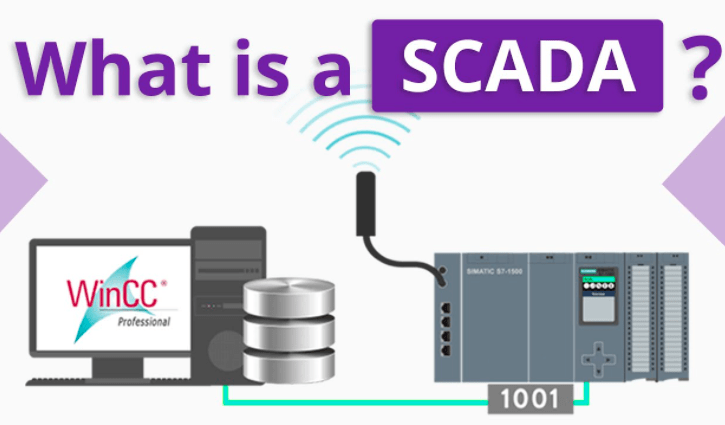
Supervisory Control and Data Acquisition (SCADA) systems monitor and control field devices at remote sites. They matter because they gather and process real-time data that keeps processes running efficiently and safely.
In simple terms, SCADA is a centralised system that oversees a whole area or process. It gathers data during the process and sends control commands back to it. Its main goal is to supervise and control equipment in industrial processes for companies in both the private and public sectors.
You may not notice it, but SCADA systems are almost everywhere. Manufacturing plants, oil and gas operations, transport systems, water supply and treatment, and electricity transmission and distribution all use them.
SCADA: what is it?
The US National Institute of Standards and Technology (NIST) defines SCADA as a generic name for a computerised system that can gather and process data and apply operational controls over long distances. SCADA is a process control system architecture that uses networked data communications, computers and graphical human-machine interfaces (HMIs) to provide high-level supervisory control and management.
SCADA systems communicate with other devices, such as programmable logic controllers (PLCs) and PID (proportional-integral-derivative) controllers, which interact directly with the plant and equipment. SCADA is a major part of control systems engineering: it gathers information from a process in real time, logs and records it, and displays it on HMIs.
This lets operators monitor what is happening in the field from a distant control room and control processes by interacting with the HMI, for example by opening a valve, starting a pump or changing a set point.
Main objectives of SCADA
- Monitor: continuously supervise physical conditions such as flow, pressure, temperature, voltage and level.
- Measure: record process values accurately over time.
- Acquire data: collect data from remote terminal units (RTUs), PLCs, data loggers and similar devices. (An earlier version of this article wrote “RTY”; the correct term is RTU.)
- Communicate data: move large amounts of data between field devices and the central system.
- Control: let operators, or automatic logic, send commands to equipment in real time.
- Automate: trigger alarms and routine actions automatically when values cross set limits.
Major components of a SCADA system
The original article described three major components. They are still the core of SCADA, alongside the operator HMI.
Master Terminal Unit (MTU)
The master terminal unit is the heart of the system. NIST’s glossary describes it as a control server that hosts the control software and communicates with lower-level control devices; in SCADA it is often called the SCADA server, MTU or supervisory controller. It starts communication with the field, collects and stores data, presents information to operators and passes data to other business systems.
Remote Terminal Unit (RTU)
RTUs are installed at field sites and connected to sensors and actuators. They collect readings from the sensors, store them and send them to the MTU, usually when the MTU requests them, and carry out the MTU’s commands. NIST notes that RTUs often communicate with remote field equipment by radio where wired links are unavailable, and that PLCs with communication capabilities are also used in place of RTUs.
Communication network
The communication network links the MTU in the central location with the RTUs in the field. It can use radio and other wireless links, telephone lines, twisted-pair cables, fibre-optic cables or cellular and satellite connections, depending on distance and reliability needs.
Human-machine interface (HMI)
The HMI is the operator’s screen: diagrams of the plant, live values, trends and alarms. Clear displays help operators notice problems quickly; good data visualisation matters here as much as anywhere, as our article on the importance of information visualisation explains.
Main functions of a SCADA system
A SCADA system combines hardware and software to perform key functions:
- monitoring and gathering real-time data;
- interacting with control stations and field devices through the HMI;
- recording system events and alarms in log files;
- controlling processes remotely;
- storing data and producing reports.
SCADA security
SCADA systems control physical processes, so a cyber attack can have real-world effects. On 23 December 2015, intrusions at three regional electricity distribution companies in Ukraine caused power outages affecting about 225,000 customers, according to the US Cybersecurity and Infrastructure Security Agency (CISA). The attackers operated breakers remotely, using remote-administration tools and remote control-system software over VPN connections, with credentials they appear to have stolen in advance.
NIST’s Guide to Operational Technology (OT) Security, Special Publication 800-82 Revision 3 (September 2023), is a widely used reference for protecting SCADA and other industrial control systems; NIST has also released a draft Revision 4 for public comment. Common protections include separating control networks from office networks, strong authentication for remote access, prompt patching where safe, monitoring for unusual activity, and tested backup and recovery plans. For an overview of security vendors, see our list of cybersecurity companies in the USA.
Is SCADA right for your organisation?
The original article suggested SCADA for any office. In practice, SCADA suits organisations that need to watch and control equipment spread across sites or large plants, such as utilities, pipelines, factories, water boards and transport operators. A single office building is usually better served by a building management system. If you do need SCADA, plan the system carefully with experienced integrators, including security, redundancy and operator training from the start.
Frequently asked questions
What is the difference between SCADA and a PLC?
A PLC is a controller that directly runs a machine or process at one location. SCADA is the supervisory layer above it that collects data from many PLCs and RTUs, displays it to operators and sends higher-level commands.
What is the difference between SCADA and DCS?
Both are industrial control systems. A distributed control system (DCS) typically controls a process within one plant, while SCADA is designed to supervise equipment spread over long distances.
Where is SCADA used?
In power grids, oil and gas pipelines, water and wastewater networks, manufacturing, railways and other transport systems.
Why is SCADA security important?
Because SCADA controls physical equipment, attacks can cause outages or safety incidents, as the 2015 Ukraine power-grid attack showed.
Checked in October 2026 against NIST’s glossary and Special Publication 800-82 Revision 3, and CISA’s alert on the December 2015 Ukraine power-grid attack.