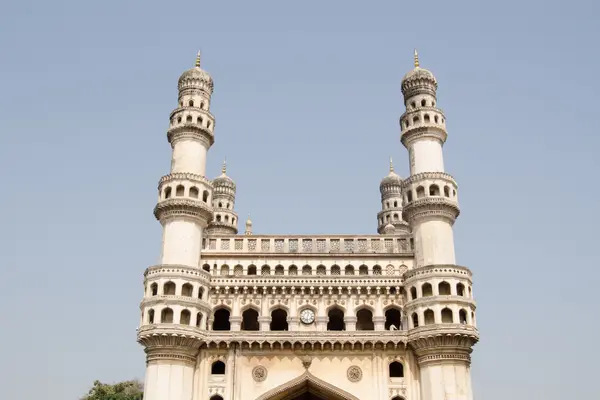
Quick answer: Charminar is the four-minaret monument at the centre of Hyderabad’s Old City, built in 1591 by Muhammad Quli Qutb Shah, the fifth Qutb Shahi sultan, when he founded the new city of Hyderabad. It is protected by the Archaeological Survey of India (ASI) and surrounded by the Laad Bazaar and Mecca Masjid. We could not confirm current entry fees or opening hours on an official page in October 2026, so check the ASI’s e-ticketing site before you go.
Charminar at a glance
| Detail | What we verified (October 2026) |
|---|---|
| Location | Old City, Hyderabad, on the east bank of the Musi; Laad Bazaar to the west, Mecca Masjid to the south-west |
| Built | 1591, by Muhammad Quli Qutb Shah |
| Protected by | Archaeological Survey of India (ticketed monument) |
| UNESCO status | On India’s Tentative List (submitted 2010), not a World Heritage Site |
| Entry fee and timings | Not confirmed on an official page; check the ASI e-ticketing site (asi.paygov.org.in) before visiting |
| Best time to visit | October to February, when the weather is cooler; evenings for the lit-up monument and bazaar |
| Time needed | About an hour for the monument; longer if you explore the bazaars |
An earlier version of this article said entry costs ₹5 for Indians and ₹100 for foreign visitors, with timings of 9:30 am to 5:30 pm. We could not confirm these figures on an official ASI page, and ASI fees have been revised since they were published, so we have not repeated them. Tickets for ASI monuments can be bought online through the ASI’s e-ticketing portal.
History of Charminar
Muhammad Quli Qutb Shah, the fifth ruler of the Qutb Shahi dynasty, moved his capital from Golconda to a new city on the banks of the Musi in the 1590s. Charminar was built in 1591 at the centre of that new city, Hyderabad, and its two main roads ran out from it east-west and north-south. Construction is generally said to have taken about two years. The architect is usually named as Mir Momin Astarabadi, a Persian who served the Qutb Shahi court.
Why it was built is not certain, and several accounts exist:
- According to the ASI, it is widely accepted that Charminar was built to mark the end of a plague in the city.
- The 17th-century French traveller Jean de Thévenot linked it to the start of the second Islamic millennium (the year 1000 of the Hijri calendar).
- Telangana Tourism retells a popular legend that the sultan built it where he first saw Bhagmati, though historians treat this as folklore.
The top floor of Charminar holds a mosque, and the building was also meant to serve as a madrasa (a place of learning). The clocks on its four faces were added much later, in 1889, under the Nizams.
Corrections to the earlier version
- An earlier version of this article said Charminar was built by “King Quli Qutub Shah”, the “fourth” Qutb Shahi king. It was built by Muhammad Quli Qutb Shah, the fifth sultan of the dynasty.
- It said the monument was “over 450 years” old and “perhaps the oldest monument in India”. Charminar dates from 1591, so it is about 435 years old in 2026, and India has many far older monuments.
- It said “Charminar” means “four pillars”. It means “four minarets” (char = four, minar = minaret).
- It said Charminar was the first multi-storey building in Hyderabad and that a carved cat on an arch marks the end of the plague. We could not find reliable sources for either claim, so they have been removed.
Architecture of Charminar
Charminar is a square structure, about 20 m on each side, with a grand arch facing each of the four directions. A minaret rises at each corner; according to Telangana Tourism, the minarets reach 48.7 m above ground level.
The repetition of the number four runs through the design: four arches, four minarets and four main directions. This is a large part of the monument’s appeal and of its name.
The secret tunnel story
A popular story says a secret tunnel linked Charminar to Golconda Fort as an escape route for the royal family. No such tunnel has ever been found. In August 2026 the ASI’s Hyderabad Circle examined a structure at Golconda Fort that had been described as a tunnel and found only a small chamber built of granite blocks, with no continuing passage, as reported by India Today. Treat the tunnel as a legend.
UNESCO and ASI status
Charminar is a centrally protected monument under the ASI. In September 2010 India submitted Charminar, Golconda Fort and the Qutb Shahi Tombs to UNESCO’s Tentative List of World Heritage Sites. Being on the Tentative List means a site may be nominated in the future; Charminar is not yet a World Heritage Site.
Places to visit near Charminar
- Mecca Masjid: the large Qutb Shahi-era mosque just south-west of Charminar. According to tradition, bricks made with soil brought from Mecca were used in its central arch, which gave the mosque its name.
- Laad Bazaar (Choodi Bazaar): the historic lane to the west of Charminar, best known for glass and lac bangles and bridal jewellery. Nearby Pathargatti is known for pearls.
- Chowmahalla Palace: the Nizams’ palace, less than 1 km away. See our guide to Chowmahalla Palace timings and entry fees.
- Salar Jung Museum: one of India’s great art collections, a short ride north on the banks of the Musi. See our Salar Jung Museum guide.
- Nehru Zoological Park: the city zoo, in Bahadurpura to the west of the Old City. See our Nehru Zoological Park guide.
The Bhagyalakshmi Temple, a small temple at the base of Charminar, is also visited by many devotees.
How to reach Charminar
- By metro: Charminar is not on a metro line. The nearest metro access to the Old City is MGBS station, the terminus of the Hyderabad Metro Green Line; from there take an auto-rickshaw, cab or city bus.
- By bus: city buses run to Charminar from the main bus stations and railway stations.
- By auto-rickshaw or cab: the easiest option for most visitors. Traffic in the Old City is heavy and the lanes are narrow, so allow extra time.
Tips for visiting
- Go early in the morning for the quietest visit, or in the evening to see the monument lit up and the bazaar at its busiest.
- The area is crowded, especially at weekends and during Ramzan, when the streets around Charminar fill with food stalls. Keep an eye on your belongings.
- Dress modestly, as Charminar stands next to working places of worship.
- Bargain politely in Laad Bazaar, and buy pearls only from shops you trust.
To see where the Qutb Shahi dynasty ruled before it moved to Hyderabad, visit Golconda Fort in the west of the city.
Frequently asked questions
Who built Charminar and when?
Muhammad Quli Qutb Shah, the fifth sultan of the Qutb Shahi dynasty, built Charminar in 1591 at the centre of his new capital, Hyderabad.
Why was Charminar built?
The reason is not certain. The most widely accepted account, cited by the ASI, is that it marks the end of a plague. Other accounts link it to the Islamic millennium or to the legend of Bhagmati.
What is the Charminar entry fee?
We could not confirm the current fee on an official page in October 2026. Charminar is an ASI ticketed monument, so check the ASI e-ticketing portal before you visit.
Is Charminar a UNESCO World Heritage Site?
No. It is on India’s Tentative List, submitted in 2010 together with Golconda Fort and the Qutb Shahi Tombs, but it has not been inscribed as a World Heritage Site.
Is there a tunnel from Charminar to Golconda Fort?
No tunnel has ever been found. It is a popular legend, and the ASI’s 2026 examination of a supposed tunnel at Golconda found only a small granite chamber.
Details checked in October 2026 against Telangana Tourism, the ASI’s published description of the monument, UNESCO Tentative List records and news reporting. Fees and timings for ASI monuments change, so check the ASI’s e-ticketing site before you visit.