Quick answer: Golconda Fort is a hilltop fortress in western Hyderabad that grew from a Kakatiya-era mud fort into the granite capital of the Qutb Shahi sultans, and the region’s mines were the source of famous diamonds such as the Koh-i-Noor. It is protected by the Archaeological Survey of India (ASI) and is on UNESCO’s Tentative List, but it is not a World Heritage Site. We could not confirm current entry fees or daytime hours on an official page in October 2026, so check the ASI’s e-ticketing site; the evening sound and light show schedule is published by Telangana Tourism.
Golconda Fort at a glance
| Detail | What we verified (October 2026) |
|---|---|
| Location | Western Hyderabad, about 9 km from Hussain Sagar Lake (Telangana Tourism) |
| Built by | Begun as a mud fort under the Kakatiyas; rebuilt in granite by the Qutb Shahi sultans in the 16th century |
| Protected by | Archaeological Survey of India (ticketed monument) |
| UNESCO status | On India’s Tentative List, not a World Heritage Site |
| Entry fee and daytime timings | Not confirmed on an official page; check the ASI e-ticketing site (asi.paygov.org.in) |
| Sound and light show | Three shows each evening: English, Hindi and Telugu (times below) |
| Best time to visit | October to February; start early, as the climb is exposed to the sun |
| Time needed | Two to three hours; add an hour if you stay for the evening show |
An earlier version of this article said entry costs ₹15 for Indians and ₹200 for foreign visitors, with timings of 9 am to 5:30 pm. We could not confirm these figures on an official page, and ASI fees have been revised since then, so we have not repeated them. Check the ASI e-ticketing site or the ticket counter before you go.
Sound and light show timings
According to Telangana Tourism’s show page, the Golconda Fort laser and multimedia show runs three times every evening:
- November to February: English at 6:30 pm, Hindi at 7:15 pm, Telugu at 8:00 pm.
- March to October: English at 7:00 pm, Hindi at 7:45 pm, Telugu at 8:30 pm.
Telangana Tourism does not list show ticket prices on that page. Book through Telangana Tourism or at the fort, and confirm that the show is running on your date.
Where the name comes from
The name is usually traced to the Telugu Golla Konda, “shepherd’s hill”. A popular legend, retold by Telangana Tourism, says a shepherd boy found an idol on the hill, which led the Kakatiya king to build a mud fort there. An earlier version of this article also linked “Gol” to the Hindi word for “round”; we found no reliable source for that, so it has been removed.
History of Golconda Fort
Telangana Tourism dates the fort to 1143, when the place was known as Mangal. The Kakatiya rulers of Warangal are credited with the first mud fort on the hill. The Bahmani sultans later took control of it, and they sent Sultan Quli as governor of the region around 1501.
Sultan Quli declared independence in 1518 and founded the Qutb Shahi dynasty, with Golconda as its seat. Over the next 62 years, the first three Qutb Shahi sultans turned the mud fort into a massive granite fortress about 5 km in circumference, with an outer wall enclosing the city. Golconda stayed the capital until 1590, when the court moved to the new city of Hyderabad, where Charminar was built in 1591.
The fort’s history ended in 1687, when the Mughal emperor Aurangzeb captured it after an eight-month siege and took the last Qutb Shahi sultan, Abul Hasan Qutb Shah, prisoner.
An earlier version of this article gave 1538 as the year Sultan Quli became independent. Most sources give 1518.
Golconda and its diamonds
Golconda’s name is tied to diamonds. The mines of the region, including the Kollur mine, produced many of the world’s most famous stones, and Golconda was the great trading centre for them. Diamonds believed to come from Golconda’s mines include:
- the Koh-i-Noor
- the Hope Diamond
- the Daria-i-Noor
- the Noor-ul-Ain
- the Regent
- the Wittelsbach-Graff
The fort is said to have had a vault where the Koh-i-Noor and the Hope Diamond were once kept. Because of this wealth, “Golconda” came to be used in English for any rich mine or source of great riches.
An earlier version of this article said 23 of India’s 38 diamond mines were near Golconda. We found no reliable source for those numbers, so they have been removed.
What to see at Golconda Fort
Fateh Darwaza and the clapping portico
The Fateh Darwaza (Victory Gate), named after Aurangzeb’s victorious army, has iron spikes to stop war elephants from ramming it. Under the dome near the entrance, a hand clap is said to be heard clearly at the Bala Hisar pavilion at the top of the hill, almost a kilometre away. It is often described as an early warning system for the royal household, and guides usually demonstrate it.
Bala Hisar and the climb
The path climbs past ruined buildings to the Bala Hisar, the highest point of the fort, with wide views over Hyderabad and the Qutb Shahi Tombs. The Bala Hisar gate on the eastern side, decorated with peacocks and mythical yalis, is the main entrance to the citadel. The climb is steep in places, so wear good shoes and carry water.
Other structures
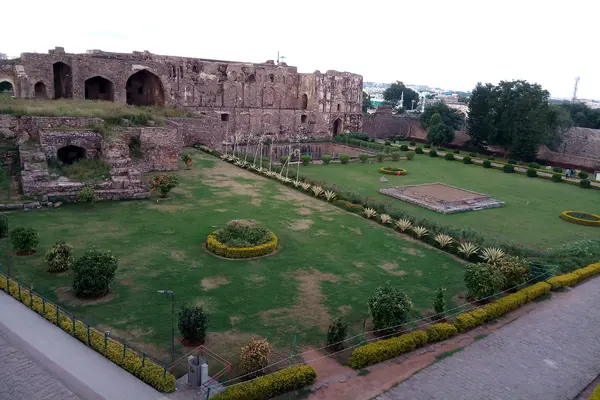
Inside the walls are the remains of palaces, halls, mosques, stores, stables and gardens, including the Taramati Mosque, the Ambar Khana (granary), the Nagina Bagh garden, and the cell known as Ramadas Bandikhana, where the poet-saint Bhakta Ramadas is said to have been imprisoned.
The tunnel legend
Stories have long claimed that secret tunnels ran from the fort’s durbar hall to the foot of the hill, or even to Charminar. None has been found. In August 2026 the ASI’s Hyderabad Circle examined a structure at the fort that had been reported as a hidden tunnel and found a small chamber built of granite blocks, with no continuing passage, as reported by India Today.
Naya Qila and the Hathiyan ka Jhad
Naya Qila (“new fort”) is an extension of Golconda Fort, begun by Sultan Abdullah Qutb Shah in 1656 after a Mughal siege. In it stands Hathiyan ka Jhad (“elephant tree”), an African baobab said to be more than 400 years old, with a girth of about 27 m. Tradition says Arab traders gave it to Sultan Muhammad Quli Qutb Shah. Part of the Naya Qila area is now a golf course, which makes access more complicated.
An earlier version of this article described a 240 kg iron stone that job-seekers had to lift with one hand. We found no reliable source for this story, so it has been removed.
Heritage status
Golconda Fort is on the ASI’s list of Monuments of National Importance under the Ancient Monuments and Archaeological Sites and Remains Act. India has also placed the Qutb Shahi monuments of Hyderabad (Golconda Fort, the Qutb Shahi Tombs and Charminar) on UNESCO’s Tentative List. An earlier version of this article called Golconda a UNESCO World Heritage Site. It is not; being on the Tentative List means it may be nominated in the future.
How to reach Golconda Fort
- By road: the fort is in the west of the city, about 9 km from Hussain Sagar Lake, according to Telangana Tourism. Auto-rickshaws, app cabs and city buses go to the fort.
- From the Old City: allow plenty of time from Charminar, as traffic through the city can be slow.
- Qutb Shahi Tombs: the tombs of the Qutb Shahi rulers lie about 1 km north of the fort’s outer wall and make an easy second stop.
Tips for visiting
- Start in the morning, before the heat, if you plan to climb to the Bala Hisar.
- Wear comfortable shoes with good grip and carry water.
- Hire a licensed guide at the entrance if you want to hear the history and see the acoustics demonstrated.
- If you plan to see the sound and light show, check the season’s timings above and arrive early.
Places to visit near Golconda Fort
Golconda pairs well with the Qutb Shahi Tombs next door. The Qutb Shahis moved their capital to Hyderabad in 1590, so the story continues at Charminar in the Old City. For a quieter half-day, combine the fort with Birla Mandir, the marble temple overlooking Hussain Sagar, or, if you have children with you, the Nehru Zoological Park.
Frequently asked questions
Who built Golconda Fort?
The Kakatiya rulers built the first mud fort on the hill. The Qutb Shahi sultans, starting with Sultan Quli in the early 16th century, rebuilt and expanded it into the granite fortress seen today.
Is Golconda Fort a UNESCO World Heritage Site?
No. It is on India’s UNESCO Tentative List, together with the Qutb Shahi Tombs and Charminar, but it has not been inscribed.
What are the Golconda sound and light show timings?
According to Telangana Tourism, there are three shows each evening. From November to February they start at 6:30 pm (English), 7:15 pm (Hindi) and 8:00 pm (Telugu); from March to October at 7:00 pm, 7:45 pm and 8:30 pm.
What is the Golconda Fort entry fee?
We could not confirm the current fee on an official page in October 2026. Golconda is an ASI ticketed monument, so check the ASI e-ticketing site before you visit.
Was the Koh-i-Noor found at Golconda?
The Koh-i-Noor is believed to have come from the Golconda region’s mines, most likely the Kollur mine, rather than from the fort itself. Golconda was the trading centre for these diamonds.
Details checked in October 2026 against Telangana Tourism’s pages on Golconda Fort and its sound and light show, ASI and UNESCO Tentative List records, standard histories of the Qutb Shahi dynasty, and news reporting on the ASI’s 2026 findings. Fees and timings change, so check before you visit.