Quick answer: World Population Day is observed every year on 11 July to draw attention to population issues such as family planning, gender equality, maternal health, poverty and human rights. It was established in 1989 by the Governing Council of the United Nations Development Programme (UNDP), inspired by interest in the “Day of Five Billion” on 11 July 1987. The world’s population passed 8 billion on 15 November 2022, according to the United Nations.

Why is World Population Day observed?
The day exists to raise awareness of how population size and change affect people’s lives and the planet. The United Nations and its sexual and reproductive health agency, the United Nations Population Fund (UNFPA), use it to focus on issues such as:
- the importance of family planning and access to reproductive health care;
- gender equality and the rights of women and girls;
- maternal health;
- poverty and development;
- human rights, including the right of people to decide freely whether and when to have children.
This article was first written in 2016, when the main message was that the world’s population was growing fast and needed to be “controlled”. The UN’s framing has shifted since then. Global growth is slowing, fertility rates are falling in many countries, and recent World Population Day themes focus less on numbers and more on people’s ability to make their own choices about family life.
World population then and now
Population growth is still a big story, but the figures have moved on since this page was written:
| Point in time | World population |
|---|---|
| 1950 | About 2.5 billion |
| 11 July 1987 (“Day of Five Billion”) | About 5 billion |
| 2011 | 7 billion |
| 2016 (when this article was first written) | About 7.4 billion |
| 15 November 2022 | 8 billion |
| Projected peak, mid-2080s | About 10.3 billion |
According to the UN, it took 12 years for the world to grow from 7 to 8 billion, and it is expected to take about 15 years, until around 2037, to reach 9 billion, a sign that growth is slowing. The UN projects that the population will peak at about 10.3 billion in the mid-2080s and then decline slightly to about 10.2 billion by 2100. One in four people already lives in a country whose population has peaked.
The challenges the original article named are still the ones the UN highlights: making growth sustainable, managing the movement of people from villages to cities, giving everyone access to health services, and creating opportunities for young people.
When did World Population Day start?
On 11 July 1987 the world’s population reached about five billion, a milestone that attracted wide public interest and became known as the Day of Five Billion. In 1989, the Governing Council of the UNDP recommended that 11 July be observed by the international community as World Population Day, “a day to focus attention on the urgency and importance of population issues”, as UNFPA puts it. An earlier version of this article said the United Nations “selected” the date in 1989; the recommendation came from the UNDP’s Governing Council.
World Population Day themes
Each year the UN and UNFPA choose a theme. Some recent and past ones:
- 2015: “Vulnerable Populations in Emergencies”, at a time when about 60 million people were displaced by crises, according to UN figures cited by UNFPA.
- 2025: “Empowering young people to create the families they want in a fair and hopeful world”.
- 2026: “Realizing the hopes and aspirations of young people – today and for the future”, based on a UNFPA survey of young adults aged 18 to 39 in 73 countries.
The theme for the coming year is usually announced by UNFPA shortly before 11 July, so check the UNFPA or UN website for the latest one.
Quotes on population
The original article collected quotes about population without saying who said most of them. We have checked each one. Where we could confirm the source, it is named; where we could not, the quote is marked “often attributed to” or left unnamed.
- “Close to a billion people – one-eighth of the world’s population – still live in hunger. Each year 2 million children die through malnutrition. This is happening at a time when doctors in Britain are warning of the spread of obesity. We are eating too much while others starve.” (Source not confirmed. The figures date from the 2000s; the UN’s current hunger estimates differ.)
- “Almost half of the population of the world lives in rural regions and mostly in a state of poverty. Such inequalities in human development have been one of the primary reasons for unrest and, in some parts of the world, even violence.” Often attributed to A. P. J. Abdul Kalam, former President of India.

- “If we do not voluntarily bring population growth under control in the next one or two decades, the nature will do it for us in the most brutal way, whether we like it or not.” (Source not confirmed.)
- “A finite world can support only a finite population; therefore, population growth must eventually equal zero.” Garrett Hardin, ecologist, in his 1968 essay The Tragedy of the Commons.

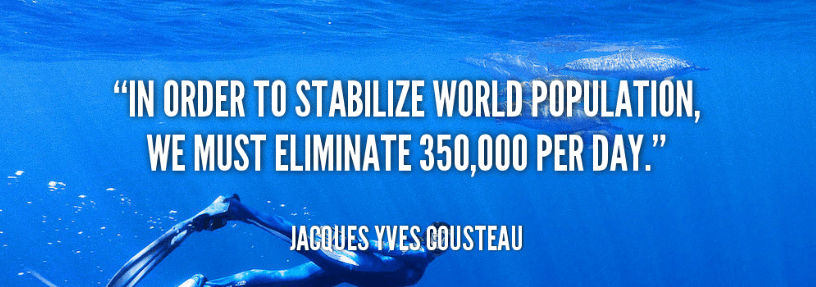
An earlier version also listed a line about “eliminating 350,000 people per day”, attributed to the ocean explorer Jacques-Yves Cousteau from a 1991 interview. We could not check its original wording or context, and it is easily read as a call for harm, so we have removed it. We also removed a quote about US job numbers and “President Obama”, which was about American politics rather than population.
- “An educated, enlightened and informed population is one of the surest ways of promoting the health of a democracy.” Often attributed to Nelson Mandela; we could not find it in his published speeches.

- “Population, when unchecked, goes on doubling itself every twenty-five years or increases in a geometrical ratio.” Thomas Robert Malthus, An Essay on the Principle of Population (1798). The same essay gives the shorter form: “Population, when unchecked, increases in a geometrical ratio.”

Malthus argued that population would always outgrow the food supply. Food production has in fact grown faster than he expected, which is one reason his predictions are now treated as history rather than forecasts. For more quotes from two of the people named above, see our collections of A. P. J. Abdul Kalam quotes and Nelson Mandela quotes.
Other days we cover include International Day of Yoga on 21 June and Father’s Day.
Frequently asked questions
When is World Population Day?
Every year on 11 July.
Who started World Population Day?
The Governing Council of the United Nations Development Programme recommended it in 1989. It is now led by UNFPA, the United Nations Population Fund.
Why was 11 July chosen?
Because the world’s population was estimated to have reached five billion on or around 11 July 1987, the “Day of Five Billion”.
What is the world population now?
The UN says the world passed 8 billion people on 15 November 2022 and expects about 9 billion around 2037. For the latest estimate, see the UN’s World Population Prospects data.
What is the theme of World Population Day 2026?
“Realizing the hopes and aspirations of young people – today and for the future”, according to the UN and UNFPA.
Checked in November 2026 against the United Nations’ World Population Day and population pages, UNFPA’s World Population Day pages for 2015, 2025 and 2026, Wikiquote, and the text of Malthus’s 1798 essay.