Quick answer: Dilli Haat INA is an open-air crafts and food bazaar in South Delhi, opposite INA Market, run by the Delhi Tourism and Transportation Development Corporation (DTTDC). Craftspeople from across India sell their own work here on a rotating basis, and food stalls serve regional dishes from many states. As of October 2026, Delhi Tourism lists it as open daily from 11 am to 8 pm, with entry tickets of ₹30 for adults, ₹20 for children and ₹100 for foreign visitors.
Dilli Haat INA at a glance
| Detail | What to know |
|---|---|
| Location | Opposite INA Market, Sri Aurobindo Marg, South Delhi |
| Timings | 11 am to 8 pm, open daily (Delhi Tourism, checked October 2026) |
| Entry fee | ₹30 adults, ₹20 children, ₹100 foreigners; tickets sold at the gate (Delhi Tourism, checked October 2026) |
| Run by | Delhi Tourism and Transportation Development Corporation (DTTDC) |
| Nearest metro | Dilli Haat – INA (Yellow and Pink lines) |
| Time needed | 2 to 3 hours (general guidance) |
| Best time to visit | October to March evenings, and weekdays for smaller crowds (general guidance) |
An earlier version of this article gave the hours as 10:30 am to 10 pm and the children’s ticket as ₹10. Delhi Tourism’s current page lists 11 am to 8 pm and ₹20 for children, so those figures have been updated. Hours can change for festivals and special events, so check the Delhi Tourism website (delhitourism.gov.in) or call the Dilli Haat office before a late visit.
What is Dilli Haat?
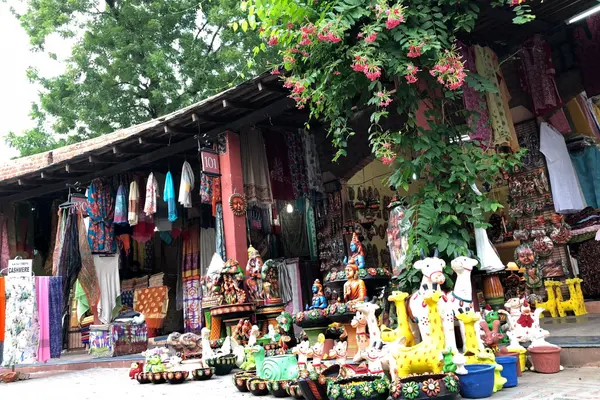
A haat is a traditional village market, usually held on a fixed day of the week. Dilli Haat recreates that idea as a permanent, paid-entry bazaar in the middle of the city. Its 6-acre site, reclaimed as part of a land reclamation project, was laid out with low brick-and-stone stalls, thatched or tiled roofs and paved courtyards, which give it the feel of a village market rather than a mall.
The main draw is that you can buy directly from the people who make the goods. According to Delhi Tourism, craft stalls are allotted on rotation, usually for 15 days at a time, to craftspeople registered with the Development Commissioner (Handicrafts), for a nominal fee. Because the sellers keep changing, you can find different crafts on different visits, and prices are not inflated by the high overheads of city showrooms.
History of Dilli Haat
Dilli Haat INA opened in March 1994. It was set up jointly by Delhi Tourism (DTTDC), the New Delhi Municipal Council, the Development Commissioners for Handicrafts and Handlooms under the Ministry of Textiles, and the Ministry of Tourism. Around 2003 the complex became fully wheelchair-accessible, including an accessible toilet.
The success of the INA site led DTTDC to open two more: Dilli Haat Pitampura, near the Pitampura TV Tower, in April 2008, and Dilli Haat Janakpuri in August 2013. The INA Haat has also hosted many festivals and events; India’s first Comic Con was held here in February 2011.
2025 fire: On the night of 30 April 2025, a fire at Dilli Haat INA gutted about 26 stalls, according to All India Radio; no one was reported hurt. The bazaar reopened in May 2025 after repairs, and DTTDC later announced plans to upgrade CCTV surveillance.
What to buy at Dilli Haat
Stock changes with the rotating stalls, but you can typically find:
- handloom textiles, silk and wool fabrics, shawls and stoles;
- ethnic wear such as chikankari kurtis, and footwear such as Kolhapuri chappals and embroidered juttis;
- jewellery, beads and gems;
- brassware, metal crafts and carved wood, including rosewood and sandalwood carvings;
- pottery, ceramics, lamps, wall hangings, paintings and home decor;
- regional products such as organic foods and oils.
Bargaining is common at many craft stalls, but be fair: much of the money goes straight to the artisan. Many stalls accept UPI, but it is worth carrying some cash for small purchases.
Food at Dilli Haat
The food court is one of the main reasons locals visit. Stalls are run by or for different states, so you can sample regional food you may not find elsewhere in Delhi. Delhi Tourism mentions dishes such as momos from Sikkim, bamboo-shoot chicken from Nagaland, kahwa and kebabs from Jammu and Kashmir, puran poli from Maharashtra and dhokla from Gujarat. Expect simple open-air seating rather than a restaurant, and try something new rather than your usual order.
Things to do
- Walk the rows of craft stalls and talk to the artisans about how their work is made.
- Eat your way around the state food stalls.
- Check the exhibition hall, which hosts shows promoting handicrafts and handlooms.
- Look out for cultural programmes, live music and dance performances, which are held from time to time, especially around festivals.
- Take photographs: the colourful stalls and courtyards are popular backdrops. Mehendi (henna) artists and similar small services are often found near the entrance.
How to reach Dilli Haat INA
- By metro: Dilli Haat – INA station, an interchange between the Yellow and Pink lines, is the nearest. The Haat is a short walk from the station exits.
- By road: the Haat is on Sri Aurobindo Marg, opposite INA Market. Autos and app cabs can drop you at the gate; parking is limited at busy times.
Do not confuse the INA Haat with the newer Dilli Haats in Pitampura (nearest metro: Netaji Subhash Place) and Janakpuri (nearest metro: Janakpuri East). They follow the same idea but have different layouts and event calendars.
Tips for visiting
- Weekdays are calmer than weekends and holidays.
- In summer, visit in the evening and carry water; in winter, the open-air food court is at its best.
- Compare a few stalls before buying, and ask the seller where the item was made.
- Keep your bags close in crowds, as you would in any busy market.
Nearby places to visit
INA Market, across the road, is known as Delhi’s food bazaar for fresh produce, seafood, spices and imported foods; Delhi Tourism notes that it closes on Mondays. For more shopping, Sarojini Nagar Market is close by for budget clothes, and Lajpat Nagar Market is a few metro stops away for ethnic wear. If you prefer history, Safdarjung’s Tomb and Lodhi Gardens are a short drive north.
Frequently asked questions
What are Dilli Haat INA’s timings?
As of October 2026, Delhi Tourism lists 11 am to 8 pm, every day. Timings can be extended or changed for special events.
How much is the Dilli Haat entry ticket?
₹30 for adults, ₹20 for children and ₹100 for foreign visitors, according to Delhi Tourism (checked October 2026).
Which metro station is closest to Dilli Haat?
Dilli Haat – INA metro station, on the Yellow and Pink lines. For Dilli Haat Pitampura, use Netaji Subhash Place; for Dilli Haat Janakpuri, use Janakpuri East.
Is Dilli Haat open after the 2025 fire?
Yes. About 26 stalls were damaged in the fire on 30 April 2025, and the bazaar reopened in May 2025 after repairs.
Can I bargain at Dilli Haat?
Bargaining is common at craft stalls, but prices are usually set by the artisans themselves, so keep it reasonable.
Details checked in October 2026 against Delhi Tourism’s Dilli Haat INA page, published histories of the market and news reports on the April 2025 fire. Timings and ticket prices can change, so check Delhi Tourism before you visit.