Quick answer: Safdarjung’s Tomb is an 18th-century garden tomb in central New Delhi, at the junction of Lodhi Road and Aurobindo Marg, built in 1753–54 for Safdarjung, Nawab of Awadh and prime minister of the Mughal Empire. It is often called the last great Mughal garden tomb, and it is usually quieter than Humayun’s Tomb. Delhi Tourism lists it as open daily from sunrise to sunset, with tickets at ₹25 for Indians and ₹300 for foreigners (checked October 2026); confirm the current fee on the ASI e-ticket portal before you go.
Safdarjung’s Tomb at a glance
| Detail | What to know |
|---|---|
| Location | Junction of Lodhi Road and Aurobindo Marg, New Delhi, next to Safdarjung Airport |
| Timings | Sunrise to sunset, open daily (Delhi Tourism, checked October 2026) |
| Entry fee | ₹25 for Indians, ₹300 for foreigners; still photography free, ₹25 for a video camera (Delhi Tourism, checked October 2026). Online ticket prices on the ASI portal may differ. |
| Managed by | Archaeological Survey of India (ASI), Delhi Circle |
| Nearest metro | Jor Bagh (Yellow Line) |
| Time needed | About an hour (general guidance) |
| Best time to visit | October to March, early morning or late afternoon (general guidance) |
Repair work in 2026: According to an ASI Delhi Circle reply under the Right to Information Act, reported by The Pioneer in September 2026, repair work is under way on the mosque and adjoining cells inside the complex. The main tomb was not listed as closed, but some corners of the site may be fenced off.
History of Safdarjung’s Tomb
Safdarjung was the title of Mirza Muqim Abul Mansur Khan (1708–1754), the second Nawab of Awadh. He moved to Delhi after Emperor Muhammad Shah died in 1748, and under the new emperor, Ahmad Shah Bahadur, he became wazir (prime minister) of a Mughal Empire that by then controlled only part of northern India. Rival nobles forced him out of Delhi in 1753, and he died in Awadh in 1754.
His son, Nawab Shuja-ud-Daula, asked the emperor for permission to build a tomb for him in Delhi. The result, completed in 1753–54, was the first time someone outside the immediate imperial family built a grand Mughal-style garden tomb for himself, which says a lot about how weak the emperors had become. Some accounts name the designer as an Abyssinian architect, Bilal Muhammad Khan.
The ASI describes the tomb as the last example of the charbagh garden layout and “the last flicker in the lamp of Mughal architecture at Delhi”. That phrase is why the monument is so often compared with Humayun’s Tomb, built nearly two centuries earlier, and with the Taj Mahal.
Architecture: what makes it different
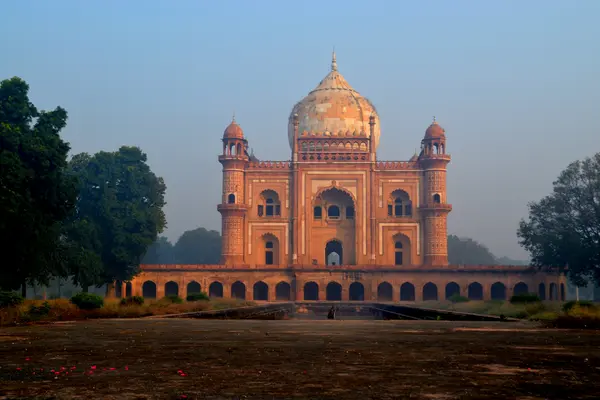
At first sight, the domed tomb on its high platform recalls the Taj Mahal and Humayun’s Tomb. Look closer and the differences show:
- Materials: the mausoleum is built of red and buff stone, relieved with marble. The Taj Mahal, by contrast, is faced almost entirely in white marble. Some of the stone slabs are said to have been taken from the nearby tomb of Abdul Rahim Khan-i-Khana.
- Proportions: the dome is more elongated and the facade more vertical than the earlier tombs. Critics have long called the building less balanced than the Taj, and Bishop Reginald Heber famously said its stone had “the colour of potted meat”.
- Corner towers: four polygonal towers topped with chhatris (domed kiosks) are attached to the main building, rather than standing apart as the Taj’s minarets do.
- Inside: the central chamber holds a single cenotaph. The actual graves of Safdarjung and his wife are in an underground chamber below, which is not open to visitors.
The tomb stands in a walled charbagh garden about 280 metres (roughly 920 feet) on each side, divided into four parts by wide paths and water channels. The ornate two-storey gateway on the east carries an Arabic inscription, and the ASI maintains a library above it.
What to see
- The main mausoleum, its rococo-style plaster decoration inside and the views of the garden from the platform.
- The gateway, with its heavily ornamented plaster facade.
- The three-domed mosque to the right of the gateway, marked with stripes (currently under repair).
- The garden pavilions along the walls, which have evocative names: Jangli Mahal (Palace in the Woods), Moti Mahal (Pearl Palace) and Badshah Pasand (the King’s Favourite).
- The madrasa (religious school) within the complex.
The symmetrical garden and the long view from the gate to the tomb make this one of Delhi’s best monuments for photography, especially in soft morning or late-afternoon light.
Timings and entry fee
As of October 2026, Delhi Tourism lists Safdarjung’s Tomb as open every day from sunrise to sunset. Its page gives the entry fee as ₹25 for Indian visitors and ₹300 for foreign visitors, with no charge for still cameras and ₹25 for video cameras. An earlier version of this article gave two different sets of fees and a 7 am to 6 pm timing; those figures were out of date and have been replaced.
Tickets can be bought on the ASI’s online booking portal (asi.paygov.org.in). At some ASI monuments, online (cashless) tickets cost less than cash tickets at the counter, so check the portal for the current price before you go.
How to reach Safdarjung’s Tomb
- By metro: Jor Bagh station on the Yellow Line is the nearest, according to Delhi Tourism. From there, the tomb is a short walk or auto-rickshaw ride.
- By road: the tomb sits at the T-junction of Lodhi Road and Aurobindo Marg, so buses, taxis and app cabs can drop you at the gate.
- By air: Indira Gandhi International Airport is Delhi’s passenger airport. An earlier version of this article named Safdarjung Airport as the nearest airport; although it is right next door, it does not handle scheduled passenger flights.
Tips for visiting
- Delhi is very hot from April to June and can be smoggy in winter. In summer, go early or in the late afternoon; in winter, mornings are pleasant once the fog lifts.
- Carry water, as there is little shade in the open garden at midday.
- Keep some cash or UPI ready for the ticket counter and small vendors outside.
- Government-approved guides work at many Delhi monuments. If you hire one, agree on the fee first.
- Commercial filming needs ASI permission; ordinary still photography is allowed.
Nearby places to visit
Safdarjung’s Tomb fits easily into a half-day in central and south Delhi. A popular plan is to start here and walk or take a short ride to Lodhi Gardens, with its 15th- and 16th-century tombs, then continue to Khan Market for food and shopping. To see the earlier Mughal garden tomb that inspired this one, visit Humayun’s Tomb near Nizamuddin. Dilli Haat at INA, the crafts and food bazaar, is a short drive south, and the medieval reservoir and ruins of Hauz Khas are a little further on.
Frequently asked questions
Who built Safdarjung’s Tomb?
It was built in 1753–54 by Nawab Shuja-ud-Daula for his father, Safdarjung, the Nawab of Awadh and prime minister (wazir) of the Mughal Empire.
Is Safdarjung’s Tomb open on Mondays?
Yes. Delhi Tourism lists it as open daily, from sunrise to sunset.
What is the entry fee for Safdarjung’s Tomb?
As of October 2026, Delhi Tourism lists ₹25 for Indians and ₹300 for foreigners. The ASI’s online portal is the best place to confirm the current price, which can differ for online and cash payment.
Which metro station is nearest to Safdarjung’s Tomb?
Jor Bagh on the Yellow Line.
How is Safdarjung’s Tomb different from Humayun’s Tomb?
Both are Mughal garden tombs, but Humayun’s Tomb (completed in the 1570s) was the first of the grand imperial tombs and is a UNESCO World Heritage Site. Safdarjung’s Tomb came at the very end of the tradition, in the 1750s, and is smaller and less refined, but also much less crowded.
Details checked in October 2026 against the Archaeological Survey of India’s monument description and ticketed-monument list, Delhi Tourism’s visitor page, and published histories of the tomb. Timings and fees can change, so check the ASI portal or Delhi Tourism before you visit.