Quick answer: Hauz Khas in South Delhi combines a medieval monument complex with one of the city’s trendiest neighbourhoods. The “royal tank” was dug by Sultan Alauddin Khalji (1296–1316) to supply his city of Siri, and Firuz Shah Tughlaq later built a madrasa, a mosque and his own tomb on its banks; around them, Hauz Khas Village is now full of boutiques, cafés and art galleries. As of October 2026, Delhi Tourism lists the ASI-protected Hauz Khas complex as open daily from 10:30 am to 7 pm, with tickets at ₹20 for Indian adults and ₹250 for foreign adults.
Hauz Khas complex at a glance
| Detail | What to know |
|---|---|
| Location | Hauz Khas Village, South Delhi |
| Timings | 10:30 am to 7 pm, open all days (Delhi Tourism, checked October 2026) |
| Entry fee | ₹20 Indian adults, ₹250 foreign adults (Delhi Tourism, checked October 2026); book on the ASI e-ticket portal |
| Protected by | Archaeological Survey of India (listed as “Group of Buildings at Hauz Khas”) |
| Nearest metro | IIT (Magenta Line); Hauz Khas (Yellow and Magenta lines); Green Park (Yellow Line) |
| Time needed | 1 hour for the monuments, longer for the village and lake (general guidance) |
Repairs in 2026: according to an ASI reply under the Right to Information Act, reported by The Pioneer in September 2026, a portion of the Hauz Khas group of buildings has been closed to visitors while emergency structural repairs are carried out.
An earlier version of this article said the complex is open from Monday to Saturday. Delhi Tourism’s current listing says it is open on all days, from 10:30 am to 7 pm.
History of Hauz Khas
The name Hauz Khas means “royal tank” (hauz: water tank or lake; khas: royal). According to the ASI, Sultan Alauddin Khalji of the Delhi Sultanate had a large tank excavated, named Hauz-i-Alai, to supply water to the people of Siri, the second city of medieval Delhi, which he founded. When it was built, the reservoir was far larger than today’s lake.
Over time the tank silted up. Sultan Firuz Shah Tughlaq (ruled 1351–88) had it desilted and repaired, and built a group of buildings along its southern and eastern banks. Those ruins are what we now call Hauz Khas. An earlier version of this article attributed the mosque and tomb to the Khalji dynasty; the buildings on the banks of the tank are from Firuz Shah Tughlaq’s time.
Delhi Tourism’s page on the reservoir gives the year of construction as 1284, which does not match Alauddin Khalji’s reign; this article follows the ASI’s description, which dates the tank to his reign (1296–1316).
What to see in the Hauz Khas complex
The madrasa
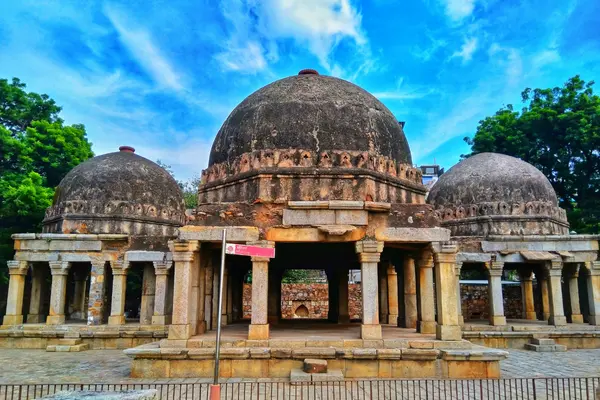
Firuz Shah built a madrasa (Islamic college) here in 1352–53, according to the ASI. It was one of the leading centres of learning in the Delhi Sultanate. The L-shaped, two-storey building runs along the south and east edges of the tank, with colonnaded halls and staircases leading down towards the water.
Firuz Shah Tughlaq’s tomb
At the corner where the two arms of the madrasa meet stands Firuz Shah’s tomb, a square chamber of plastered rubble with high, slightly sloping walls and a lofty dome. The ASI notes that the inside of the dome and its corners are decorated with plaster work and paintings, and that the inscriptions over the southern doorway were added in 1507, when Sikandar Lodi repaired the tomb. Of the four graves inside, the central one is Firuz Shah’s; two others are believed to be those of his son and grandson.
The mosque and pavilions
A small mosque joins the northern end of the madrasa, and several domed pavilions (chhatris) stand in the gardens. Some of these octagonal and square chhatris are thought to be the tombs of the madrasa’s teachers.
The lake
The surviving reservoir is now a lake in the District Park, home to many birds. For years it was badly polluted by sewage. Since 2019, a citizen-led project has created wetlands to clean the water, and the lake is a popular spot for walks and photography.
Hauz Khas Village today
The old village around the monuments has been transformed since the 1980s. According to Delhi Tourism, it began with designer Bina Ramani opening a boutique here in 1988, and Hauz Khas soon became known as “the national capital of ethnic chic”. Today its narrow lanes and converted old houses hold boutiques, handicraft and curio shops, art galleries, cafés, restaurants and bars, which attract young people from across the city and many foreign visitors. The surrounding residential area, Hauz Khas Enclave, was developed in the 1960s.
Shops, galleries and nightspots open and close frequently, so check current listings. An earlier version of this article recommended specific bars and their ladies’ night offers; those details could not be verified and have been removed.
Deer Park and Rose Garden
Next to the village, the A.N. Jha Deer Park, named after the social worker Aditya Nath Jha, is part of a large green belt with the District Park (around the lake) and the Rose Garden. It is popular for morning walks, jogging and picnics.
Visitors should not expect large herds of deer any more. In June 2023 the Central Zoo Authority cancelled the park’s recognition as a mini zoo, and many of the deer have since been moved to wildlife reserves in Rajasthan; a 2026 Supreme Court ruling, as reported by legal news sites, allowed further relocation while permitting a small number to remain.
Other monuments nearby
- Chor Minar: a tower traditionally linked to Alauddin Khalji’s time, where, according to local tradition, the heads of executed thieves (chor) were displayed.
- Neeli Masjid: a small old mosque in the neighbourhood.
- Siri Fort: the remains of Alauddin Khalji’s city, along with the Siri Fort Auditorium and Sports Complex nearby.
How to reach Hauz Khas
- By metro: Delhi Tourism lists IIT (Magenta Line) as the nearest station to the complex and Hauz Khas (Yellow Line) for the reservoir. Hauz Khas station is an interchange between the Yellow and Magenta lines and, at 29 metres below ground, is the deepest station on the Delhi Metro. Green Park (Yellow Line) is also close to the village.
- By road: autos and app cabs can drop you at the village entrance. Parking is limited, especially in the evenings and at weekends.
Tips for visiting
- Visit the monuments in the late afternoon, then stay for sunset over the lake.
- Weekday mornings are quietest; evenings and weekends are crowded.
- Wear comfortable shoes, as the madrasa has uneven floors and steps.
- If you go out at night in the village, arrange your ride home in advance and keep your belongings secure.
Nearby places to visit
From Hauz Khas, Qutub Minar is a short drive south, and the 14th-century Khirki Mosque is near Saket. Safdarjung’s Tomb and Dilli Haat INA are a few kilometres north along Aurobindo Marg.
Frequently asked questions
Who built Hauz Khas?
Alauddin Khalji (ruled 1296–1316) built the royal tank for his city of Siri. Firuz Shah Tughlaq (ruled 1351–88) desilted it and built the madrasa, mosque and his own tomb on its banks.
What are the Hauz Khas complex timings?
As of October 2026, Delhi Tourism lists 10:30 am to 7 pm, open on all days.
Is there an entry fee for the Hauz Khas complex?
Yes. Delhi Tourism lists ₹20 for Indian adults and ₹250 for foreign adults (checked October 2026). It is a ticketed ASI monument, so you can book on the ASI’s online portal.
Which metro station is nearest to Hauz Khas Village?
IIT (Magenta Line) is nearest to the complex, according to Delhi Tourism. Hauz Khas (Yellow and Magenta) and Green Park (Yellow) are also close.
Are there still deer in Hauz Khas Deer Park?
Only a small number. Most of the deer have been relocated since 2023, under orders that the Supreme Court upheld in 2026.
Details checked in October 2026 against the Archaeological Survey of India’s monument description and ticketed-monument list, Delhi Tourism’s Hauz Khas pages and news and court reports on the Deer Park. Timings and fees can change, so check the ASI portal before you visit.