Quick answer: Khirki Mosque is a 14th-century Tughlaq-era mosque in Khirki village, near Saket and Malviya Nagar in south Delhi. It was built by Khan-i-Jahan Junan Shah, prime minister of Sultan Firuz Shah Tughlaq, and is named after the latticed windows (khirki means “window”) on its upper storey. It is a protected monument of the Archaeological Survey of India (ASI); no official timings or entry fee are published online, so check locally and visit in daylight.
Khirki Mosque at a glance
| Detail | Information |
|---|---|
| Location | Khirki village, off Press Enclave Marg (opposite Select Citywalk mall), Saket, south Delhi |
| Built | 14th century, by Khan-i-Jahan Junan Shah under Firuz Shah Tughlaq (r. 1351–1388) |
| Status | Monument of National Importance, protected by the ASI |
| Timings and entry fee | Not officially published online; check locally |
| Nearest metro | Malviya Nagar (Yellow Line) |
| Best time to visit | October to March, in daylight |
| Time needed | About an hour |
Recent restoration
Khirki Mosque had been in poor repair for decades: some domes on the north-east side had collapsed and parts of the roof were close to falling. The ASI listed it among the monuments to be restored before the 2010 Commonwealth Games, but that early work drew criticism from heritage experts for using modern materials and was paused. During later work in 2018, the ASI found a large number of copper coins on the site. A further round of restoration was announced in June 2023 and reported as completed in December 2024.
History of Khirki Mosque
The mosque was built by Khan-i-Jahan Junan Shah, who succeeded his father, Khan-i-Jahan Maqbul Tilangani, as prime minister (wazir) of Sultan Firuz Shah Tughlaq. Firuz Shah and his ministers were great builders, and Junan Shah is traditionally credited with seven mosques in Delhi, of which Khirki is the most unusual.
No inscription gives the date of construction. Junan Shah’s name appears on the eastern gate, but the year is not recorded. One study, comparing it with other large buildings of the period, dates it to between 1351 and 1354, early in Firuz Shah’s reign; other sources place it in the 1370s or around 1380. What is certain is that it belongs to the Tughlaq period and was built inside Jahanpanah, the walled city that Muhammad bin Tughlaq created to join the earlier settlements of Delhi.
An earlier version of this article described the builder’s fall and execution in detail. We could not verify that account from reliable sources, so it has been left out.
Architecture: the “mosque of windows”
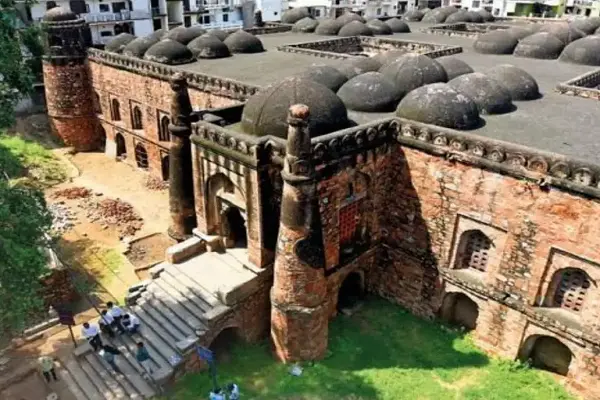
Khirki Mosque is unusual among Delhi’s mosques. Instead of one large open courtyard in front of a prayer hall, it is almost entirely roofed over and divided by four small open courtyards, arranged in a cross plan. Historians describe this cross-axial plan as a novel design for its time.
- Size and plinth: The mosque is a square about 52 metres on each side, raised on a plinth about 3 metres high, so the main rooms sit above a vaulted lower storey.
- Courtyards: Four open courtyards, each about 9 metres square, bring light and air into the covered prayer spaces. They are surrounded by arcades of square stone pillars.
- Domes: The roof is divided into 25 squares; most are covered by groups of nine small domes, giving 81 domes in all, with flat roofs in between.
- Windows: On the upper storey are arched windows filled with perforated stone screens (jalis). These are the “khirkis” that give the mosque its name.
- Gates and minarets: Minarets mark the four corners, and three gateways, each flanked by tapering turrets, project from the outer walls. The southern gate, approached by a flight of steps, mixes arches with post-and-beam construction.
- Materials: The walls are rubble masonry, originally plastered, with plain interiors broken by carved screens.
The ground around the mosque has risen over the centuries as the village grew, so the building’s raised plinth is now partly hidden and the mosque appears to sit in a sunken space below the surrounding lanes.
An earlier version of this article said the mosque has “more than 85 domes” and an area of “87 square metres”. The usual count is 81 domes, and a 52-metre square covers far more than 87 square metres, so both figures have been corrected.
Visiting Khirki Mosque
The mosque is hidden in the narrow lanes of Khirki village, on the opposite side of Press Enclave Marg from the Select Citywalk mall in Saket. It can be hard to find, so use a map app and ask for “Khirki Masjid” in the village. Once you reach it, the scale of the building, rising above the houses around it, is striking.
As of October 2026 we could not find official visiting hours or an entry fee for the mosque, so the details in an earlier version of this article have not been repeated. Visit in daylight and check locally.
How to reach
- Metro: Malviya Nagar station on the Yellow Line is the nearest. From there, take an auto-rickshaw towards Press Enclave Marg and Khirki village.
- Road: Taxis and auto-rickshaws can take you to the edge of Khirki village; the last stretch is on foot through narrow lanes.
- Air and rail: From Indira Gandhi International Airport or New Delhi railway station, travel by taxi or by metro to Malviya Nagar.
Tips for visitors
- Dress modestly and behave respectfully, as you would at any historic religious building.
- Wear comfortable shoes; the approach lanes and the monument’s floors are uneven.
- Carry water, especially in summer.
- Be mindful of residents when taking photographs in the village lanes.
Nearby places
Close by is the Satpula, a seven-arched sluice bridge that was part of Jahanpanah’s southern wall, and a little further are the Begumpur Mosque and the Bijay Mandal. The Hauz Khas complex, also linked to Firuz Shah Tughlaq, is a short drive away. About 4 km to the west are the Qutub Minar and the Tomb of Balban, and the Garden of Five Senses is also nearby, off the Mehrauli-Badarpur Road.
Frequently asked questions
Who built Khirki Mosque?
Khan-i-Jahan Junan Shah, prime minister of Sultan Firuz Shah Tughlaq, whose name is inscribed on the eastern gate.
Why is it called Khirki Mosque?
“Khirki” means “window” in Urdu and Hindi. The mosque is named after the latticed stone windows on its upper storey, and is sometimes called the “mosque of windows”.
How many domes does Khirki Mosque have?
The roof is divided into 25 squares, with nine small domes over most of them, giving a total of 81 domes.
Which metro station is nearest to Khirki Mosque?
Malviya Nagar on the Yellow Line. From there, take an auto-rickshaw to Khirki village and walk the last part.
Is there an entry fee for Khirki Mosque?
We could not find an official entry fee or timetable as of October 2026. Check locally and visit during daylight hours.
Details checked in October 2026 against published architectural studies of Khirki Mosque, records of the ASI’s restoration work and descriptions of the Jahanpanah area. Timings and access can change, so check locally before you visit.