Quick answer: The Tomb of Balban is the ruined mausoleum of Ghiyas-ud-din Balban, the ninth sultan of Delhi’s Mamluk (Slave) dynasty, who died in 1287. It stands in Mehrauli Archaeological Park, next to the Qutb Minar complex in south Delhi, and is famous as the place where the first true arch in India appeared. No official timings or entry fee are published for the tomb, so plan a daytime visit and check locally before you go.
Tomb of Balban at a glance
| Detail | Information |
|---|---|
| Location | Mehrauli Archaeological Park, Mehrauli, south Delhi (beside the Qutb complex) |
| Built | About 1287 CE, for Sultan Ghiyas-ud-din Balban |
| Known for | The earliest true arch in India |
| Timings and entry fee | Not officially published; check locally before visiting |
| Nearest metro | Qutub Minar (Yellow Line) |
| Best time to visit | October to March, in daylight |
| Time needed | About an hour for the tomb; half a day for the whole park |
Why Balban’s tomb matters: India’s first true arch
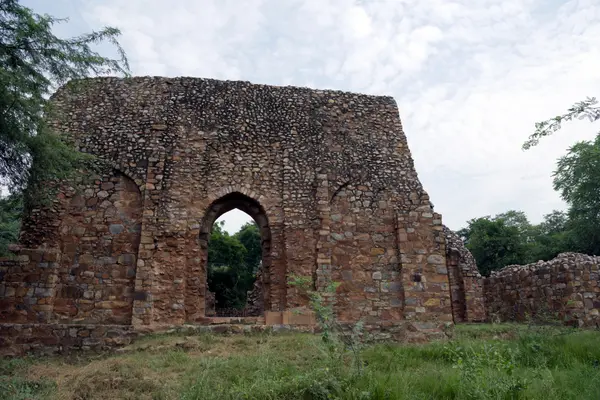
Balban’s tomb is a roofless ruin today. Only some rubble-masonry walls, the doorways and the grave chamber remain. Its importance is architectural. Historians regard it as the building where the first true arch in the Indian subcontinent appeared, and many believe it also had the first true dome, although that dome has not survived.
Before the Delhi Sultanate, builders in India mostly used corbelled or “false” arches. In a corbelled arch, stones are laid in horizontal courses, and each course projects a little beyond the one below until the two sides meet. The result looks like an arch but does not work like one. A true arch is built from wedge-shaped stones (voussoirs) set in a curve and locked in place by a keystone, so the load is carried down through the curve.
The true arch was developed long before, in the Roman world, and spread widely through Islamic architecture. Builders in Delhi took time to adopt it. Early buildings of the Sultanate, including the first mosque in the Qutb complex, still use corbelled arches. Balban’s tomb, built in about 1287, marks the change. The nearby Alai Darwaza, built in 1311 in the Qutb complex, is the earliest surviving true dome in India. True arches later became central to Indo-Islamic buildings, from Humayun’s Tomb to the Red Fort.
Who was Ghiyas-ud-din Balban?
Ghiyas-ud-din Balban was an Ilbari Turk born in Central Asia, probably around 1216. As a boy he was captured by the Mongols and sold as a slave to a merchant, Khwaja Jamal-ud-din Basri, who brought him to Delhi. Sultan Iltutmish bought him, reportedly in 1232, and Balban became one of the Chahalgani, the group of forty Turkish slave-officers who held great power at the Delhi court.
Balban rose steadily. Under Sultan Nasir-ud-din Mahmud he served as the chief minister from 1246 to 1265 and effectively ran the state. Nasir-ud-din Mahmud married Balban’s daughter. When Mahmud died, Balban became sultan himself and ruled from 1266 until his death on 13 January 1287.
An earlier version of this article said that Balban married the sultan’s daughter and that he was the last ruler of the Slave dynasty. Both claims were wrong: it was the sultan who married Balban’s daughter, and the dynasty continued for three more years after Balban.
Balban’s rule
- Royal authority: Balban insisted on strict court ceremony to raise the dignity of the crown. He introduced the Persian customs of sijda (prostrating before the ruler) and paibos (kissing the ruler’s feet).
- Breaking the Forty: Having risen through the Chahalgani, he broke up the group as sultan so that no group of nobles could challenge the throne.
- Intelligence network: He set up a system of news-writers and spies (barids) in the provinces who reported directly to him.
- Defence: Much of his reign was spent guarding the north-west frontier against Mongol raids.
Succession and the end of the dynasty
Balban’s elder son, Muhammad, known after his death as Khan Shahid (“the martyred prince”), was killed fighting the Mongols in 1285. The loss is said to have broken the ageing sultan. His younger son, Bughra Khan, was governor of Bengal and did not want the throne. After Balban’s death the nobles placed his grandson, Muiz-ud-din Kaiqubad, on the throne. Kaiqubad’s short reign ended in turmoil, and in 1290 Jalal-ud-din Khalji took power, ending the Mamluk dynasty.
What to see at the tomb
- The tomb chamber: A square chamber with arched openings. Look closely at the arches, which are the reason the ruin is famous.
- Khan Shahid’s grave: To the east of Balban’s tomb is a ruined rectangular structure said to be the grave of his son Muhammad (Khan Shahid).
- The setting: The tomb is surrounded by the ruins of a later medieval settlement, and from some angles it gives a fine view of the Qutub Minar.
The tomb was only identified and excavated in the mid-20th century, which helps explain its ruined state. It was long overshadowed by the grander monuments nearby.
Mehrauli Archaeological Park
The tomb lies inside Mehrauli Archaeological Park, an area of about 200 acres next to the Qutb complex that holds more than 100 historic structures, from the remains of Lal Kot to Mughal and British-era buildings. Since 1997 the park has been conserved by the Archaeological Survey of India (ASI), the Delhi Development Authority (DDA) and the Indian National Trust for Art and Cultural Heritage (INTACH), which has added signs and heritage trails. Other highlights include the Jamali Kamali mosque and tomb (1526–1535), Quli Khan’s tomb and the Rajon ki Baoli stepwell.
Timings, entry fee and how to find the tomb
As of October 2026 we could not find official visiting hours or an entry fee for Balban’s tomb or Mehrauli Archaeological Park, so the timing and fee details in an earlier version of this article have been removed. The tomb stands in open parkland, so visit in daylight and check locally before you go.
The paths inside the park are informal and the tomb is easy to miss. A practical way to find it is to head first for the Jamali Kamali mosque and tomb, which are better signposted, and then follow the trail markers towards Balban’s tomb from there.
How to reach
- Metro: Qutub Minar station on the Yellow Line is the nearest. From there, take an auto-rickshaw or walk to the park entrance on the Mehrauli side.
- Bus and road: Delhi Transport Corporation buses serve the Mehrauli and Qutub Minar area. Taxis and auto-rickshaws can drop you near the park.
- Air and rail: Indira Gandhi International Airport and the city’s main railway stations are connected to the Yellow Line by metro or by road.
Tips for visiting
- Wear comfortable shoes; the ground is uneven and some paths are overgrown.
- Carry water, especially from April to June, when Delhi is very hot.
- Go with company or join a heritage walk if possible; parts of the park are quiet and isolated.
- Do not climb on the walls or remove stones. The ruins are fragile.
Nearby places
Combine the tomb with the Qutub Minar complex next door, where you can also see the 1,600-year-old Iron Pillar. Further east in south Delhi are the Tughlaq-era Khirki Mosque and the lake and ruins at Hauz Khas.
Frequently asked questions
Who built the Tomb of Balban?
The tomb was built for Sultan Ghiyas-ud-din Balban, who died in 1287, and dates from about that year. No record names the architect.
Why is Balban’s tomb important?
It is regarded as the first building in India with a true arch, built with wedge-shaped stones and a keystone rather than corbelled horizontal courses. Many historians believe it also had India’s first true dome, which has not survived.
Is there an entry fee for Balban’s tomb?
We could not find an official entry fee or timetable as of October 2026. The tomb stands in open parkland in Mehrauli Archaeological Park, so check locally and visit in daylight.
Which metro station is nearest to Balban’s tomb?
Qutub Minar station on the Yellow Line. From there it is a short auto-rickshaw ride or walk to Mehrauli Archaeological Park.
Who is buried next to Balban?
A ruined structure to the east of the tomb is said to be the grave of his elder son Muhammad, known as Khan Shahid, who was killed fighting the Mongols in 1285.
Details checked in October 2026 against published histories of the Delhi Sultanate and records of Mehrauli Archaeological Park and its conservation by the ASI, DDA and INTACH. No official timings or fee were available, so check locally before you visit.