Quick answer: Humayun’s Tomb, in Nizamuddin East, New Delhi, is the garden tomb of the second Mughal emperor, Humayun, built in the 1560s during Akbar’s reign on the initiative of Humayun’s chief queen, Bega Begum. It was the first grand Mughal garden tomb in the Indian subcontinent, a forerunner of the Taj Mahal, and has been a UNESCO World Heritage Site since 1993. As of October 2026, Delhi Tourism lists it as open daily from sunrise to 7:30 pm, with tickets at ₹35 for Indian adults and ₹550 for foreign adults; confirm on the ASI e-ticket portal before you go.
Humayun’s Tomb at a glance
| Detail | What to know |
|---|---|
| Location | Mathura Road, opposite Hazrat Nizamuddin Dargah, Nizamuddin East, New Delhi |
| Timings | Sunrise to 7:30 pm, open all days (Delhi Tourism, checked October 2026). The ASI lists it among monuments open for night viewing. |
| Entry fee | ₹35 Indian adults, ₹550 foreign adults (Delhi Tourism, checked October 2026); prices can differ for online and cash tickets |
| Heritage status | UNESCO World Heritage Site (1993); ticketed ASI monument |
| Nearest metro | Jangpura (Violet Line); JLN Stadium (Violet Line) is also used |
| Time needed | 2 to 3 hours for the whole complex (general guidance) |
| Best time to visit | October to March; early morning or late afternoon light (general guidance) |
An earlier version of this article listed the timings as 6 am to 6 pm and the fees as ₹30 and ₹500. Those were older figures and have been updated. According to an ASI reply under the Right to Information Act reported by The Pioneer in September 2026, public amenities at the site are being upgraded; no closure of the tomb was reported.
History of Humayun’s Tomb
Humayun, the second Mughal emperor, died in Delhi in January 1556, and his body was first buried in his palace at Purana Qila. His widow and chief queen, Bega Begum, also known as Haji Begum, devoted herself to building a grand memorial for him beside the Yamuna, close to the shrine of the Sufi saint Hazrat Nizamuddin Auliya.
The Archaeological Survey of India (ASI) says the tomb was built during the reign of Humayun’s son, Emperor Akbar (1556–1605), on the initiative of Bega Begum, and that historians do not agree on the exact dates; the most likely start is around 1565–66, about nine years after Humayun’s death. Many histories date the work from 1565 to about 1572. UNESCO describes it as built in the 1560s with Akbar’s patronage. An earlier version of this article said the queen herself “built” the tomb; the patronage was shared between her and the imperial court.
The design is attributed to the Persian architect Mirak Mirza Ghiyas, brought from Herat (in present-day Afghanistan). He died before the tomb was finished, and his son, Sayyid Muhammad, completed it. Persian and Indian craftsmen worked together on the building.
Later events at the tomb include:
- 1857: during the uprising, the last Mughal emperor, Bahadur Shah Zafar, took refuge here with three princes. He was captured by the British officer William Hodson and later exiled to Rangoon (Yangon). An earlier version of this article said he sheltered with “three other emperors”; it was three princes.
- 1947: during Partition, Humayun’s Tomb and Purana Qila became large refugee camps, which damaged the gardens and water channels.
- 1993: the tomb was inscribed as a UNESCO World Heritage Site.
- 1999–2003 and later: the Aga Khan Trust for Culture and the ASI restored the gardens, water channels and fountains, followed by conservation of the tomb itself.
- 2014–2016: a storm knocked the finial off the dome in May 2014; a restored finial was installed in 2016, and the original is displayed in the site museum.
Architecture
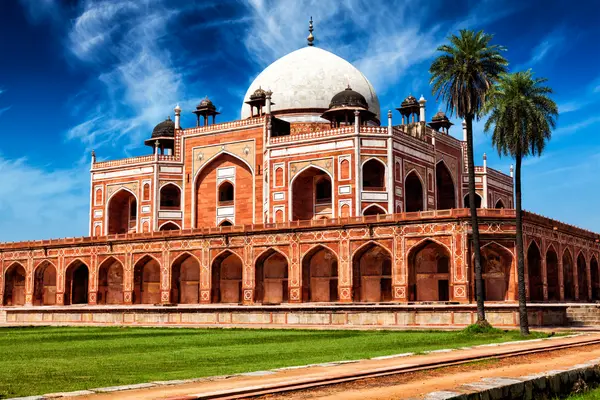
The ASI calls Humayun’s Tomb the first mature example of Mughal architecture and the first fully developed garden tomb (charbagh style) in the subcontinent. UNESCO notes that the architectural style it began reached its peak about 80 years later in the Taj Mahal.
- The charbagh garden: the tomb stands at the centre of a walled garden divided into four parts by walkways and water channels, representing the rivers of paradise. Two lofty double-storey gateways lead in from the west and south; today visitors enter from the west, though the southern gate was the original entrance.
- The mausoleum: it stands on a wide, high terrace lined with vaulted cells. Built of rubble masonry faced with red sandstone and inlaid with white and black marble borders, it has an irregular octagonal plan and rises to about 47 metres.
- The double dome: the 42.5-metre marble-clad dome is a Persian-style double dome, with an outer shell for the exterior shape and an inner one for the interior ceiling. Humayun’s Tomb is generally described as the first building in India to use this Persian technique.
- Inside: the central octagonal chamber holds a single cenotaph of Humayun. As in many later Mughal tombs, the actual grave lies in an underground chamber directly below, which is generally closed to visitors.
- “Dormitory of the Mughals”: according to UNESCO, more than 150 members of the Mughal family are buried in the cells of the complex, including Bega Begum and, by tradition, Dara Shikoh.
Other monuments in the complex
The World Heritage property covers about 27 hectares and includes several other 16th-century tombs:
- Isa Khan’s tomb and mosque: on the path from the west entrance, the octagonal tomb of Isa Khan Niazi, an Afghan noble at the court of Sher Shah Suri, stands in its own octagonal garden. Built in 1547, about 20 years before Humayun’s Tomb, it has a red sandstone mosque beside it.
- Bu Halima’s tomb and garden, the first enclosure you pass when entering from the west.
- Afsarwala tomb and mosque, and the Arab Serai, built to house the craftsmen who worked on the tomb.
- Barber’s Tomb (Nai ka Gumbad): in the south-east corner of the charbagh, dated by an inscription to 1590–91. It is the only other structure inside the main tomb enclosure, which suggests the person buried there was important to the court.
- Nila Gumbad: just outside the complex, the “blue dome” is covered with blue glazed tiles. It was built by Abdul Rahim Khan-i-Khana, a noble at Akbar’s court, for his servant Miyan Fahim, and is octagonal outside and square inside.
- Chilla Nizamuddin Auliya: a Tughlaq-period building near the north-east corner, believed to have been the residence of the saint Nizamuddin Auliya.
A site museum near the entrance tells the story of the tomb and its restoration.
Timings and entry fee
As of October 2026, Delhi Tourism lists Humayun’s Tomb as open from sunrise to 7:30 pm on all days, with entry at ₹35 for Indian adults and ₹550 for foreign adults. Tickets can be booked on the ASI’s online portal (asi.paygov.org.in). At major ASI monuments such as Qutub Minar, Delhi Tourism notes that citizens of SAARC and BIMSTEC countries pay the Indian rate and children up to 15 enter free; confirm the categories for Humayun’s Tomb on the ASI portal.
How to reach Humayun’s Tomb
- By metro: Delhi Tourism names Jangpura (Violet Line) as the nearest station; JLN Stadium on the same line is also commonly used. From either, take a short auto or cab ride.
- By rail: Hazrat Nizamuddin railway station is close by.
- By road: the tomb is near the crossing of Mathura Road and Lodhi Road, opposite the Nizamuddin Dargah, and is served by city buses, autos and app cabs.
Tips for visiting
- Arrive early to enjoy the gardens before the crowds and the midday heat.
- Allow time for Isa Khan’s tomb and the smaller monuments; many visitors rush straight to the main tomb.
- Still photography is generally allowed at ASI monuments; tripods, drones and commercial filming need permission.
- Wear comfortable shoes: the complex is large and the main tomb has steep steps to the platform.
Nearby places to visit
Humayun’s Tomb sits in one of Delhi’s richest heritage areas. Across the road, Hazrat Nizamuddin Dargah is famous for its evening qawwali. The landscaped Sunder Nursery is next door. A short drive north are Purana Qila, where Humayun was first buried, and the National Zoological Park. To compare the first and the last of Delhi’s great Mughal garden tombs, visit Safdarjung’s Tomb on the same day.
Frequently asked questions
Who built Humayun’s Tomb?
It was built during Emperor Akbar’s reign on the initiative of Humayun’s chief queen, Bega Begum (Haji Begum), and designed by the Persian architect Mirak Mirza Ghiyas, whose son Sayyid Muhammad completed it.
When was Humayun’s Tomb built?
In the 1560s. The ASI gives about 1565–66 as the most likely start date, and many histories say it was completed around 1572.
What are Humayun’s Tomb’s timings?
As of October 2026, Delhi Tourism lists sunrise to 7:30 pm, every day.
Is Humayun’s Tomb a UNESCO World Heritage Site?
Yes. It was inscribed in 1993 as “Humayun’s Tomb, Delhi”.
Why is Humayun’s Tomb called the inspiration for the Taj Mahal?
It introduced the grand garden tomb, the double dome and the combination of red sandstone and white marble to Mughal India. UNESCO notes that this style reached its peak about 80 years later in the Taj Mahal.
Details checked in October 2026 against UNESCO’s World Heritage listing, the Archaeological Survey of India’s monument page, Delhi Tourism’s visitor page and published histories of the tomb. Timings and fees can change, so check the ASI portal before you visit.