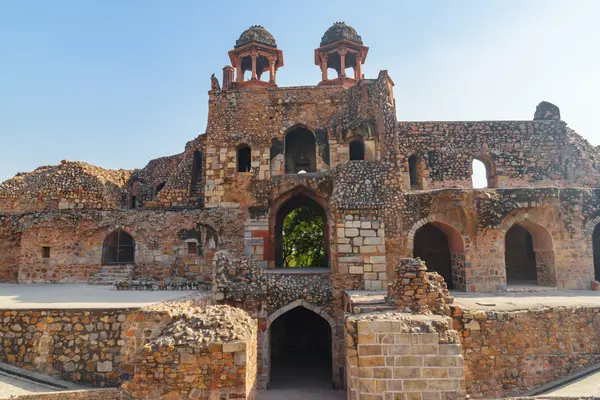
Quick answer: Purana Qila (the Old Fort) is a 16th-century fort on Mathura Road in central Delhi, next to the National Zoological Park. Its walls were begun by the Mughal emperor Humayun as the citadel of his city Dinpanah, and Sher Shah Suri continued the work and added the Qila-i-Kuhna Mosque. It is a ticketed monument of the Archaeological Survey of India (ASI); check the current fee and hours on the ASI ticketing portal, as we could not confirm them from an up-to-date official page in October 2026.
Purana Qila at a glance
| Detail | Information |
|---|---|
| Location | Mathura Road, near the National Zoological Park and Pragati Maidan, New Delhi |
| Built | 16th century, by Humayun and Sher Shah Suri |
| Managed by | Archaeological Survey of India (ASI) |
| Entry fee and timings | Ticketed; check the ASI e-ticket portal (asi.paygov.org.in) or the counter |
| Days closed | None, according to Delhi Tourism |
| Nearest metro | Supreme Court (formerly Pragati Maidan), Blue Line |
| Best time to visit | October to March, early morning or late afternoon |
| Time needed | Two to three hours |
What’s new at Purana Qila
- Boating is back: Boating on the moat-side lake stopped in 2016, when an agreement between Delhi Tourism and the ASI lapsed. It was relaunched in 2025 by the Sabhyata Foundation in partnership with the ASI: trial runs began on 30 June 2025, with full operation planned from 1 September 2025. Outlook Traveller reported 20-minute rides starting near the Talaqi Darwaza, between 9 am and 6 pm. Check the current schedule and charges at the site.
- Sound and light show: The fort has long hosted an evening sound and light show on Delhi’s history. In February 2026, India Tourism Development Corporation (ITDC) showcased a teaser for a new immersive sound and light show at Purana Qila, but no opening date or ticket details had been announced when we checked in October 2026. Check with ITDC or Delhi Tourism before planning an evening visit.
- Metro station renamed: The nearest metro station, Pragati Maidan on the Blue Line, has been renamed Supreme Court.
History of Purana Qila
Indraprastha and early settlement
Purana Qila stands on a mound that has been lived on for a very long time. ASI excavations, first by B. B. Lal in 1954–55 and 1969–73 and later in 2013–14 and 2017–18, found Painted Grey Ware pottery from around 1000 BCE and evidence of habitation through the Mauryan, Shunga, Kushana, Gupta, Rajput, Sultanate and Mughal periods. The site has long been linked with Indraprastha, the city of the Pandavas in the Mahabharata; until the early 20th century the fort was known locally as Pandavon ka Qila. Archaeologists caution, however, that matching excavated remains to an epic city cannot be proved.
Humayun, Sher Shah Suri and Dinpanah
The second Mughal emperor, Humayun, began building a new city called Dinpanah here in the 1530s, with the fort as its citadel. In 1540 Sher Shah Suri defeated Humayun, took over the work, strengthened the fortifications and added buildings inside. Contemporary accounts disagree on exactly who built what, so the fort is usually credited to both rulers. Humayun regained the throne in 1555 but died the following year.
Purana Qila saw other turning points too. In October 1556, the Hindu king Hemu, also known as Hem Chandra Vikramaditya, was crowned here after defeating Akbar’s forces at Delhi, a month before the Mughals defeated him at the Second Battle of Panipat. In the 20th century, Edwin Lutyens aligned New Delhi’s ceremonial avenue, now Kartavya Path, with the fort. During the Partition of 1947, Purana Qila and nearby Humayun’s Tomb became huge refugee camps.
What to see inside the fort
The walls and gates
The fort is roughly rectangular, with walls up to about 18 metres high. The circuit is about 1.5 to 2 km; published figures vary. The walls once overlooked a moat linked to the Yamuna, which then flowed to the east. There are three gateways, each a double-storeyed sandstone structure flanked by bastions and decorated with marble inlay, jharokhas (overhanging balconies) and chhatris (domed pavilions):
- Bara Darwaza (Big Gate), facing west, which is the entrance in use today;
- Humayun Darwaza, the southern gate;
- Talaqi Darwaza, the northern “forbidden gate”.
An earlier version of this article said the walls were 0.33 metres thick and that the Talaqi Darwaza stands “39 metres taller” than the ground. Neither figure is supported, so both have been removed.
Qila-i-Kuhna Mosque
The single-domed Qila-i-Kuhna Mosque, built by Sher Shah Suri in 1541, is the best-preserved building in the fort. It was designed as a Friday mosque for the sultan and his court. The prayer hall measures about 51 by 15 metres and has five arched openings with prayer niches in the west wall. Red, white and slate-coloured marble and finely carved inscriptions decorate the central arch, and the building is seen as a link between Lodi and Mughal architecture.
Sher Mandal
The Sher Mandal is a two-storeyed octagonal tower of red sandstone topped by a chhatri. Humayun used it as a library and observatory after he regained Delhi. On 24 January 1556 he fell down its steep stairs, and he died of his injuries two days later. Entry into the Sher Mandal is not allowed.
Archaeological museum
A small ASI museum inside the fort displays pottery and other finds from the excavations, from Painted Grey Ware to Mughal objects. Check at the gate whether it is open on the day you visit.
How to reach Purana Qila
- Metro: Supreme Court station (formerly Pragati Maidan) on the Blue Line. From there, walk or take an auto-rickshaw along Mathura Road to the fort.
- Road: The fort is on Mathura Road, across the road from the Major Dhyan Chand National Stadium and next to the zoo. Taxis and auto-rickshaws can drop you at the gate.
- Rail: New Delhi and Hazrat Nizamuddin railway stations are both a short taxi ride away.
Tips for visitors
- Buy tickets online through the ASI portal to save time at the counter.
- Go early in the morning or late in the afternoon from April to June, when Delhi is very hot.
- Wear comfortable shoes; the grounds are large and some paths are uneven.
- The fort is popular for photography, including pre-wedding shoots. If you plan a professional shoot, check the ASI’s rules on permissions first.
- Do not climb on fragile walls or into closed areas such as the Sher Mandal.
Nearby places
The National Zoological Park is right next to the fort; check whether it is open before you go, as it has had temporary closures. Humayun’s Tomb and the Nizamuddin Dargah are a short drive south, and India Gate lies to the west, on the same ceremonial axis.
Frequently asked questions
Who built Purana Qila?
The Mughal emperor Humayun began it in the 1530s as the citadel of his city Dinpanah. Sher Shah Suri, who defeated Humayun in 1540, continued the work and built the Qila-i-Kuhna Mosque in 1541.
What is the entry fee for Purana Qila?
Purana Qila is a ticketed ASI monument. We could not confirm the current fee from an up-to-date official page in October 2026, so check the ASI e-ticket portal (asi.paygov.org.in) or the ticket counter.
Is boating available at Purana Qila?
Yes. Boating was relaunched in 2025 after a gap of almost ten years, run by the Sabhyata Foundation with the ASI. Check the current timings and charges at the site.
Is Purana Qila the site of Indraprastha?
The site has long been associated with Indraprastha, and excavations show people lived here from about 1000 BCE. Linking the remains to the city of the Mahabharata, however, cannot be proved archaeologically.
Which metro station is nearest to Purana Qila?
Supreme Court station on the Blue Line, formerly called Pragati Maidan.
Details checked in October 2026 against Delhi Tourism and ASI information, published histories and excavation records of Purana Qila, and 2025–2026 reports on the boating relaunch and ITDC’s sound and light shows. Fees and timings change, so check the ASI portal before you visit.