Quick answer: Lodhi Gardens (also spelt Lodi Gardens) is a large public park on Lodhi Road in central New Delhi, between Khan Market and Safdarjung’s Tomb, where 15th- and 16th-century tombs of the Sayyid and Lodi dynasties stand among lawns, trees and a lake. Entry is free. As of October 2026, Delhi Tourism lists it as open every day from 5 am to 8 pm (April to September) and 6 am to 8 pm (October to March).
Lodhi Gardens at a glance
| Detail | Information |
|---|---|
| Location | Between Lodhi Road, Amrita Shergill Marg and Max Mueller Marg, New Delhi |
| Managed by | New Delhi Municipal Council (NDMC); monuments protected by the ASI |
| Timings | 5 am–8 pm (April–September); 6 am–8 pm (October–March); open all days (Delhi Tourism, October 2026) |
| Entry fee | Free |
| Nearest metro | Jor Bagh (Yellow Line), per Delhi Tourism; Khan Market and JLN Stadium (Violet Line) are also close |
| Best time to visit | October to March; early morning or late afternoon |
| Time needed | One to two hours |
An earlier version of this article gave the timings as 6 am to 7:30 pm. Delhi Tourism’s current listing is shown above.
History of Lodhi Gardens
The tombs in the garden were built between the mid-15th and early 16th centuries, when this area was the village of Khairpur, on the outskirts of the Delhi of the Sayyid and Lodi sultans. In the 1930s, as New Delhi was being built, the villagers were moved and a park was laid out around the monuments. It was inaugurated by Lady Willingdon, wife of the Viceroy, on 9 April 1936 and named Lady Willingdon Park. It was later renamed Lodhi Garden after the dynasty whose tombs it holds.
In 1968 the garden was redesigned under the architect Joseph Allen Stein, with the American landscape architect Garrett Eckbo often credited alongside him. Later additions include a glasshouse built in December 1970 with support from the Ford Foundation, a National Bonsai Park set up in 1996 with the Indian Bonsai Association, and a herbal garden of medicinal plants created in 2007.
Monuments in Lodhi Gardens
Tomb of Muhammad Shah
The oldest tomb in the garden is that of Muhammad Shah, the third ruler of the Sayyid dynasty, built in 1444 by his son and successor, Ala-ud-din Alam Shah. It is octagonal, with a domed central chamber surrounded by a verandah of arched openings, and it has several graves inside, the central one believed to be Muhammad Shah’s. Look for the carved lotus finial crowning the dome.
Bara Gumbad
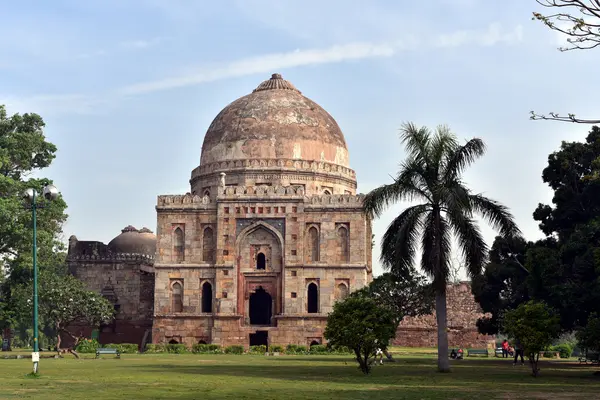
The Bara Gumbad (“big dome”), built in about 1494 during the reign of Sikandar Lodi, is a massive square building with a large dome. No grave has been found inside, and historians think it may have served as a grand gateway to the mosque beside it, or to an enclosure. The adjoining Bara Gumbad Mosque has fine carved and painted plasterwork.
Sheesh Gumbad
The Sheesh Gumbad (“glass dome”), close to the Bara Gumbad, is a square tomb that once glittered with blue glazed tiles, of which traces survive. Inside, the ceiling is decorated with painted floral designs and Quranic inscriptions. It contains several graves, but who is buried there is not known for certain. Like the Bara Gumbad, it has a façade that gives the impression of two storeys.
Tomb of Sikandar Lodi
The tomb of Sultan Sikandar Lodi, who ruled from 1489 to 1517, was built in 1517–18 by his son Ibrahim Lodi. It is octagonal like Muhammad Shah’s tomb and stands inside a walled garden enclosure entered through a gateway on the south; the western wall doubles as a wall mosque. It is described as the earliest surviving enclosed garden tomb in India.
Athpula
The Athpula (“eight piers”) is a stone bridge with seven arches, built during the reign of the Mughal emperor Akbar over a stream that once ran through the area, near Sikandar Lodi’s tomb.
An earlier version of this article dated the Bara Gumbad to 1490 and described the Sheesh Gumbad as a blend of Hindu and Islamic design. Published records date the Bara Gumbad to about 1494, and the “blend” description has been removed.
Plants, birds and the lake
According to the NDMC, the garden has a rose garden of about 5,000 plants on two acres, a palm corner, a bamboo garden and a large collection of trees such as arjun, neem, jamun, semal, amaltas and peepal. The NDMC describes a spiral-shaped lake, about 300 metres long, with a fountain in the middle. The NDMC lists more than 20 bird species seen here, including parakeets, mynas, kingfishers, Indian grey hornbills, black drongos and spotted owlets, and the garden also attracts migratory birds in winter.
Things to do
- Walk or jog: The garden is one of Delhi’s most popular places for morning and evening walks.
- Explore the monuments: Allow time to step inside the tombs and look at the plasterwork and tile traces.
- Birdwatching and photography: Early morning is best for birds and soft light.
- Read or picnic: The lawns are good for a quiet hour with a book or a simple picnic.
- Shop and eat nearby: Khan Market, with its shops, cafés and restaurants, is a short walk away.
Tips for visitors
- The garden has gates on Lodhi Road and Amrita Shergill Marg; Delhi Tourism gives its location as Lodhi Road, beside the India International Centre.
- Carry water and a cap in summer; parts of the garden are open to the sun.
- Do not litter, climb on the monuments or disturb the birds.
- Follow any NDMC rules displayed at the gates about cycling, pets and sports.
An earlier version of this article suggested combining a visit with Chandni Chowk. Chandni Chowk is in Old Delhi, some distance away; the attractions below are much closer.
How to reach
- Metro: Delhi Tourism names Jor Bagh (Yellow Line) as the nearest station; Khan Market and JLN Stadium (Violet Line) are also close. From any of them, it is a short walk or auto-rickshaw ride.
- Road: The garden lies along Lodhi Road, beside the India International Centre. Taxis, auto-rickshaws and buses serve the area.
- Air: From Indira Gandhi International Airport, take a taxi or the metro into central Delhi.
Nearby places
Safdarjung’s Tomb stands at the western end of Lodhi Road, and Humayun’s Tomb and the Nizamuddin Dargah are at its eastern end. India Gate is a short drive north.
Frequently asked questions
What are the timings of Lodhi Gardens?
As of October 2026, Delhi Tourism lists 5 am to 8 pm from April to September and 6 am to 8 pm from October to March, every day.
Is there an entry fee for Lodhi Gardens?
No. Entry to Lodhi Gardens is free.
Who is buried in Lodhi Gardens?
The garden holds the tombs of Muhammad Shah of the Sayyid dynasty (1444) and Sultan Sikandar Lodi (1517–18). The Sheesh Gumbad also contains graves whose occupants are not known for certain; the Bara Gumbad has no grave.
What was Lodhi Gardens called before?
It was laid out as Lady Willingdon Park and inaugurated by Lady Willingdon on 9 April 1936. It was later renamed Lodhi Garden.
Which metro station is nearest to Lodhi Gardens?
Delhi Tourism names Jor Bagh on the Yellow Line. Khan Market and JLN Stadium on the Violet Line are also nearby.
Details checked in October 2026 against Delhi Tourism’s Lodhi Gardens listings, the NDMC’s note on its important gardens and published records of the Sayyid and Lodi monuments. Timings can change, so check before you visit.