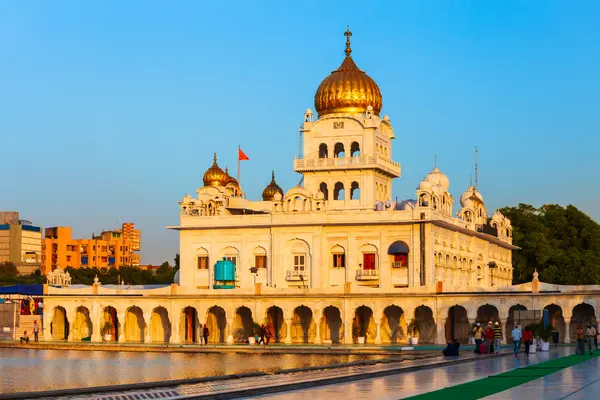
Quick answer: Gurudwara Bangla Sahib is one of Delhi’s most important Sikh shrines, on Baba Kharak Singh Marg near Connaught Place. It stands on the site of a bungalow where the eighth Sikh Guru, Guru Har Krishan, stayed in 1664 and cared for people during a smallpox epidemic, and it is known for its golden dome, its sacred pool (sarovar) and its free community kitchen (langar). Entry is free and people of all faiths are welcome; cover your head and remove your shoes before entering.
Gurudwara Bangla Sahib at a glance
| Detail | What to know |
|---|---|
| Location | Baba Kharak Singh Marg, near Connaught Place, New Delhi |
| Managed by | Delhi Sikh Gurdwara Management Committee (DSGMC) |
| Entry fee | None |
| Timings | Open to devotees through the day; check with the DSGMC for the times of specific services |
| Dress code | Head covered, shoes removed, modest clothing |
| Nearest metro | Patel Chowk (Yellow Line); Rajiv Chowk (Yellow and Blue lines) is also close |
| Time needed | About an hour, longer if you eat at the langar (general guidance) |
History of Gurudwara Bangla Sahib
In the 17th century the site was a bungalow (bangla) belonging to Mirza Raja Jai Singh I of Amber, a senior noble at the Mughal court. According to the DSGMC, Guru Har Krishan came to Delhi at the request of the Mughal emperor Aurangzeb, persuaded by Raja Jai Singh, who invited the young Guru to stay at his bungalow. Guru Har Krishan, who became Guru at the age of five and is remembered as the Bal Guru (child Guru), was only seven or eight years old at the time.
Smallpox was then raging through Delhi. Sikh tradition, as told by the DSGMC, says the Guru cared for the sick of every community, and that water from a small tank at the bungalow, blessed by him, cured those who drank it. Guru Har Krishan himself fell ill and died in Delhi in 1664. Raja Jai Singh later built a small tank over the well, and the water of today’s sarovar is still taken home by devotees as amrit (holy water).
An earlier version of this article said the epidemic was of cholera and smallpox; the DSGMC’s account refers to smallpox, so the article now follows that.
The bungalow was turned into a shrine in 1783 by the Sikh general Sardar Baghel Singh, who that year also built shrines at several other sites in Delhi linked to the Sikh Gurus, during the reign of the Mughal emperor Shah Alam II. The present large white-marble building has grown over the years since. In 1984, during the anti-Sikh riots, around 150 Sikhs took shelter inside the gurdwara, and a mob that tried to storm it was driven back.
Architecture and the complex
The main prayer hall is built of white marble, with a gold-plated central dome and smaller domes around it. A tall flagpole, the Nishan Sahib, flies the Sikh flag outside. The complex also includes:
- The sarovar: the large holy pool, about 225 by 235 feet, with a walkway around it.
- The langar hall and kitchen, where free meals are served.
- A hospital and diagnostic centre run by the DSGMC in the lower levels of the complex.
- A school and an art gallery-cum-museum named after Baghel Singh.
- Guru Harkrishan Yatri Niwas, a pilgrims’ rest house run by the DSGMC. Contact the DSGMC for current availability and charges; an earlier version of this article listed room rates that could not be verified.
Langar at Bangla Sahib
The langar is a community kitchen where a simple vegetarian meal, usually dal, roti and rice, is served free to everyone who comes, regardless of religion, caste or background. Visitors sit together on the floor in rows, which reflects the Sikh principle of equality. Volunteers cook and serve the food, and visitors are welcome to join in seva (voluntary service): helping in the kitchen, serving food or water, washing dishes or helping at the shoe counter.
What to do at Gurudwara Bangla Sahib
- Listen to the kirtan (hymns from the Guru Granth Sahib) in the main hall. The DSGMC also streams live kirtan from Bangla Sahib.
- Receive karah prasad, the sweet offering given to visitors.
- Walk around the sarovar and spend some quiet time by the water.
- Eat at the langar, or volunteer for seva.
- Visit the museum to learn more about Sikh history.
Etiquette and tips
- Cover your head: this is required for everyone. Scarves are usually available near the entrance if you do not have one.
- Remove your shoes and leave them at the shoe counter, and wash your feet in the water channel before entering.
- Dress modestly: clothing that covers your shoulders and knees is best.
- No alcohol or tobacco is allowed on the premises.
- Photography: be respectful, especially inside the prayer hall, and follow any instructions from the sevadars (volunteers).
- Timing: in summer, visit early in the morning or in the evening, when the marble is cooler underfoot.
Festivals
Bangla Sahib draws especially large congregations on the birth anniversary (Prakash Purab) of Guru Har Krishan. Other major Sikh occasions, such as the Gurpurabs of Guru Nanak Dev and Guru Gobind Singh and Baisakhi (Vaisakhi), are also marked with special kirtan, processions and langar. Expect big crowds on these days.
How to reach Gurudwara Bangla Sahib
- By metro: Patel Chowk on the Yellow Line is commonly used for Bangla Sahib. Rajiv Chowk (Yellow and Blue lines) under Connaught Place and R K Ashram Marg (Blue Line) are also nearby. From any of them, take a short auto or e-rickshaw ride, or walk.
- By road: the gurdwara is on Baba Kharak Singh Marg, just off Connaught Place, and is easy to reach by bus, auto or app cab. Parking is available, but it fills up on weekends and festival days.
An earlier version of this article gave distances from metro stations (for example, 2.8 km from Rajiv Chowk) that did not match the gurdwara’s location; they have been removed.
Nearby places to visit
Bangla Sahib is in the heart of New Delhi, so it combines easily with other sights. Connaught Place is a short walk away, and Jantar Mantar, the 18th-century observatory, is close by on Sansad Marg. Agrasen ki Baoli, a medieval stepwell, and the Sacred Heart Cathedral are also within easy reach.
Frequently asked questions
Is there an entry fee at Gurudwara Bangla Sahib?
No. Entry, the langar meal and karah prasad are all free.
Can non-Sikhs visit Bangla Sahib?
Yes. People of all faiths are welcome. Cover your head, remove your shoes and dress modestly.
Why is it called Bangla Sahib?
“Bangla” means bungalow. The gurdwara stands on the site of Raja Jai Singh’s bungalow, where Guru Har Krishan stayed in 1664.
Which metro station is nearest to Bangla Sahib?
Patel Chowk on the Yellow Line is commonly used; Rajiv Chowk and R K Ashram Marg are also nearby.
Can I stay at Gurudwara Bangla Sahib?
The DSGMC runs the Guru Harkrishan Yatri Niwas at Bangla Sahib for pilgrims. Contact the DSGMC directly for availability and rules.
Details checked in October 2026 against the Delhi Sikh Gurdwara Management Committee’s pages on Gurudwara Bangla Sahib and its yatri niwas, and published histories of the shrine. Service times can change on festival days, so check with the DSGMC before you visit.