Quick answer: Jantar Mantar in New Delhi is an 18th-century astronomical observatory near Connaught Place, built by Maharaja Sawai Jai Singh II of Jaipur and usually dated to 1724. It is a ticketed monument protected by the Archaeological Survey of India (ASI). Delhi Tourism lists it as open every day from sunrise to sunset, with tickets at ₹25 for Indians and ₹300 for foreign visitors; check the ASI e-ticketing site before you go, as rates are revised from time to time.
Jantar Mantar Delhi at a glance
| Detail | What we verified (October 2026) |
|---|---|
| Location | Sansad Marg, near Connaught Place, New Delhi |
| Built by | Maharaja Sawai Jai Singh II of Jaipur, about 1724 |
| Status | Centrally protected, ticketed monument of the ASI (Delhi Circle) |
| Timings | Sunrise to sunset, open all days (Delhi Tourism) |
| Entry fee | ₹25 for Indians, ₹300 for foreign visitors (Delhi Tourism); tickets are also sold online through ASI’s e-ticketing |
| Photography | Still photography free; a small charge for video filming (Delhi Tourism) |
| Nearest metro | Patel Chowk (Yellow Line) |
| Time needed | About an hour |
An earlier version of this article gave the timings as 6 am to 6 pm and the fee as ₹15 for Indians and ₹200 for foreigners. Those figures are out of date. ASI fees for Indian visitors also apply to visitors from SAARC and BIMSTEC countries, and ASI does not charge children under 15 at its ticketed monuments, but confirm the current rates on the ASI ticketing website before your visit.
History of Jantar Mantar
The name comes from yantra (instrument) and mantra (formula or calculation). According to the ASI, the Mughal emperor Muhammad Shah gave Jai Singh II (1699 to 1743) the task of revising the calendar and astronomical tables. Jai Singh first built brass instruments of the astrolabe type, following Islamic astronomical texts, but found them unsatisfactory: small instruments could not give accurate readings. He then designed much larger instruments of his own, such as the Jai Prakash, Ram Yantra and Samrat Yantra, built of brick and rubble and plastered with lime.
Delhi’s was the first of five observatories that Jai Singh built. The others were at Jaipur, Ujjain, Varanasi and Mathura. The ASI notes that the 19th-century scholar Sir Syed Ahmad Khan dated the Delhi observatory to 1724, and that the observations made here formed the basis of Jai Singh’s new astronomical tables, the Zij-i Muhammad Shahi. A plaque put up in 1910 gave the date as 1710, but later research supports 1724.
The Jaipur observatory is the largest and best preserved of the five, and was inscribed as a UNESCO World Heritage Site in 2010. The Mathura observatory no longer survives. In Delhi, tall buildings now surround the site, and the instruments can no longer make accurate observations.
An earlier version of this article credited Jai Singh with abolishing practices such as sati. We could not find reliable support for that claim, so it has been removed.
The main instruments
Jantar Mantar has 13 architectural astronomical instruments. Four are the best known:
Samrat Yantra
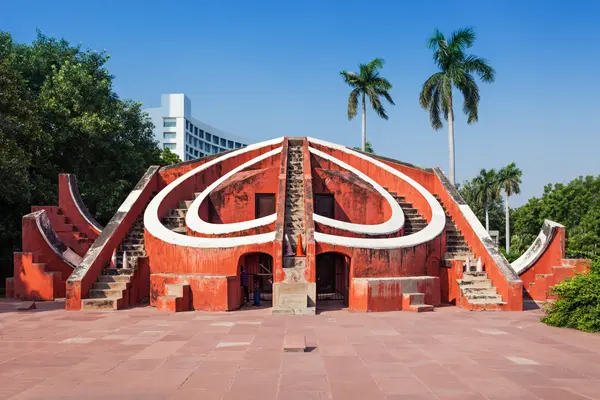
The “supreme instrument” is a giant equal-hour sundial shaped like a huge triangle, about 70 feet high, 114 feet long at the base and 10 feet thick. Its sloping hypotenuse, about 128 feet long, runs parallel to the Earth’s axis and points to the North Pole. Quadrants on either side are marked to read hours and minutes from the shadow, and the instrument was also used to measure the declination of the sun and other bodies. An earlier version of this article described its arm as 27 m long at an angle of 27 degrees. In fact the slope matches Delhi’s latitude, about 28.6 degrees, as it must for a sundial of this kind.
Jai Prakash Yantra
Two hollow hemispheres, sunk into the ground, with markings on their inner surfaces and crosswires stretched across the rims. The shadow of the crosswires shows the position of the sun or other bodies in both the horizon (altitude and azimuth) and equatorial coordinate systems.
Ram Yantra
Two large, open-topped cylindrical structures with a pillar at the centre, used to measure the altitude and azimuth of stars and planets.
Misra Yantra
“Misra” means mixed. This instrument combines five instruments in one and was used to find the shortest and longest days of the year and the moment of noon in various cities around the world. It is the one major structure here not invented by Jai Singh himself.
An earlier version of this article said Jantar Mantar “stands at 723 ft”. That number is the site’s elevation above sea level (about 220 m), not the height of any structure.
How to reach Jantar Mantar
- Metro: Patel Chowk on the Yellow Line is the nearest station. Rajiv Chowk (Yellow and Blue Lines) and Janpath (Violet Line) are also within walking distance.
- Railway station: New Delhi Railway Station is about 2 km away.
- Airport: Indira Gandhi International Airport. The Airport Express (Orange) Line runs to Shivaji Stadium and New Delhi stations near Connaught Place.
- Road: Auto-rickshaws, cabs and DTC buses to Connaught Place and Sansad Marg all pass close by.
Tips for visiting
- Visit on a sunny morning or afternoon. The instruments make most sense when you can see their shadows move.
- A guidebook or a guide helps, because the instruments are hard to read without an explanation.
- Do not climb on the instruments. They are protected monuments.
- Jantar Mantar Road, outside, is often used for public protests, so expect police barricades on some days.
Places to visit nearby
Jantar Mantar is a few minutes from the shops and colonnades of Connaught Place, the stepwell Agrasen ki Baoli and Gurudwara Bangla Sahib. Rashtrapati Bhavan and the government buildings of Raisina Hill are a short ride away. Astronomy fans can also visit the Nehru Planetarium, which has run calibration and sky-watching events at Jantar Mantar.
Frequently asked questions
Who built Jantar Mantar in Delhi?
Maharaja Sawai Jai Singh II of Jaipur, about 1724, after the Mughal emperor Muhammad Shah asked him to revise the calendar and astronomical tables.
What is the Jantar Mantar Delhi entry fee?
Delhi Tourism lists ₹25 for Indians and ₹300 for foreign visitors. Check the ASI e-ticketing site for the current rate and any online discount.
Is Jantar Mantar Delhi open every day?
Yes. Delhi Tourism lists it as open all days, from sunrise to sunset.
How many Jantar Mantars did Jai Singh build?
Five: Delhi, Jaipur, Ujjain, Varanasi and Mathura. The Mathura one no longer survives, and Jaipur’s is a UNESCO World Heritage Site.
Which is the nearest metro station to Jantar Mantar?
Patel Chowk on the Yellow Line.
History was checked in October 2026 against the Archaeological Survey of India’s monument page; timings and fees against Delhi Tourism’s official listing. Fees change, so confirm on the ASI ticketing site before visiting.