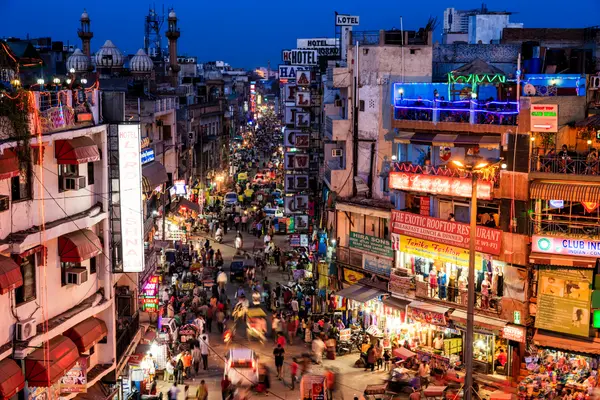
Quick answer: Paharganj is a busy neighbourhood just west of New Delhi Railway Station, best known for its Main Bazaar, a street about a kilometre long lined with budget hotels, cafés and shops selling clothes, bags, leather goods, jewellery, incense, books and handicrafts. It is a long-time favourite of backpackers and budget travellers. There is no entry fee; shop hours vary, and the nearest metro stations are New Delhi and R K Ashram Marg.
Paharganj at a glance
| Detail | What to know |
|---|---|
| Location | Central Delhi, opposite the Paharganj side of New Delhi Railway Station |
| Known for | Main Bazaar shopping, budget hotels and guesthouses, international cafés |
| Entry fee | None |
| Timings | Vary by shop; check before a special trip |
| Nearest metro | New Delhi (Yellow Line and Airport Express); R K Ashram Marg (Blue Line) |
| Time needed | 1 to 3 hours for shopping (general guidance) |
About Paharganj Main Bazaar
According to Delhi Tourism, as you step out of New Delhi Railway Station and cross the road, you are at the entrance of Paharganj Main Bazaar. The street stretches for about a kilometre and is packed with shops selling books, music, jewellery, bags, clothes, shoes, incense, textiles, carved wooden statues and handicrafts. Delhi Tourism also warns, fairly, that it is chaotic, noisy and crowded, and suits shoppers who do not mind the bustle.
Paharganj is also one of Delhi’s best-known areas for affordable hotels, lodges and guesthouses. Its closeness to the railway station, Connaught Place and Old Delhi made it a base for backpackers from around the world, and its cafés now serve food from many countries alongside Indian dishes. The area’s traveller culture has featured in films such as Holy Smoke! (1999), parts of which were shot here, and Anurag Kashyap’s Dev.D (2009).
The name Paharganj means “hilly neighbourhood”. It is usually explained by the area’s closeness to Raisina Hill, where Rashtrapati Bhavan stands today.
History of Paharganj
Paharganj is much older than New Delhi. After Shah Jahan founded his walled capital, Shahjahanabad, in 1638, the city soon spread beyond its walls. Paharganj, just outside the Ajmeri Gate, was one of the city’s five main markets and the only one outside the walled city. In the 18th century it was the principal grain market of Delhi. In Mughal times the area was also known as Shahganj, the king’s market.
Other moments in its history include:
- 1690s: Ghaziuddin Khan, a general of Emperor Aurangzeb, founded a madrasa near Ajmeri Gate. It grew into today’s Zakir Husain Delhi College, which moved to a new building outside Turkman Gate in 1986. (An earlier version of this article said the college was founded in Paharganj in 1986; 1986 is when it moved.)
- 1924: communal riots broke out in July in Paharganj and neighbouring Sadar Bazaar, causing deaths and damage to property.
- 1926–1931: New Delhi Railway Station opened next to the area in 1926, before the new capital was inaugurated in 1931, bringing travellers, eateries and lodgings. A dhaba set up here in 1928 later grew into a hotel with a well-known rooftop restaurant.
- 1942: during the Quit India Movement, British barracks near Paharganj were attacked, and the Paharganj post office and several tax posts were set on fire.
- 1947: after Partition, many Hindu refugees from Pakistan settled here and were allotted shops, shaping the market seen today.
- 2005: the Main Bazaar was hit by one of the serial bomb blasts in Delhi on 29 October 2005, two days before Diwali.
Paharganj also had some of Delhi’s early cinemas. Sheila Cinema was Delhi’s first 70 mm screen, and the Imperial theatre, built in 1930, dates from the years when New Delhi was being built.
What to buy in Paharganj
- Footwear and leather goods: the market has many shoe and leather shops, with everything from ethnic juttis to boots, along with leather bags, jackets and belts. Check stitching and material carefully before you buy.
- Bags: slings, laptop bags, duffels and backpacks in leather and synthetic materials, at a wide range of prices.
- Jewellery: Delhi Tourism mentions handmade beaded necklaces and bangles; some shops also sell silver jewellery and pieces set with semi-precious stones.
- Attar, incense and tea: attar (natural perfume oils) in roll-ons and bottles, incense sticks and cones, and Indian tea make light, easy gifts.
- Clothes and textiles: loose cotton trousers, kurtas, shawls, bedspreads, cushion covers and wall hangings.
- Books and handicrafts: new and second-hand books, carved wooden figures of gods and goddesses, and brassware.
Bargaining is expected at most stalls and small shops. Around Diwali, the market is decorated with lights and is especially busy.
Food in Paharganj
Paharganj has dozens of cafés, bakeries and rooftop restaurants, many aimed at international travellers, as well as dhabas serving Indian staples such as chole bhature. Restaurants open and close often, so check recent reviews rather than relying on old lists. An earlier version of this article named specific cafés and bars that we could not confirm are still operating; those names have been removed.
Safety tips
- A common scam: touts around the railway station claim your train is cancelled or the official booking office has moved. Use only the official reservation counters inside the station, or book online.
- The area has had problems with scams and drug peddling. Keep your belongings close, avoid deals that sound too good to be true, and be cautious late at night, especially if travelling alone.
- Check hotel reviews and the room before you pay, and agree on prices in advance.
How to reach Paharganj
- By rail: the Main Bazaar starts across the road from the Paharganj side (Platform 1 side) of New Delhi Railway Station.
- By metro: New Delhi metro station (Yellow Line and Airport Express Line) is at the railway station. R K Ashram Marg station on the Blue Line is also close to Paharganj.
- From the airport: the Airport Express Line runs from Indira Gandhi International Airport to New Delhi station, the most convenient way to arrive with luggage.
Nearby places to visit
Paharganj is well placed for central Delhi. Connaught Place is just beyond the railway station for shopping and restaurants, and Gurudwara Bangla Sahib, known for its sarovar and karah prasad, is a short ride south. For Old Delhi, head north-east to Chandni Chowk and Jama Masjid. Karol Bagh, another big market for clothes and phone accessories, is a short ride west.
Frequently asked questions
What is Paharganj famous for?
Its Main Bazaar, budget hotels and guesthouses, and cafés popular with backpackers, right next to New Delhi Railway Station.
Which metro station is nearest to Paharganj?
New Delhi metro station (Yellow Line and Airport Express) at the railway station, or R K Ashram Marg on the Blue Line.
What does the name Paharganj mean?
“Hilly neighbourhood”, usually explained by its closeness to Raisina Hill. In Mughal times the area was also called Shahganj, the king’s market.
Is Paharganj safe for tourists?
Many travellers stay here without trouble, but the area has a reputation for scams and touts. Use official counters at the station, keep valuables secure and take normal care at night.
Is Paharganj Main Bazaar open on Mondays?
Shop days vary. An earlier version of this article said the market is closed every Monday; we could not confirm this from an official source, so check locally before planning a Monday visit.
Details checked in October 2026 against Delhi Tourism’s Paharganj shopping page and published histories of Delhi. Shop hours vary, so check before a special trip.