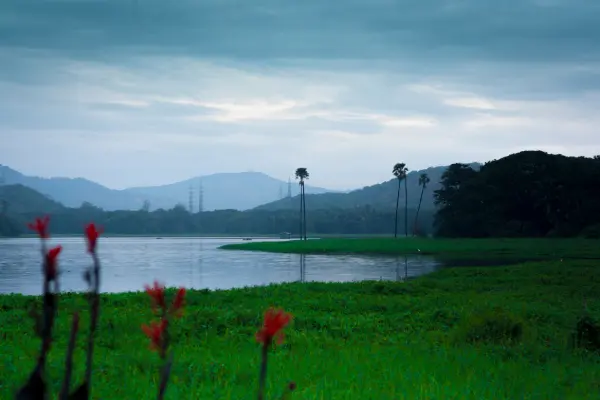
Quick answer: Powai Lake is an artificial lake in Powai, north-east Mumbai, created in 1891 by damming a stream that feeds the Mithi river. It was meant to supply drinking water but was soon declared unfit, and today it is a popular spot for evening walks, sunsets and birdwatching, with IIT Bombay on its eastern side. The lakeside promenade is a public space with no ticket; the lake also has resident mugger crocodiles, so stay out of the water.
Powai Lake at a glance
| Detail | What to know |
|---|---|
| Location | Powai, north-east Mumbai, between Hiranandani Gardens and IIT Bombay |
| Built | 1891, by damming a stream feeding the Mithi river |
| Area at construction | About 2.1 sq km (520 acres) |
| Managed for angling by | Maharashtra State Angling Association |
| Entry | The lakeside promenade is a public space; no ticket |
| Best time | November to February, late afternoon to sunset |
| Time needed | One to two hours |
| Nearest station | Kanjurmarg (Central line) |
About Powai Lake
Powai Lake sits in the Powai valley, which gave the suburb its name. A century ago the area was a valley of small villages; today the lake is ringed by apartment towers, hotels and institutes. The Hiranandani Gardens township lies on one side, and the campus of the Indian Institute of Technology (IIT) Bombay on the other, with the Indian Institute of Management (IIM) Mumbai, formerly NITIE, nearby. (An earlier version of this article called it “IIT Mumbai”; the institute’s name is IIT Bombay.)
When it was built, the lake covered about 2.1 sq km, with depths from about 3 metres at the edges to 12 metres at the deepest point. It overflows into the Mithi river for roughly 60 days a year in a typical monsoon.
History of Powai Lake
In the 19th century the Powai estate was leased to Framji Kavasji, a vice-president of the Agricultural and Horticultural Society of Western India, and the lake was originally named after him. In 1891, under British rule, a stream that feeds the Mithi river was dammed to add to Bombay’s water supply. The scheme was finished within a year and supplied about two million gallons a day, but complaints about the water quality led to it being abandoned.
An earlier version of this article said the lake was formed by “two dams on the Mithi” in 1891; published records describe a dam on a stream feeding the Mithi, downstream of Vihar Lake.
After the water-supply plan was dropped, the lake was leased to a fishing association for fish culture and angling. The Bombay Presidency Angling Association was formed in 1936 and registered in 1955 as the Maharashtra State Angling Association (MSAA), which still controls angling on the lake. The MSAA works on clearing water hyacinth, monitoring water quality and, with the state Fisheries Department, on conserving the Indian mahseer. A group of IIT Bombay alumni from the class of 1980 also started a project to revive the lake.
Pollution and silt
The Maharashtra government describes the water as unfit for drinking because untreated sewage and garbage have caused eutrophication (excess nutrients that feed algae and weeds). Silt has built up for more than a century, and in places the water is now very shallow. The Brihanmumbai Municipal Corporation (BMC) has announced plans to desilt the lake. Today the water is used for recreation, gardening and fishing, and for non-drinking supply to Aarey Colony and Larsen & Toubro.
Things to do at Powai Lake
Birdwatching and wildlife
The lake and its fringe of vegetation attract birds, butterflies and bees. Kingfishers, spot-billed ducks, egrets and herons are among the birds often seen, and raptors and storks sometimes visit. Powai Lake is also home to Indian marsh (mugger) crocodiles: a BMC census in 2022 counted at least 18. Watch them from a distance and never go down to the water’s edge.
Watching the sunset
Mumbai’s sea-facing promenades are not the only places for a sunset. The lakeside promenade is a popular place to watch the sky change colour in the evening, and you can pick up roasted peanuts or bhelpuri from snack sellers along the road.
A walk around Hiranandani
The Hiranandani Gardens township next to the lake has landscaped parks, cafés and shops, which makes it easy to combine a lakeside walk with a meal.
Timings and entry
The road and promenade along Powai Lake are public spaces, open throughout the day with no entry ticket. Some people visit at night to see the lights of the buildings reflected in the water, but stay on well-lit, busy stretches after dark. An earlier version of this article also referred to a “Powai Garden” open all day; we could not confirm a specific garden’s timings, so check locally if you plan to visit one.
Best time to visit
- November to February: the most comfortable months, with cooler evenings and clear sunsets.
- Monsoon (June to September): the lake fills and overflows, and the surroundings turn green, but heavy rain can flood nearby roads. Avoid the lake edge in heavy rain.
- Summer (March to May): hot and humid; come in the early morning or after 5 pm.
How to reach Powai Lake
- By suburban rail: Kanjurmarg on the Central line is the nearest station. Vikhroli and Ghatkopar (Central line) are other options, followed by an auto-rickshaw.
- By road: Powai is linked to the western suburbs by the Jogeshwari-Vikhroli Link Road (JVLR) and to the eastern suburbs by the Eastern Express Highway. By road it is about 40 km from downtown Mumbai, so allow plenty of time in traffic.
- From the airport: Chhatrapati Shivaji Maharaj International Airport is relatively close; a taxi is the easiest option.
Safety tips
- Do not swim, wade or feed animals. There are crocodiles in the lake.
- Keep children away from the water’s edge and walls.
- Don’t throw food or plastic into the water; the lake already struggles with pollution and weeds.
Places to visit near Powai Lake
- Sanjay Gandhi National Park, the forest park to the north, with lion and tiger safaris and nature trails. (An earlier version of this article listed lions among the animals you might see on a safari “with deer and monkeys”; lions are seen only in the park’s enclosed lion safari.)
- Chhota Kashmir, the garden and boating lake in Aarey Colony, on the way to Goregaon.
- Mumbai Film City in Goregaon East, one of India’s best-known film-shooting complexes.
- The Buddhist Kanheri Caves, inside the national park.
Frequently asked questions
Is Powai Lake natural or artificial?
Artificial. It was created in 1891 by damming a stream that feeds the Mithi river, to supply water to Bombay.
Can you drink the water from Powai Lake?
No. The water was declared unfit for drinking within a few years of the lake’s construction, and today it is used only for non-drinking purposes such as gardening and fishing.
Are there crocodiles in Powai Lake?
Yes. A BMC census in 2022 recorded at least 18 Indian marsh crocodiles. Stay away from the water’s edge.
Is there an entry fee for Powai Lake?
No. The lakeside road and promenade are public spaces with no ticket.
Which railway station is nearest to Powai Lake?
Kanjurmarg on the Central line is the nearest station, followed by a short auto-rickshaw ride.
History and details were checked in October 2026 against published records of Powai Lake, including Maharashtra government and BMC information on its water quality and wildlife. Conditions around the lake change with the season, so check before you go.