Quick answer: No. Aadhaar is not compulsory for getting a driving licence in India. Aadhaar is one accepted proof of identity, age and address, and using it lets you apply for many licence services online without visiting the RTO. If you prefer not to use Aadhaar, you can still apply in person with other documents such as a passport, birth certificate or school certificate.
Is Aadhaar compulsory for a driving licence?
Aadhaar is optional for a driving licence. The rules changed after this article was first written:
- 2017: The central government asked states to make Aadhaar a required document for driving licences. The stated aim was to stop people holding several licences under different identities. This article originally reported that plan, which was expected to start in October 2017.
- September 2018: In Justice K.S. Puttaswamy (Retd.) v. Union of India, a five-judge bench of the Supreme Court of India upheld Aadhaar for government subsidies and for income tax (PAN and returns). The court struck down compulsory Aadhaar linking for bank accounts and mobile connections and limited how far Aadhaar could be demanded for other services. Our explainer on the Aadhaar Act and the 2018 judgment covers the legal history.
- March 2021: The Ministry of Road Transport and Highways (MoRTH) notified that Aadhaar authentication can be used voluntarily for a set of contactless licence and registration services on the Parivahan portal. People who do not opt for Aadhaar authentication can still get these services by visiting the transport office.
So today, Aadhaar makes the process faster, but it is not a condition for holding a licence.
Why Aadhaar is still useful when you apply
The original concern behind the 2017 plan was real: one person holding several licences in different states, and continuing to drive after one licence was suspended. Licence records now sit in Sarathi, the national driving licence database, which helps RTOs see whether an applicant already holds a licence elsewhere.
Using Aadhaar on the Sarathi Parivahan portal also cuts paperwork:
- Your name, date of birth, address and photo can be taken from Aadhaar after an OTP check (how Aadhaar e-KYC works), so you do not upload separate proofs.
- Several services can be completed online without an RTO visit, including a learner’s licence (in states that run the test online), renewal of a licence that does not need a fresh test, a duplicate licence, change of address and an International Driving Permit.
- Many states now require the mobile number on your licence record to be verified by OTP, and linking it through Aadhaar is the quickest way to do that.
Who can get a driving licence in India?
Section 4 of the Motor Vehicles Act, 1988 sets the minimum ages:
| Vehicle | Minimum age |
|---|---|
| Motorcycle with an engine of 50cc or less | 16 years (with a parent’s or guardian’s consent for the learner’s licence) |
| Other motorcycles, cars and other non-transport vehicles | 18 years |
| Transport vehicles (commercial) | 20 years |
There is no minimum educational qualification for a private (non-transport) licence. An earlier version of this article said applicants must have passed class 8; that requirement never applied to private licences.
How to apply for a driving licence today
- Apply for a learner’s licence on the Sarathi Parivahan portal (sarathi.parivahan.gov.in) and choose your state. You can authenticate with Aadhaar or upload other proofs of age and address.
- Pass the learner’s test. This checks road signs and traffic rules. Some states run it online with Aadhaar-based identity checks; others hold it at the RTO.
- Practise for at least 30 days. A learner’s licence is valid for six months, and states ask you to wait at least 30 days from its issue before applying for the permanent licence.
- Book and take the driving test at your RTO or an authorised testing track.
- Receive your licence. Most states post a smart-card licence. You can also keep a digital copy in DigiLocker or the mParivahan app.
Fees, test formats and the exact list of accepted documents are set by each state, so check your state’s page on the Parivahan portal before you apply.
Smart-card and digital licences
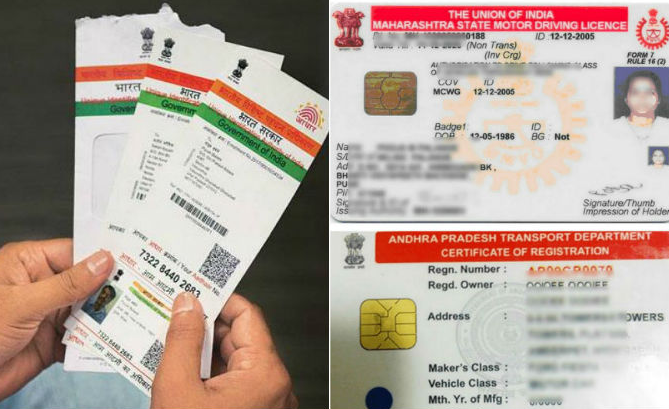
Paper licence booklets have been replaced by credit-card-sized smart cards in most states. The card format, security features and any chip or QR code vary by state. Like the original smart licences described here, they carry your photograph, signature and licence details, and they are much harder to forge than paper booklets.
Since 2018, MoRTH has advised states to accept a driving licence shown through DigiLocker or mParivahan as valid, at par with the physical card, under the Information Technology Act, 2000. You still have to show the licence when an officer asks for it.
If you do not have Aadhaar yet
You do not need Aadhaar to apply for a licence, but it is free to get one if you want the faster online route:
- Find a centre using “Locate Enrolment Centre” on uidai.gov.in (see how to find an Aadhaar centre near you), or book a slot at an Aadhaar Seva Kendra. Many bank branches and post offices also enrol.
- Take an original proof of identity and proof of address from UIDAI’s list of accepted documents.
- The operator records your demographic details, fingerprints, iris scan and photograph.
- You receive an acknowledgement slip with a 28-digit Enrolment ID (a 14-digit enrolment number plus the date and time). Use it to track your application on myaadhaar.uidai.gov.in.
Aadhaar enrolment is free. Updating details later can carry a fee; for example, a separate demographic update at a centre costs ₹75, according to UIDAI’s published charges.
Frequently asked questions
Can the RTO refuse my licence application if I do not have Aadhaar?
No. Aadhaar authentication for licence services is voluntary. You can apply in person with other accepted proofs of identity, age and address.
Is it compulsory to link Aadhaar with an existing driving licence?
No. Linking is optional. It does make online services such as renewal and change of address easier, and states increasingly require an OTP-verified mobile number on your licence record.
Which documents can I use instead of Aadhaar?
States accept documents such as a passport, birth certificate, school leaving certificate, voter ID or utility bills as proof of age or address. The exact list varies by state and is shown on the Sarathi Parivahan portal.
Is a driving licence in DigiLocker valid?
Yes. MoRTH advised states in 2018 to accept licences shown through DigiLocker or mParivahan as valid documents.
How long is a learner’s licence valid?
Six months from the date of issue, under Section 14 of the Motor Vehicles Act. You can apply for the permanent licence after 30 days.
Rules and fees in this guide were checked in October 2026 against the Motor Vehicles Act, 1988, the Supreme Court’s 2018 Aadhaar judgment, MoRTH notifications and UIDAI’s published charges. Transport rules vary by state, so confirm details on your state’s Parivahan page before applying.