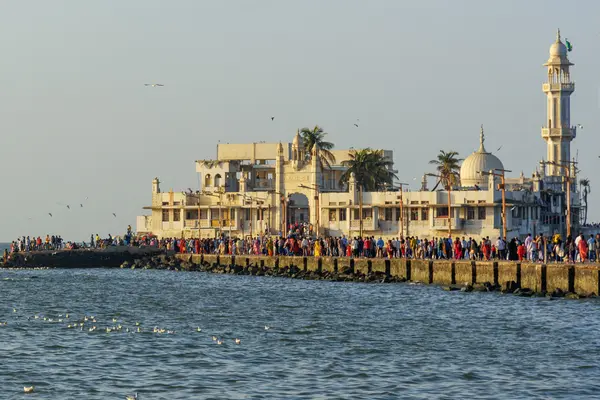
Quick answer: Haji Ali Dargah is a white mosque and tomb (dargah) of the Sufi saint Pir Haji Ali Shah Bukhari, standing on an islet about 500 yards off the Worli coast in Mumbai and reached by a narrow causeway from Lala Lajpat Rai Marg. It is open to people of all faiths, and entry is free. As of October 2026, the Haji Ali Dargah Trust lists ziyarat (visiting) hours as 5:30 am to 10 pm. The causeway can be covered by the sea at high tide, so check tide times before you go.
Haji Ali Dargah at a glance
| Detail | What to know |
|---|---|
| Location | Islet off Lala Lajpat Rai Marg (Hornby Vellard), near Mahalaxmi and Worli, Mumbai |
| Timings | 5:30 am to 10 pm (Haji Ali Dargah Trust, October 2026) |
| Entry fee | Free |
| Who can visit | People of all faiths; women can enter the inner sanctum since November 2016 |
| Managed by | Haji Ali Dargah Trust (formed 1916) |
| Best time to visit | Weekday mornings at low tide; evenings for the sunset |
| Time needed | About 1 to 2 hours |
Who was Haji Ali?
Pir Haji Ali Shah Bukhari was a Sufi saint who settled in Bombay and spent his life teaching Islam. The Haji Ali Dargah Trust describes him as a saint who came to India from Persia; other accounts, reflected in the name “Bukhari”, say he was a wealthy merchant from Bukhara in present-day Uzbekistan. He never married and had no descendants, and most of what is known about him has been passed down by the dargah’s caretakers.
The legend of the spilled oil
According to the Trust’s account of the traditions, a woman once passed the saint in his hometown, crying because she had spilled the oil she was carrying and feared her husband’s anger. He went with her to the spot and pressed the ground with his thumb, and oil gushed out to refill her vessel. Afterwards he was troubled by the thought that he had wounded the earth. With his mother’s permission, he left for India with his brother and reached the Mumbai shore near Worli. His brother returned home, but Haji Ali stayed and spent the rest of his life in Mumbai.
How the dargah came to be in the sea
Before he died, Haji Ali asked his followers not to bury him in a graveyard. Instead, they were to set his shroud (kafan) adrift in the sea and bury him wherever it came to rest. The shroud came to rest on a small mound of rocks rising out of the sea off Worli, and the tomb and mosque were later built on that spot.
History of the dargah
The dargah is commonly dated to 1431. The Trust says the structure, built on high rocks, took its present-day shape in the early 19th century. Key dates in the complex’s later history, according to the Trust, include:
- 1916: the Haji Ali Dargah Trust was legally formed.
- 1944: a concrete pathway (causeway) was built from Trust funds.
- 1946 to 1950: the qawwali hall, sanatorium buildings and main gate were built.
- 1960 to 1964: the dargah and mosque were reconstructed and renovated.
- 1984 to 1990: the pathway was rebuilt wider and higher.
- 2009 onwards: because sea air had corroded the concrete, the Trust began restoring the mausoleum in white Makrana marble from Rajasthan, the marble famously used in the Taj Mahal. The work is being done in phases so that daily visitors are not disrupted.
Women’s entry to the sanctum
In June 2012 the Trust barred women from entering the inner sanctum around the tomb. On 26 August 2016 the Bombay High Court ruled that women must be allowed into the sanctum, and they were allowed back in on 29 November 2016.
Architecture
The dargah is built in the Indo-Islamic style, with a whitewashed exterior, a marble courtyard, a dome and an 85-foot minaret. The Trust gives the complex’s total area as about 5,000 square metres. Inside the main hall, mirror work in Arabic patterns spells out the 99 names of Allah.
The complex includes the main gate, the dargah with the tomb, the mosque and minaret, a qawwali hall, sanatorium buildings, a rest area for women and the Trust’s offices. A small mosque, the Kinara Masjid, stands near the entrance on Lala Lajpat Rai Marg.
Visiting Haji Ali Dargah
- Start at Lala Lajpat Rai Marg. The causeway begins on the main road near the Haji Ali junction.
- Walk the causeway. The narrow path runs out across the water.
- Enter the complex. Leave your footwear at the shoe stand, cover your head (a scarf or cap for men and women alike is respectful), and use the marble steps up to the tomb.
- Visit the tomb. Offer prayers or flowers if you wish, and keep your voice low.
- Sit by the sea. The open area around the dargah is a calm place to watch the waves and, in the evening, the sunset.
Tides and the causeway
The causeway has no railings and is low over the water. At high tide the sea can cover it, cutting off the dargah from the mainland until the water drops. Check the tide times before you go, and set off back in good time if the tide is rising. During the monsoon, high waves can make the walk dangerous; follow any instructions from police or Trust staff.
Etiquette
- Dress modestly, covering shoulders and legs.
- Cover your head inside the dargah.
- Photography is not appropriate inside the tomb area; ask before taking photos elsewhere in the complex.
- Thursdays and Fridays are especially busy, as are Eid and the saint’s annual urs.
The Trust warns that people falsely claiming to represent it operate both online and in person. Make donations only through the Trust’s official channels.
How to reach Haji Ali Dargah
- Suburban rail: Mahalaxmi station on the Western line is the nearest; from there it is a short taxi ride or walk to Haji Ali junction.
- By road: Taxis and app cabs stop on Lala Lajpat Rai Marg near the start of the causeway. The Mumbai Coastal Road also passes close to Haji Ali.
Nearby places
- The Worli Sea Face promenade, a short drive north
- The Bandra-Worli Sea Link, starting at Worli
- The Nehru Planetarium at Worli
- Shree Siddhivinayak Temple in Prabhadevi
Frequently asked questions
What are the Haji Ali Dargah timings?
The Haji Ali Dargah Trust lists ziyarat hours as 5:30 am to 10 pm. Access also depends on the tide, as the causeway can be covered at high tide.
Can non-Muslims visit Haji Ali Dargah?
Yes. The Trust says people of all faiths and backgrounds visit and pray at the dargah.
Can women enter the Haji Ali Dargah sanctum?
Yes. After the Bombay High Court’s ruling in August 2016, women have been allowed into the inner sanctum since 29 November 2016.
When was Haji Ali Dargah built?
The dargah is commonly dated to 1431. The Trust says it took its present shape in the early 19th century, and it was rebuilt in 1960 to 1964. Restoration in Makrana marble has been under way in phases since 2009.
Is there an entry fee for Haji Ali Dargah?
No. Entry is free.
Timings, history and visitor information in this guide were checked in October 2026 against the Haji Ali Dargah Trust’s official website and published records of the 2016 court ruling. Access depends on the tide, so check before you go.