Quick answer: Shree Siddhivinayak Temple is a Ganesh temple in Prabhadevi, central Mumbai, first consecrated on 19 November 1801 and now one of the busiest temples in the city. Entry and darshan are free. As of October 2026, the temple trust’s published schedule opens darshan at 6 am (after the 5:30 am Kakad Aarti) and ends with the Shejaarti at 9:50 pm from Wednesday to Monday, while on Tuesdays darshan starts at 3:15 am and runs late into the night.
Siddhivinayak Temple at a glance
| Detail | What to know |
|---|---|
| Location | Prabhadevi, Mumbai (between Dadar and Worli) |
| Deity | Shree Siddhivinayak (Ganesh), with Riddhi and Siddhi |
| Timings (Wednesday to Monday) | Kakad Aarti 5:30 am; darshan from 6 am; Shejaarti 9:50 pm, after which the temple closes |
| Timings (Tuesday) | Early darshan from 3:15 am; last darshan until 11:30 pm; Shejaarti 11:45 pm |
| Entry fee | Free |
| Managed by | Shree Siddhivinayak Ganapati Temple Trust |
| Busiest days | Tuesdays, Sankashti and Angarki Chaturthi, Ganesh Chaturthi |
Timings are from the temple trust’s schedule (siddhivinayak.org) as of October 2026. Special days follow a different timetable, so check the trust’s website or call the temple before you go.
History of Siddhivinayak Temple
According to the temple trust, the Siddhivinayak temple was first consecrated on Thursday, 19 November 1801, a date the trust says is noted in government records. The original shrine was a small structure housing the black stone idol. Laxman Vithu Patil and Deubai Patil are generally named as the people who had it built.
For most of the 19th and 20th centuries the shrine stayed modest. The trust describes the older temple as having a hall, a sanctum, some open space, an administrative office to one side and a water tank in front.
The present building is the result of a major reconstruction. According to the trust, work began in 1990 and took about three years, and the new crown was installed with a Kumbhabhishek ceremony on 13 June 1994. The trust puts the cost at about ₹3 crore. An earlier version of this article said the new temple was “planned to open in 2018”; that was wrong, as the rebuilt temple has been in use since the 1990s.
The temple is run by the Shree Siddhivinayak Ganapati Temple Trust, which is governed by a dedicated state law, the Shri Siddhivinayak Ganapati Temple Trust (Prabhadevi) Act, 1980.
The Siddhivinayak idol
The idol is the main reason devotees come. As the trust describes it:
- It is carved from a single block of black stone, about 2.5 feet high and 2 feet wide.
- The trunk turns to the right. Most Ganesh idols have a trunk curving to the left, so a right-trunk idol is considered unusual.
- The idol has four hands (chaturbhuj), holding a lotus, an axe, a rosary and a bowl of modaks, the sweet associated with Ganesh.
- A snake-like sacred thread is wrapped around the neck.
- The goddesses Riddhi and Siddhi, associated with success and prosperity, stand on either side.
The trust’s pages also mention an eye carved on the forehead, which resembles Shiva’s third eye.
Temple architecture
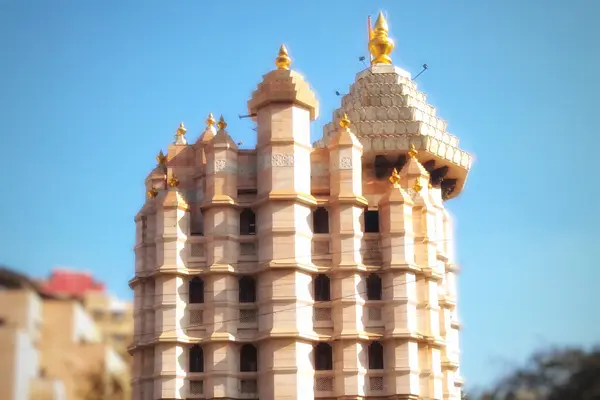
The new temple was designed by architect Sharad Athale of SK Athale and Associates. According to the trust, the team studied temples in Rajasthan and Tamil Nadu. They then chose the Shiva temple at Ambernath, near Mumbai, as the model, because its stone construction had survived a hot, humid coastal climate and about four months of heavy monsoon every year.
The result is a six-storey, multi-angled structure. The trust says the summit carries 47 gold-plated crowns, including a 12-foot main crown, and that the building has three main entrances, each 13 feet tall. Over 300 devotees can see the idol at once from the main hall and mezzanine. The inner roof of the sanctum is gold-plated.
Darshan and aarti timings
The temple trust publishes a detailed daily schedule. As of October 2026 it reads:
Wednesday to Monday
- Kakad Aarti (morning prayer): 5:30 to 6:00 am
- Darshan: 6:00 am to 12:00 noon
- Naivedya (food offering): 12:05 to 12:30 pm
- Darshan: 12:30 to 7:00 pm
- Dhup Aarti: 7:00 to 7:10 pm
- Evening Aarti: 7:30 to 8:00 pm
- Darshan: 8:00 to 9:50 pm
- Shejaarti (last aarti): 9:50 pm, after which the temple closes
Tuesday
- Early darshan: 3:15 to 4:45 am
- Kakad Aarti: 5:00 to 5:30 am
- Darshan: 5:30 am to 12:00 noon, then 12:30 to 8:45 pm (with short breaks for naivedya and Dhup Aarti)
- Night pooja and aarti: 9:00 to 10:10 pm. The main doors are closed during this time, but the idol can be seen from a distance.
- Darshan: 10:10 to 11:30 pm; Shejaarti at 11:45 pm
On Vinayaki Chaturthi, Sankashti Chaturthi, Maghi Ganesh Jayanti and Bhadrapad Ganesh Chaturthi, the schedule changes. The sanctum closes to devotees for several hours during the abhishek and pooja. On Sankashti, the evening pooja is tied to moonrise. Check the trust’s “Temple Schedule” page before visiting on these days.
Poojas you can book
The Pooja Booking Counter is outside the Siddhi Gate and, according to the trust, is open daily from 7 am to 7 pm. Poojas are performed by the temple’s priests and include:
- Aavartan Panchamrut Pooja
- 11 Aavartan Shodashopchar Pooja
- Sahastra Namavali and Atharvashirsha recitations
- Shree Satyanarayan and Satya Vinayak Mahapooja
- Two-wheeler and four-wheeler vehicle poojas
The trust lists a fee for each pooja on its “Pooja Details” page. Fees change, so check the current amount there or at the counter.
Rules and tips for visitors
- Mobile phones: The trust asks visitors to switch off mobile phones before entering. Do not photograph inside the temple.
- Dress code: The trust asks for modest, traditional clothing. Revealing or provocative clothes are not allowed.
- Footwear: Leave shoes at the footwear stand outside the entrance.
- Crowds: The trust says Tuesdays, Sankashti Chaturthi and Angarki Chaturthi can draw around 2 lakh devotees. If you want a shorter queue, visit on a weekday other than Tuesday, early in the morning.
- Online darshan: The trust streams a live darshan on its website for devotees who cannot visit.
An earlier version of this article quoted a ₹50 “paid darshan” queue and specific cloakroom charges for cameras and laptops. We could not confirm these on the trust’s website, so they have been removed. Ask at the temple for the current arrangements.
How to reach Siddhivinayak Temple
- Metro: Mumbai Metro Line 3 (the Aqua Line) has a station named Siddhivinayak, between Dadar and Worli.
- Suburban rail: Dadar is the nearest major suburban railway station, served by both the Western and Central lines. From there, the temple is a short taxi or auto-rickshaw ride.
- By road: Taxis and app cabs reach the temple from anywhere in the city. Parking nearby is limited, especially on Tuesdays.
Places to visit near Siddhivinayak Temple
Prabhadevi sits close to the Worli waterfront, so the temple fits easily into a day in central Mumbai:
- Drive across the Bandra-Worli Sea Link, which starts at Worli.
- Walk along the Worli Sea Face promenade in the evening.
- Visit the Haji Ali Dargah, the Sufi shrine on an islet off the Worli coast.
- For another of Mumbai’s old temples, see the Babulnath Shiva temple near Girgaon Chowpatty.
Frequently asked questions
Is there an entry fee for Siddhivinayak Temple?
No. Entry and general darshan are free. Fees apply only to poojas booked at the Pooja Booking Counter.
What time does Siddhivinayak Temple open on Tuesday?
According to the trust’s schedule, early darshan on Tuesday runs from 3:15 to 4:45 am, and the temple stays open until the Shejaarti at 11:45 pm. Tuesday is the busiest day of the week.
Who built the Siddhivinayak Temple?
The original shrine, consecrated in 1801, is generally attributed to Laxman Vithu Patil and Deubai Patil. The present six-storey temple was designed by architect Sharad Athale and completed in the early 1990s, with the crown installed in June 1994.
Why is the Siddhivinayak idol’s trunk turned to the right?
The idol was carved with its trunk to the right, which is rarer than the usual left-curving trunk. In Hindu tradition, right-trunk Ganesh idols are regarded as especially significant, which adds to the temple’s importance for devotees.
Can I carry my phone into Siddhivinayak Temple?
The trust asks visitors to switch off their phones before entering, and photography inside is not allowed.
Timings, history and visitor rules in this guide were checked in October 2026 against the Shree Siddhivinayak Ganapati Temple Trust’s official website. The trust changes timings on festival days, so check before visiting.