Quick answer: The Red Fort (Lal Qila) in Old Delhi is the Mughal palace-fortress that Emperor Shah Jahan began in 1639 for his new capital, Shahjahanabad, and completed in 1648. It is part of the Red Fort Complex, a UNESCO World Heritage Site since 2007, and is protected by the Archaeological Survey of India (ASI). According to the ASI, entry costs ₹35 online or ₹50 in cash for Indian, SAARC and BIMSTEC visitors, and ₹550 online or ₹600 in cash for other foreign visitors; children under 15 enter free. Check opening hours and any closures on the ASI e-ticketing site before you go.
Red Fort at a glance
| Detail | What we verified (October 2026) |
|---|---|
| Location | Netaji Subhash Marg, Chandni Chowk, Old Delhi |
| Built by | Mughal emperor Shah Jahan; begun 1639, completed 8 April 1648 |
| Heritage status | UNESCO World Heritage Site (Red Fort Complex, 2007); ASI-protected ticketed monument |
| Entry fee: Indian, SAARC and BIMSTEC | ₹35 online, ₹50 cash (ASI) |
| Entry fee: other foreign visitors | ₹550 online, ₹600 cash (ASI) |
| Children | Free below 15 years (ASI) |
| Timings and weekly closure | Not clearly stated on ASI’s monument pages; check the ASI e-ticketing site before visiting |
| Time needed | Two to three hours |
Closures: the ASI closes the Red Fort to the public every year for a period before Independence Day (15 August), when the Prime Minister addresses the nation from its ramparts. In 2026, according to All India Radio, the complex was closed until the 80th Independence Day celebrations. Plan around late July and early August, and check for other security closures, such as around Republic Day.
History of the Red Fort
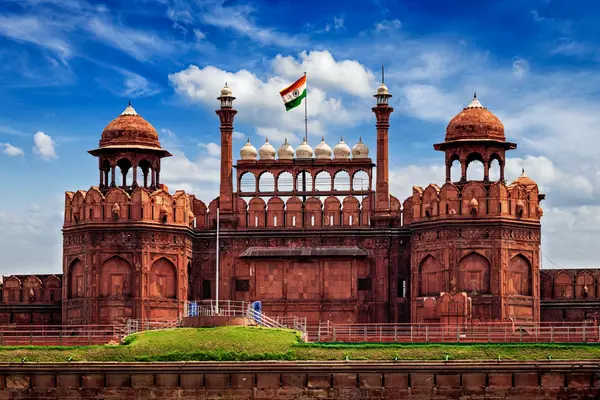
In 1638 Shah Jahan decided to move his capital from Agra to Delhi and founded Shahjahanabad, the seventh city of Delhi. According to the ASI, he began his citadel in 1639 at the town’s northern end, on the right bank of the Yamuna and south of the older Salimgarh Fort, and it was completed after nine years, on 8 April 1648. It was first called Qila-i-Mubarak, the “blessed fort”. The name Lal Qila, or Red Fort, comes from its red sandstone walls.
The architect is traditionally named as Ustad Ahmad Lahori, who is also associated with the Taj Mahal. The ASI notes that the Red Fort is better planned than the Agra Fort, because Shah Jahan built on his experience at Agra and because it was the work of one design.
Decline, 1857 and after
In 1739 the Persian invader Nadir Shah sacked Delhi and carried away the fort’s treasures, including the famous Peacock Throne. After the uprising of 1857, the British captured the fort, put the last Mughal emperor, Bahadur Shah Zafar, on trial there in 1858 and exiled him to Rangoon. They demolished a large part of the palace buildings, including harem apartments, servants’ quarters and gardens, and built stone barracks for their troops. Viceroy Lord Curzon later began restoration work.
On 15 August 1947, Prime Minister Jawaharlal Nehru raised the national flag above the Lahori Gate. Since then the Prime Minister has hoisted the flag and addressed the nation from the ramparts every Independence Day.
Corrections to the earlier version
- An earlier version of this article said the British painted the fort red after “limestone started to flake off”, and that “Lal Qila” means “people’s property”. The walls, gates and several buildings are built of red sandstone, which is where the name comes from; “Lal Qila” simply means “Red Fort”. Some marble and plaster surfaces were originally white, which is why some historians describe the fort as originally red and white.
- It also said the British took the Koh-i-Noor from the fort. The diamond was carried off by Nadir Shah in 1739 and reached the British much later, from Punjab, so it was not looted from the Red Fort by the British.
- It said the fort houses the “Delhi Science Museum”. It does not. The museums are listed below.
Architecture of the Red Fort
According to the ASI, the fort is an irregular octagon, with two long sides on the east and west and six shorter ones on the north and south. Its walls of red sandstone carry turrets, kiosks, balconies and perforated screens, with 21 circular and octagonal bastions. A moat 18 m wide and 9 m deep ran outside the walls, except on the river side. The walls are about 2.4 km long and enclose about 255 acres, and they rise from about 18 m on the river side to about 33 m on the city side. While the walls and gates are of red sandstone, marble was used extensively in the palaces.
What to see inside the Red Fort
- Lahori Gate: the main western entrance, named because it faces towards Lahore.
- Delhi Gate: the southern gate, flanked by two life-size stone elephants.
- Chhatta Chowk: a vaulted, covered arcade inside the Lahori Gate, which once housed shops for the imperial household.
- Naubat Khana (Naqqar Khana): the drum house, where ceremonial music was played. Its upper storey houses the Indian War Memorial Museum.
- Diwan-i-Aam: the Hall of Public Audience, with a façade of nine arches and a marble canopy where the throne stood. The wall behind it has pietra dura panels, one showing Orpheus with his lute.
- Rang Mahal: the “Painted Palace”, once decorated in colour, with the Nahr-i-Bihisht (“Stream of Paradise”) water channel running through it.
- Mumtaz Mahal: once part of the imperial women’s quarters, now the Delhi Fort Museum (the Red Fort Archaeological Museum).
- Diwan-i-Khas: the richly decorated Hall of Private Audience, whose marble dais is said to have held the Peacock Throne.
- Khas Mahal, Tasbih-Khana and Khwabgah: the emperor’s private chambers, with the Scales of Justice carved on a marble screen, and the Muthamman Burj balcony, from which King George V and Queen Mary appeared before the people of Delhi in December 1911.
- Hammam: the royal baths, lined with inlaid marble.
- Moti Masjid: the small Pearl Mosque, added by Aurangzeb.
- Hayat Bakhsh Bagh and Zafar Mahal: the “life-giving garden”, with a red sandstone pavilion built by Bahadur Shah II in about 1842.
- Barrack museums: four museums opened in 2019 in the British-era barracks, on the 1857 uprising, the Jallianwala Bagh massacre, Subhas Chandra Bose and the Indian National Army, and Indian art.
Light and sound show
The ASI stages a light and sound show at the Red Fort after sunset, telling the fort’s history with narration, music and digital laser mapping. Show times, languages and ticket prices change, so check the ASI’s booking site before you go. An earlier version of this article listed show times and ticket prices that we could not confirm, so they have been removed.
How to reach the Red Fort
- Metro: Lal Quila station on the Violet Line is the closest. Chandni Chowk on the Yellow Line is also within walking distance.
- Rail: Old Delhi Railway Station (Delhi Junction) is close by; New Delhi station is a short ride away.
- Road: Cycle-rickshaws and e-rickshaws run from Chandni Chowk. Traffic in Old Delhi is heavy, so the Metro is usually quicker.
Tips for visiting
- Buy tickets online through the ASI to save money and queue time.
- Carry ID and expect a security check; avoid bringing large bags.
- Winter mornings are the most comfortable time to walk the large grounds.
- Pair the visit with lunch in Old Delhi; the lanes of Chandni Chowk start right outside.
Places to visit nearby
Old Delhi’s landmarks are all close by: Jama Masjid, also built by Shah Jahan, the bazaars of Chandni Chowk and Fatehpuri Masjid at its western end. Rajghat, the memorial to Mahatma Gandhi, is a short drive south.
Frequently asked questions
Who built the Red Fort?
Mughal emperor Shah Jahan, between 1639 and 1648, as the citadel of his new capital, Shahjahanabad.
What is the Red Fort entry fee?
According to the ASI, ₹35 online or ₹50 in cash for Indian, SAARC and BIMSTEC visitors; ₹550 online or ₹600 in cash for other foreign visitors. Children under 15 enter free.
Is the Red Fort a UNESCO World Heritage Site?
Yes. The Red Fort Complex was inscribed in 2007.
Why is the Red Fort closed in August?
The ASI closes it to the public every year for a period before Independence Day, when the Prime Minister speaks from its ramparts.
Which metro station is nearest to the Red Fort?
Lal Quila on the Violet Line; Chandni Chowk on the Yellow Line is also close.
History, architecture and entry fees were checked in October 2026 against the Archaeological Survey of India’s Red Fort pages, with closure information from All India Radio. Check the ASI e-ticketing site for timings before visiting.