Quick answer: Jama Masjid, officially Masjid-i-Jahan-Numa, is the great congregational mosque of Old Delhi, built by Mughal emperor Shah Jahan and inaugurated in 1656. Its courtyard holds about 25,000 worshippers, making it one of the largest mosques in India. As of October 2026, Delhi Tourism lists tourist hours as 11 am to sunset for Indian visitors (free entry) and 8 am to sunset for foreign visitors (₹400), with photography free; tourists are not allowed during prayer times, and modest dress is required.
Jama Masjid at a glance
| Detail | What to know |
|---|---|
| Location | Off Netaji Subhash Marg, west of the Red Fort, Old Delhi |
| Built | 1650s by Shah Jahan; inaugurated 23 July 1656 |
| Tourist timings | Indian visitors 11 am to sunset; foreign visitors 8 am to sunset; open all days, but closed to tourists during prayers (Delhi Tourism, checked October 2026) |
| Entry fee | Free for Indian visitors; ₹400 for foreign visitors (Delhi Tourism, checked October 2026) |
| Photography | Free (Delhi Tourism, checked October 2026) |
| Dress code | Shoes off; shoulders and legs covered; robes available at the northern gate |
| Nearest metro | Jama Masjid (Violet Line); Chawri Bazar (Yellow Line) |
| Time needed | About an hour (general guidance) |
An earlier version of this article gave the hours as 7 am to noon and 1:30 pm to 6:30 pm, said entry was free for everyone and said visitors had to pay ₹300 to take photographs. Delhi Tourism’s current page lists different tourist hours, a ₹400 fee for foreign tourists and free photography, so the article has been updated. Rules at an active mosque can change at short notice, so check at the gate.
Name and meaning
Shah Jahan named the mosque Masjid-i-Jahan-Numa, usually translated as “the mosque that reflects (or commands a view of) the world”. The everyday name, Jama Masjid, comes from jama or jumu’ah, the Friday congregational prayer; many cities have a “Jama Masjid”, but Delhi’s is the most famous.
History of Jama Masjid
Shah Jahan moved the Mughal capital from Agra to Delhi and built a new walled city, Shahjahanabad (today’s Old Delhi), with the Red Fort as its palace. Jama Masjid was built as the city’s imperial mosque on a hill, its highest point. Most histories date construction to between 1650 and 1656; Delhi Tourism’s pages give a start of 1644.
- About 5,000 workers built the mosque, under the supervision of Shah Jahan’s wazir (prime minister), Sadullah Khan, and Fazil Khan, the comptroller of the royal household.
- It cost about ten lakh (one million) rupees at the time.
- It was inaugurated on 23 July 1656 by Syed Abdul Ghafoor Shah Bukhari, a scholar from Bukhara (in present-day Uzbekistan), whom Shah Jahan appointed as its first Shahi Imam. The Shahi Imams of Jama Masjid have traditionally come from his family ever since. An earlier version of this article gave the inauguration year as 1956; it was 1656.
- It was one of the last great buildings of Shah Jahan’s reign, and the Mughal emperors used it as their royal mosque until the end of the empire in 1857.
- After the uprising of 1857, the British confiscated the mosque and used part of it as barracks. It was returned to the Muslim community in 1862, on conditions, and a managing committee was formed to look after it.
Architecture
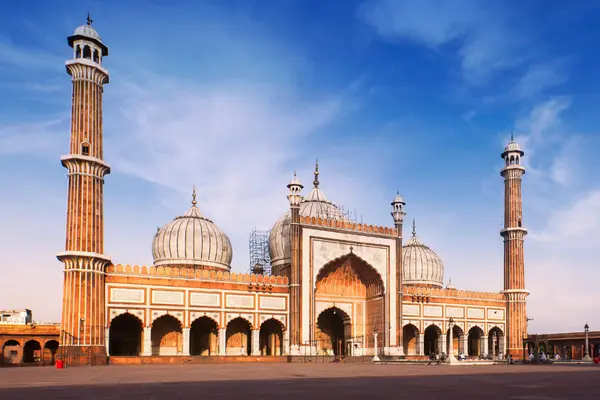
Jama Masjid is built mainly of red sandstone, with much more white marble than earlier Mughal mosques, and black marble for decoration. It stands on a plinth about 10 metres above the surrounding streets and faces west, towards Mecca.
- Gates: three sandstone gateways with broad flights of steps lead into the mosque. The three-storey eastern gate was the royal entrance used by the emperor; the northern and southern gates were used by the public.
- Courtyard: the square courtyard, about 99 metres a side, can hold 25,000 worshippers. A marble ablution tank in the centre is used for washing before prayer.
- Prayer hall: about 61 metres long and 27 metres wide, topped by three marble domes striped in black and white, with a grand central arch flanked by smaller arches. The floor is laid in white and black marble to resemble prayer mats.
- Minarets: two minarets, about 40 metres high and striped with white marble, rise at the corners of the prayer hall.
- Relics: a cabinet in the north gate holds relics associated with the Prophet Muhammad, including a Quran written on deerskin.
An earlier version of this article gave the mosque’s size in two different ways (261 by 90 feet, and 65 by 35 metres) and listed step counts for each gate that we could not verify; the figures above follow published architectural descriptions.
Rules and tips for visitors
- Prayer times: tourists are not allowed in during namaz. Delhi Tourism notes that the mosque is closed to non-Muslim visitors for about two hours around the Friday midday prayer, and that after sunset only worshippers are allowed in.
- Dress: remove your shoes before entering; you can carry them or leave them with the shoe attendants. Cover your shoulders and legs. Robes can be hired at the northern gate, according to Delhi Tourism.
- Women visitors: women are welcome; Delhi Tourism describes it as one of the few mosques where women can enter. Covering your head is respectful.
- Behaviour: keep your voice down, do not photograph people at prayer without permission and avoid public displays of affection.
- Weather: the courtyard stone gets very hot in summer, so visit early or late in the day.
How to reach Jama Masjid
- By metro: Jama Masjid station on the Violet Line’s “Heritage Line” section is the closest. Delhi Tourism names Chawri Bazar (Yellow Line) as the nearest station on its page, and it is a short walk away. Lal Quila (Violet Line) is also close.
- By rail and bus: Old Delhi Railway Station and the Kashmere Gate Inter-State Bus Terminal are a short ride away.
- Locally: cycle rickshaws and e-rickshaws are the easiest way through the crowded lanes of Old Delhi.
Food and shopping around Jama Masjid
The lanes around the mosque are famous for Old Delhi’s Mughlai food, especially kebabs and meat dishes, and are particularly lively in the evenings during Ramzan. Meena Bazaar, a busy street market, is right by the mosque. Choose busy stalls where food is cooked fresh, and check recent reviews, as eateries change over time.
Nearby places to visit
Jama Masjid is at the heart of Old Delhi. The Red Fort is a short walk east, and Chandni Chowk, with its specialist bazaars, runs just to the north. At the western end of Chandni Chowk stands Fatehpuri Masjid, another mosque of Shah Jahan’s time. The tomb of Maulana Abul Kalam Azad, India’s first education minister, is right beside Jama Masjid, and Raj Ghat, Mahatma Gandhi’s memorial, is a short drive away.
Frequently asked questions
Who built Jama Masjid in Delhi?
Mughal emperor Shah Jahan, who also built the Red Fort and the Taj Mahal. The work was supervised by his wazir, Sadullah Khan, and the mosque was inaugurated in 1656.
Is there an entry fee for Jama Masjid?
As of October 2026, Delhi Tourism lists free entry for Indian visitors and ₹400 for foreign tourists, with free photography.
What are Jama Masjid’s timings for tourists?
Delhi Tourism lists 11 am to sunset for Indian visitors and 8 am to sunset for foreign visitors, every day, except during prayers.
Can women visit Jama Masjid?
Yes. Dress modestly, cover your shoulders and legs, and remove your shoes. Robes are available at the northern gate.
Which metro station is nearest to Jama Masjid?
Jama Masjid station on the Violet Line; Chawri Bazar on the Yellow Line is also close.
Details checked in October 2026 against Delhi Tourism’s Jama Masjid and spiritual Delhi pages and published histories of the mosque. Visiting rules at an active mosque can change, so check at the gate.