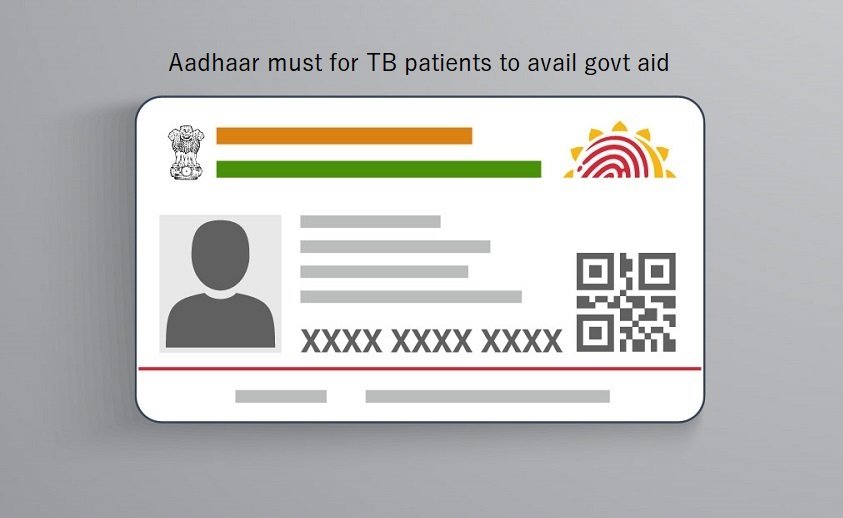
Quick answer: No. TB patients do not need Aadhaar to get government help. Under the Ni-kshay Poshan Yojana, every TB patient notified on the Ni-kshay portal gets ₹1,000 a month for the whole treatment period, paid by direct benefit transfer to a bank account. The health ministry asks for Aadhaar where available, but its own rules say the benefit cannot be denied for lack of an Aadhaar card, and TB tests and treatment are free in any case.
TB in India: the current picture
Tuberculosis (TB) is still common in India, and it is curable. The latest official figures show:
- Infection: the National TB Prevalence Survey (2019–2021) found that about 31% of people aged 15 and over carried TB infection, most of it latent (infected, but not ill). The original version of this article quoted “about 40%”, an older and widely repeated estimate.
- Falling incidence: WHO’s Global TB Report 2025, as reported by the Press Information Bureau (PIB), shows new TB cases in India fell by 21%, from 237 per lakh population in 2015 to 187 per lakh in 2024.
- Treatment length: treatment lasts at least six months, and sometimes longer, according to a March 2026 PIB backgrounder.
- Free care: TB diagnosis and treatment are free of cost at all public health facilities under the National TB Elimination Programme (NTEP).
The government had set 2025 as its target year for ending TB in India, five years ahead of the global Sustainable Development Goal target of 2030. The disease has not been eliminated yet, but the decline is real, and nutrition support is one part of the effort.
Ni-kshay Poshan Yojana: how much TB patients get
The Ni-kshay Poshan Yojana (NPY) is the Ministry of Health and Family Welfare’s direct benefit transfer (DBT) scheme for nutritional support. It began on 1 April 2018.
- Amount today: ₹1,000 per patient per month for the entire duration of treatment, up from ₹500. Health Minister J P Nadda announced the increase on 7 October 2024, and the ministry said all TB patients would receive ₹3,000 to ₹6,000 over their treatment.
- Who is eligible: according to the scheme’s listing on the government’s myScheme portal, all TB patients notified on or after 1 April 2018 and registered on the Ni-kshay portal.
- Payout so far: a March 2026 PIB backgrounder said ₹4,454.68 crore had been paid directly into the bank accounts of 1.38 crore beneficiaries since the scheme’s launch.
The same October 2024 announcement added two more kinds of help:
- Energy-dense nutritional supplements for underweight patients (BMI below 18.5) during the first two months of treatment.
- Food baskets from Ni-kshay Mitras (community volunteers, companies and organisations) extended to patients’ household contacts.
Is Aadhaar compulsory for TB cash benefits?
This article was first published in 2017, after the health ministry issued a notification under Section 7 of the Aadhaar Act (dated June 2017). That notification required people claiming cash assistance under the TB programme to show proof of an Aadhaar number, or to apply for one. Until an Aadhaar number was issued, they could use the enrolment slip or documents such as a voter ID, PAN, bank passbook or ration card. Diagnosis and treatment were never meant to depend on Aadhaar.
The current rules are gentler in practice:
- The Central TB Division’s Direct Benefit Transfer manual says a patient’s Aadhaar details may be collected, but the beneficiary cannot be denied the benefit in the absence of an Aadhaar card.
- The scheme’s myScheme listing describes the Aadhaar document as “optional but recommended”. It also asks for a savings account that is “preferably Aadhaar-linked”. Patients without Aadhaar are encouraged to apply for it and submit the acknowledgement slip.
- The same manual notes that, at the time it was written, Aadhaar could not be authenticated inside Ni-kshay, so health staff simply record the details.
An earlier version of this article said that without Aadhaar “you can’t avail the service”, and that Aadhaar was a must for “at least 106 schemes”. Neither is accurate for TB patients today, and we could not verify the 106 figure.
How the money reaches you
- Get diagnosed and notified. Your TB case is notified on Ni-kshay by the government health facility, or by the private doctor treating you.
- Give your bank details to the TB health worker or your doctor’s clinic: a passbook, cancelled cheque or bank statement for an active savings account. Give your Aadhaar number too if you have one.
- The health staff enter the account in Ni-kshay. It is then validated through the Public Financial Management System (PFMS). Each account can be used for only one beneficiary.
- Money is paid in instalments during treatment. If the bank details are rejected, you get an SMS asking you to contact the health staff to correct them.
If you do not have a bank account
- You can open a basic account, for example under Pradhan Mantri Jan Dhan Yojana or with India Post Payments Bank (IPPB).
- Or you can receive the money in a family member’s account with written consent, using the format in the ministry’s DBT manual.
If payments are delayed, ask the TB health worker or the District TB Officer to check your status. You can also call the Ni-kshay Sampark helpline on 1800-11-6666 (toll-free).
Other TB support that does not depend on Aadhaar
- Free tests and medicines at government health facilities and many private centres under NTEP.
- Treatment support: the original article described 99DOTS, where patients confirm each dose with a free phone call so that missed doses can be followed up. Ni-kshay integrates adherence tools such as 99DOTS and MERM (medication monitors).
- Ni-kshay Mitra food baskets under the Pradhan Mantri TB Mukt Bharat Abhiyaan, launched on 9 September 2022.
- Information: the TB Aarogya Sathi app (Android) shows symptoms, nearby testing and treatment centres, and nutrition advice.
For how Aadhaar works with other health schemes, such as Ayushman Bharat and the ABHA health ID, see our guide to Aadhaar in health schemes. For the bigger picture of Aadhaar-based direct benefit transfers, read how Aadhaar underpins Digital India.
Frequently asked questions
How much money does a TB patient get from the government?
₹1,000 a month for the full duration of treatment under the Ni-kshay Poshan Yojana, as of October 2026. The rate was raised from ₹500 in October 2024.
Can a TB patient get the ₹1,000 without Aadhaar?
Yes. The health ministry’s DBT manual says the benefit cannot be denied for lack of an Aadhaar card. A working savings bank account, your own or a consenting family member’s, is what the payment needs.
Are patients treated by private doctors eligible?
The scheme covers all notified TB patients, so the key step is that your case is notified on Ni-kshay. Private doctors and hospitals can notify TB cases, and the ministry’s DBT manual even pays private practitioners an incentive for doing so. Ask your doctor to confirm that your case has been notified.
Is TB treatment free in India?
Yes. TB diagnosis and treatment are free at government health facilities under the National TB Elimination Programme.
Is my health information shared through Aadhaar?
No. The original article suggested your medical history would be “stored in the Aadhaar database”. It is not. Aadhaar holds identity details only. TB treatment records sit in Ni-kshay, the programme’s own case-management system.
Figures in this guide were checked in October 2026 against Ministry of Health and Family Welfare releases published through PIB, the Central TB Division’s DBT manual, the National TB Prevalence Survey report and the scheme’s listing on myScheme. Scheme amounts can change, so confirm the current rate with your TB health worker or the Ni-kshay helpline.


Great post! We will be linking to this great post on our site.
Keep up the good writing.