Quick answer: Bhagwan Mahavir Wildlife Sanctuary and Mollem National Park together form Goa’s largest protected area, about 240 sq km of Western Ghats forest along the Karnataka border, near Mollem, roughly 57 km east of Panaji. The area is home to Dudhsagar Falls, the Tambdi Surla temple, Devil’s Canyon and wildlife such as gaur, sambar, leopards and king cobras. The Goa Forest Department’s published entry fee is Rs 20 for adults and Rs 10 for children; trips to Dudhsagar run only in registered jeeps, and only outside the monsoon.
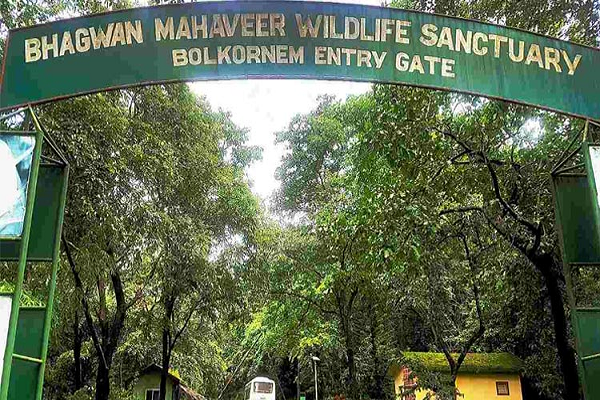
Bhagwan Mahavir Wildlife Sanctuary at a glance
| Detail | What to know (October 2026) |
|---|---|
| Location | Near Mollem, Sanguem and Dharbandora talukas (now in Goa’s new Kushavati district), on the Karnataka border |
| Area | About 240 sq km combined; the core 107 sq km is Mollem National Park |
| Status | Wildlife sanctuary since 1969; national park (core) since 1978 |
| Entry fee | Forest Department schedule: Rs 20 per adult (Indian or foreign), Rs 10 per child or student up to Class 12; vehicle and camera charges extra. Confirm at the gate. |
| Dudhsagar trips | Forest-registered jeeps from Collem (Kulem), booked through the Goa Tourism Development Corporation (GTDC); gates 8 am to 3 pm in the 2026–27 season, as reported in October 2026 |
| Best time to visit | November to March for wildlife; Dudhsagar opens after the monsoon, usually in October |
| Time needed | A full day; more if you stay overnight at Mollem |
About the sanctuary
Bhagwan Mahavir Wildlife Sanctuary lies in the Western Ghats on Goa’s eastern border with Karnataka. According to the Goa Forest Department, the sanctuary and national park have a combined area of 240 sq km, making them the state’s largest contiguous protected area, spread across Sanguem and Dharbandora talukas. The Panaji–Belagavi highway (the old National Highway 4A) cuts through the area, and the railway line from Goa’s coast to Londa in Karnataka runs through it too.
An earlier version of this article said 170 sq km of the sanctuary was national park. The correct figure for Mollem National Park, the core area, is 107 sq km.
District change
Mollem and Dudhsagar were long described as South Goa. On 31 December 2025 the Goa government notified a third district, Kushavati, with its headquarters at Quepem. Its four talukas are Dharbandora, Sanguem, Quepem and Canacona, so the sanctuary now falls in Kushavati district. Until the new district’s administration is fully in place, the South Goa Collector continues to oversee it.
History
The area was once known as the Mollem Game Sanctuary. It was declared a wildlife sanctuary in 1969 and renamed Bhagwan Mahavir Wildlife Sanctuary the same year. In 1978 the core of the sanctuary, about 107 sq km with the richest forest, was notified as Mollem National Park. The sanctuary and park were set up to protect the forests and wildlife of this stretch of the Western Ghats.
Flora and fauna
Forests and plants
The forests are a mix of West Coast tropical evergreen, West Coast semi-evergreen and moist deciduous types. Common trees include species of Terminalia, Lagerstroemia (crepe myrtle), Xylia and Dalbergia (rosewood). Published surveys record 722 species of flowering plants here, 128 of them endemic, and 37 species of ferns and their relatives. An earlier version described these as “128 plant species and 722 blossom species”; the 128 figure refers to endemic species.
Animals, birds and reptiles
Mammals recorded in the area include gaur (Indian bison), sambar, spotted deer, barking deer, mouse deer, wild dog (dhole), leopard, including the black form often called a black panther, pangolin, slender loris and the Malabar giant squirrel. Tigers are rare visitors: in May 2019 camera traps photographed two tigers that had come from Karnataka. Birds include the great hornbill, the Malabar pied hornbill and the ruby-throated yellow bulbul, Goa’s state bird. The sanctuary is known for snakes, especially the king cobra, as well as Russell’s viper and the common krait, and for butterflies such as the southern birdwing and the Malabar tree nymph.
Sightings are never guaranteed. Early morning is usually the best time to see animals and birds.
What to see in and around the sanctuary
- Dudhsagar Falls. Goa’s tallest waterfall drops roughly 310 metres (the Forest Department gives 306 m) on the Mandovi river at the Karnataka border, about 10 km from Collem. An earlier version of this article gave its height as 107 feet, which badly understated it. See our Dudhsagar Falls guide for jeep trips and rules.
- Tambdi Surla Mahadev Temple. A small black basalt temple to Lord Shiva (Mahadev) at Tambdi Surla, about 13 km from Mollem. The Forest Department dates it to the 13th century, while other published accounts say the 12th century; the Forest Department describes it as the only one of its kind in Goa.
- Devil’s Canyon. A gorge of water-carved rocks and underwater passages just downstream of Dudhsagar, near the Collem entry point, where the river flows fast and turbulent. Do not swim here.
- Tambdi Falls. A rarely visited waterfall about 2 km south-west of Tambdi Surla at the Karnataka border. The terrain is difficult, and a local guide is needed.
- Sunset Point. A viewpoint at the end of a 9 km forest track that needs a four-wheel-drive vehicle; park vehicles can be hired at the Mollem check-post. Sloth bears and gaur are sometimes seen on the way.
- Nature Interpretation Centre, Mollem. Run by the Forest Department, with information on the area’s nature, environment and wildlife. An earlier version called this an “eco-tourism wing”; it is the same idea.
An earlier version also described Cotigao Wildlife Sanctuary as Goa’s second-largest and oldest sanctuary. Cotigao, in Canacona in the far south, was established in 1968 and covers 85.65 sq km; we could not confirm the “second-largest” ranking, so it has been removed. Cotigao is easiest to visit from Palolem.
Safari and visiting
The main organised trip in the sanctuary is the jeep ride from Collem to Dudhsagar Falls. According to an October 2026 report citing the Forest Department’s order for the 2026–27 season, only jeeps registered with the department may enter, private vehicles and two-wheelers are stopped at the entry gate, bookings go through a GTDC portal, trips are capped at 240 a day, and life jackets are compulsory at the falls. Forest Department trekking, bird-watching and nature-trail bookings are made through the Goa government’s online services portal (goaonline.gov.in).
An earlier version said a jeep safari cost Rs 150 per person and ran from 8 am to 5.30 pm every day. We could not confirm those figures on an official source, so they have been removed. Check current rates and timings with the Forest Department or GTDC before you go.
Staying overnight
The Forest Department runs the Aranyak eco-tourism campsite at Mollem, with tents and a dormitory, and a Forest Rest House at Mollem. Both are booked through the department’s wildlife and eco-tourism offices; check current rates when you book. Camping elsewhere inside the sanctuary needs the permission of the sanctuary’s Director.
Best time to visit
November to March is the most comfortable time and a good season for wildlife, after the rains have ended. Dudhsagar is closed to visitors in the monsoon, roughly June to September, because the river is dangerous, and usually reopens in October. An earlier version gave a winter temperature range of 18 to 23°C; we could not verify it, so it has been removed.
How to reach
- By road: Mollem is about 57 km east of Panaji on the Panaji–Belagavi highway. Taxis and hired cars are the easiest option; Kadamba (KTC) buses run towards Mollem and Collem.
- By rail: Kulem (Collem) station, on the South Western Railway line from Vasco da Gama towards Londa, is the base for Dudhsagar trips. Madgaon (Margao) is the main railhead for long-distance trains; continue by road.
- By air: Goa International Airport at Dabolim is the nearer airport; Manohar International Airport at Mopa is in the far north of the state.
Drive slowly on the highway through the sanctuary. Wild animals, including gaur and deer, cross the road.
Rules and tips
- Carry your entry receipt and follow forest staff instructions.
- Do not feed animals, play loud music or leave litter. Plastic bottles and bags are not allowed on the Dudhsagar trip, according to the October 2026 reports.
- Alcohol is not allowed on the Dudhsagar circuit; people found drunk or carrying alcohol can face strict action.
- Never walk on the railway line to reach Dudhsagar. The Forest Department does not allow entry to the falls from the track.
- Wear sturdy shoes, carry water and keep to marked paths.
For more of India’s protected forests, see our guide to the best national parks in India, or head back to the coast with our guide to the best beaches in Goa.
Frequently asked questions
What is the entry fee for Bhagwan Mahavir Wildlife Sanctuary?
The Goa Forest Department’s published schedule lists Rs 20 per adult, Rs 10 per child or student up to Class 12, and separate charges for vehicles and cameras. The schedule is not dated, so confirm at the gate.
Is Dudhsagar inside Bhagwan Mahavir Wildlife Sanctuary?
Yes. Dudhsagar Falls lies within the sanctuary and national park, on the Karnataka border, and is reached by registered jeeps from Collem.
Are there tigers in Bhagwan Mahavir Wildlife Sanctuary?
Tigers are rare. Camera traps recorded two tigers from Karnataka in the park in May 2019. Leopards, gaur, deer and many snakes are more likely to be seen.
What is the difference between Bhagwan Mahavir Wildlife Sanctuary and Mollem National Park?
They are one protected area. The 107 sq km core was notified as Mollem National Park in 1978; the wider area is the wildlife sanctuary, declared in 1969.
Can I visit in the monsoon?
The highway is open, but Dudhsagar trips stop in the monsoon and forest trails are slippery. Plan your visit for October to May.
Details checked in October 2026 against the Goa Forest Department’s protected-area pages, its entry fee schedule and Dudhsagar public notice, October 2026 reporting on the Dudhsagar reopening, published records of the sanctuary, and reporting on the creation of Kushavati district. Fees and trip rules change, so confirm with the Forest Department before you visit.