Quick answer: The Kalka–Shimla toy train is a 2 ft 6 in narrow-gauge mountain railway that climbs about 96 km from Kalka, at the foot of the Shivalik hills, to Shimla. It opened on 9 November 1903 and, since 2008, has been part of the “Mountain Railways of India” UNESCO World Heritage Site. Several trains run each way every day, including the Shivalik Deluxe Express, the Himalayan Queen and the glass-roofed Vistadome (Him Darshan) service, but timetables and fares change and services are sometimes cancelled in bad weather, so check the train on IRCTC or the National Train Enquiry System before you travel.
Kalka–Shimla toy train at a glance
| Detail | What we verified (October 2026) |
|---|---|
| Route | Kalka (Haryana) to Shimla (Himachal Pradesh) |
| Length | About 96 km |
| Gauge | Narrow gauge, 2 ft 6 in (762 mm) |
| Opened | 9 November 1903 |
| Height gained | From about 656 m at Kalka to about 2,075 m at Shimla |
| Tunnels | 102 in use; the longest, near Barog, is about 1,144 m |
| Heritage status | Declared a heritage property by the Himachal Pradesh government in 2007; added to the UNESCO “Mountain Railways of India” World Heritage Site in July 2008 |
| Timetable and fares | Not published in one official place we could read; check IRCTC, NTES or call 139 |
History of the Kalka–Shimla railway
Shimla became the summer capital of British India in the 19th century, and the journey up from the plains by road was slow. The Kalka–Shimla line was built to solve that. It opened for traffic on 9 November 1903 and was extended to Shimla Goods station in 1909. The line was first planned to a 2 ft gauge and was changed to 2 ft 6 in under a revised contract in 1901, which is the gauge it still uses.
Himachal Pradesh Tourism describes the line as “an engineering marvel”, with 102 tunnels built between 1898 and 1903. The Himachal Pradesh government declared the railway a heritage property in 2007, and in July 2008 UNESCO added it to the Mountain Railways of India World Heritage Site, alongside the Darjeeling Himalayan Railway and the Nilgiri Mountain Railway.
A correction: an earlier version of this article said the railway “ranks fourth” on UNESCO’s World Heritage list. UNESCO does not rank its sites. The Kalka–Shimla line is one of three railways in a single shared listing.
The route: tunnels, bridges and Barog
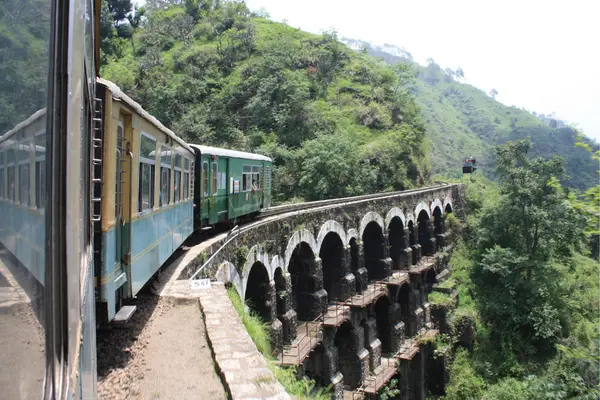
The train climbs from about 656 m at Kalka to about 2,075 m at Shimla, winding through the Shivalik hills on hundreds of bridges and curves. Published counts vary slightly by source and date. The earlier version of this article said there were 103 tunnels, about 800 bridges and 900 curves. Himachal Pradesh Tourism now gives 102 tunnels, and some tunnels have been closed over the years after landslides.
The longest tunnel, No. 33, runs for about 1,144 m on the Kalka side of Barog station. Barog is the usual halt on the way up, and the best-known stretch of scenery is the climb from Barog towards Shimla, through pine and deodar forest. Other stations on the line include Dharampur, Solan, Kandaghat, Taradevi, Jutogh and Summer Hill.
The train is slow because of the steep gradient: average speeds are roughly 25 to 30 km/h. Plan for a journey of around five to six hours, and longer if the train is delayed.
Trains on the Kalka–Shimla line
Indian Railways runs several services on the route. Names and numbers change from time to time, but the main ones are:
- Shivalik Deluxe Express: a premium service with more comfortable seating than the regular trains.
- Himalayan Queen: a regular train that stops at more stations, which gives you more chances to step out and take photographs.
- Kalka–Shimla Express and Kalka–Shimla Passenger: regular services with reserved and unreserved classes.
- Him Darshan (Vistadome): coaches with large windows and glass roofs for views of the hills.
- Rail Motor Car: a small, self-propelled railcar that is faster than the trains but carries very few passengers, so seats are hard to get.
- Shivalik Queen: a luxury rake that groups can charter through IRCTC.
Not every service runs every day of the year. In August 2026, for example, the Railway Board cancelled three up and three down trains on the line until 10 August because of heavy rain, landslide risk and low occupancy, according to Amar Ujala. These included the Himdarshan (52459/52460) and the Kalka–Shimla Express (52451/52452). Six other trains, including the Himalayan Queen (52455/52456), kept running.
Timetable and fares
An earlier version of this article listed departure times, train numbers and fares for each service. They were several years old, and many have since changed, so they have been removed. We could not find a single official timetable page for the line. To plan your journey:
- Search Kalka (KLK) to Shimla (SML) on the IRCTC website or app to see the trains running on your date, their current timings and their fares.
- Check live running status on the National Train Enquiry System (NTES) or by calling the railway enquiry number, 139.
- Book early for weekends, holidays and the summer and snow seasons, when the trains fill up.
- If you are coming from Delhi, check that your train to Kalka arrives in time for your toy train.
Tips for the journey
- Monsoon (roughly July to September) brings landslides, delays and occasional cancellations. Check running status on the morning of travel.
- Carry water and snacks. Station stalls are limited, and the journey is long.
- Keep a warm layer handy. Shimla is much colder than Kalka, especially from November to February.
- If you only want the experience, you can take the train one way and return by road.
- Kalka has few places to stay. Many travellers stay in nearby Parwanoo, Panchkula or Chandigarh instead.
The earlier version of this article also named hotels and a spa resort near Kalka. We have not checked whether they still operate, so they have been removed.
What to see when you reach Shimla
Shimla station is below the town centre. From there, the Mall Road and the Ridge are a climb or a short taxi ride away. Summer Hill station, the stop before Shimla, is close to Summer Hill and the Viceregal Lodge. Taradevi station is the starting point for the walk up to Tara Devi Temple.
Frequently asked questions
How long does the Kalka to Shimla toy train take?
Usually around five to six hours for about 96 km, depending on the train. The faster Rail Motor Car takes less time. Check current timings on IRCTC.
Is the Kalka–Shimla railway a UNESCO World Heritage Site?
Yes. It was added in July 2008 to the Mountain Railways of India listing, together with the Darjeeling Himalayan and Nilgiri Mountain Railways.
How many tunnels does the Kalka–Shimla railway have?
Himachal Pradesh Tourism gives 102 tunnels. The longest, near Barog, is about 1,144 m.
Which toy train is best for sightseeing?
The Vistadome (Him Darshan) coaches have the largest windows and glass roofs. The Himalayan Queen makes more stops. The Shivalik Deluxe Express is more comfortable. Check which of them is running on your date.
Do toy trains run during the monsoon?
Most do, but some services are cancelled during heavy rain and landslides, as happened in August 2026. Check running status before you travel.
Route, history and heritage status were checked in October 2026 against Himachal Pradesh Tourism and published records of the line, with service changes from Amar Ujala (August 2026). Confirm timings and fares on IRCTC before travelling.