Quick answer: The Viceregal Lodge, now called Rashtrapati Niwas, is the former summer residence of the British Viceroys of India on Observatory Hill in Shimla. Designed by Henry Irwin and completed in 1888 for Lord Dufferin, it hosted the 1945 Simla Conference and the 1946 Cabinet Mission talks, and since 1965 it has housed the Indian Institute of Advanced Study (IIAS). According to the IIAS, from 1 March 2026 the guided tour costs ₹200 for Indian nationals and ₹1,000 for foreign nationals; it is open 9:30 am to 5 pm and closed on Mondays and national holidays.
Viceregal Lodge at a glance
| Detail | What we verified (October 2026) |
|---|---|
| Location | Observatory Hill, Boileauganj, Shimla; about 3 km from the Mall via Chaura Maidan |
| Built | Completed 1888; architect Henry Irwin |
| First occupants | Lord and Lady Dufferin, who moved in on 23 July 1888 |
| Today | Indian Institute of Advanced Study (IIAS) |
| Timings | 9:30 am to 5 pm; lunch break of half an hour between 1 pm and 2 pm (IIAS) |
| Closed | Mondays and national holidays (IIAS) |
| Guided tour (main building) | ₹200 Indian nationals; ₹1,000 foreign nationals above 5 years; ₹50 children aged 6–12 (IIAS, from 1 March 2026) |
| Lawns and gardens only | ₹60 Indian nationals; ₹100 foreign nationals (IIAS) |
| Free entry | Children up to 5; armed forces and central paramilitary personnel and dependants, and government school students up to Class XII, with documents (IIAS) |
| Time needed | About two hours |
Fee change: an earlier version of this article said entry cost ₹20 for Indians and ₹50 for foreigners. The IIAS revised its rates from 1 March 2026; the figures above are the current ones. Tickets are sold at the counter on a first-come, first-served basis and are not refundable.
History of the Viceregal Lodge
Simla (now Shimla) was the summer capital of British India, but for a long time the Viceroy had no purpose-built residence there. A grand Viceregal Lodge had been discussed for years, and work on the project began in the 1880s (sources give start dates from 1880 to 1886). Observatory Hill, one of the seven hills on which Shimla is built, was chosen as the site, and Captain H. H. Cole of the Royal Engineers prepared the first designs.
The building was carried through under Lord Dufferin (Viceroy 1884–88), who took a close personal interest in it and won approval for a cost of about 38 lakh rupees. Henry Irwin, an architect in the Public Works Department, was the architect and superintendent of works. Lord and Lady Dufferin moved in on 23 July 1888, although some work continued until that September. The Lodge had electric lighting when it opened, before the rest of Shimla, and it could host more than 800 guests at a state ball.
Where India’s future was negotiated
- Simla Conference, 1945: Lord Wavell called Indian leaders, including Jawaharlal Nehru, Maulana Azad, Muhammad Ali Jinnah, Liaquat Ali Khan and Master Tara Singh, to the Lodge from 25 June to 14 July 1945 to discuss his plan for Indian self-government. The conference failed.
- Cabinet Mission talks, 1946: a three-way conference of the Congress, the Muslim League and the British Cabinet Mission was held here from 5 to 12 May 1946. It failed to settle the main issues, and the IIAS notes that after it, partition became certain.
After Independence
In 1947 the estate passed to the President of India and was renamed Rashtrapati Niwas. Presidents rarely used it. At the suggestion of Dr S. Radhakrishnan, the President, it was given to education: the Ministry of Education set up the Indian Institute of Advanced Study in 1964, and Dr Radhakrishnan inaugurated it on 20 October 1965. The President’s summer retreat today is a different property, Rashtrapati Niwas at Mashobra.
Architecture
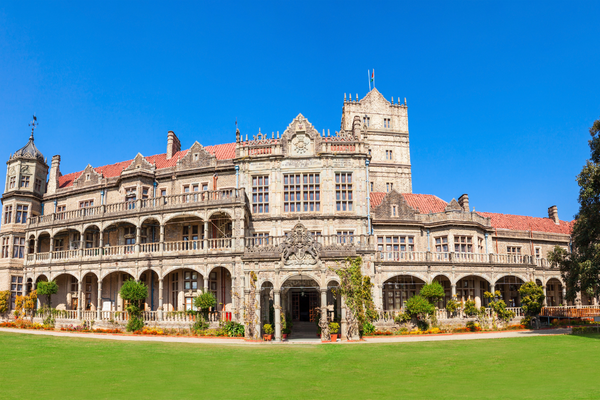
The Lodge is built of light blue-grey stone masonry with tiled pitched roofs, in a style usually described as Jacobethan, an English Renaissance revival with touches of a Scottish castle; Himachal Pradesh Tourism says it looks like a Scottish castle. Teak brought from Burma (now Myanmar) was used along with local deodar (Himalayan cedar) and walnut for the elaborate woodwork inside. Much of the original British-period furniture survives, and the IIAS library inside holds a large collection.
Corrections: an earlier version of this article said the Lodge was built of “dark sandstone and light blue limestone”, that only local pine and cedar were used, that Observatory Hill is the second-highest point in Shimla and that Mahatma Gandhi visited the Lodge four times, in 1922, 1931, 1945 and 1947. The building materials are corrected above; we could not verify the other claims, so they have been removed. It also explained “Viceregal” as meaning “royal”; it simply means “of the Viceroy”. The building’s present name, Rashtrapati Niwas, means “President’s residence”.
What you see on a visit
- The guided tour of the main building: 30 minutes, in Hindi and English, with up to 60 people per group. According to the IIAS, the first tour starts around 10:30 am and the last around 4:30 pm. A missed slot is not rescheduled.
- Gallery No. 2: on the 1945 Simla Conference and the 1946 Cabinet Mission talks.
- The Tagore Gallery: opened on 6 March 2026.
- The Fire Station Gallery and the Wall of Fame.
- The lawns, three terrace gardens and the nurseries, with views over the hills.
- The Sunset View Café on the campus.
Rules for visitors
- Photography is strictly prohibited inside the main building; it is allowed outside. Commercial shoots need prior permission, and drones are banned.
- Smoking is banned, with a fine of ₹500. Food, picnics and camping are not allowed.
- Do not walk on the front lawn; there is a rainwater tank beneath it.
- Vehicles cannot park near the building. The IIAS charges for parking at Gorkha Gate and runs a golf cart between the main gate and the ticket booth (₹10 per person per ride).
How to reach the Viceregal Lodge
- On foot: About 3 km from the Mall via Chaura Maidan, according to the Shimla district administration. The walk passes the Himachal State Museum.
- By bus: Take a local bus to Boileauganj and walk the short distance up.
- By taxi: Taxis run to the Lodge; drivers drop visitors and return to the main parking.
Places to visit nearby
The Himachal State Museum is on the way from the Mall. Below Observatory Hill lie the forest trails of the Glen, whose nature trail can be entered from Boileauganj near the IIAS, and the Army Heritage Museum at Annandale. Summer Hill, where Mahatma Gandhi stayed during the 1945 conference, is next door.
Frequently asked questions
What is the Viceregal Lodge entry fee?
According to the IIAS, from 1 March 2026 the guided tour costs ₹200 for Indian nationals, ₹1,000 for foreign nationals and ₹50 for children aged 6–12. The lawns and gardens alone cost ₹60 for Indians and ₹100 for foreigners.
Is the Viceregal Lodge open on Mondays?
No. It is closed on Mondays and national holidays.
Who designed the Viceregal Lodge?
Henry Irwin, an architect in the Public Works Department, after first designs by Captain H. H. Cole of the Royal Engineers.
Can I take photos inside the Viceregal Lodge?
No. Photography is strictly prohibited inside the main building, but allowed outside.
What is the Viceregal Lodge used for today?
It houses the Indian Institute of Advanced Study, a research institute set up by the Ministry of Education, which began functioning on 20 October 1965.
Fees, timings, rules and history were checked in October 2026 against the Indian Institute of Advanced Study’s visitor and history pages, Himachal Pradesh Tourism’s Shimla page and the Shimla district administration. Check the IIAS before visiting, as fees and tour times can change.